
Worthington Steel: Operating Scale Meets Margin Pressure as Interest Costs Reshape the Outlook
Worthington Steel’s latest quarter highlights the tension between industrial scale and the financial realities of rising interest expense, operational restructuring, and cyclical headwinds. The company’s ability to translate its robust asset base and manufacturing footprint into durable earnings will hinge on margin management and capital allocation in a volatile steel market.
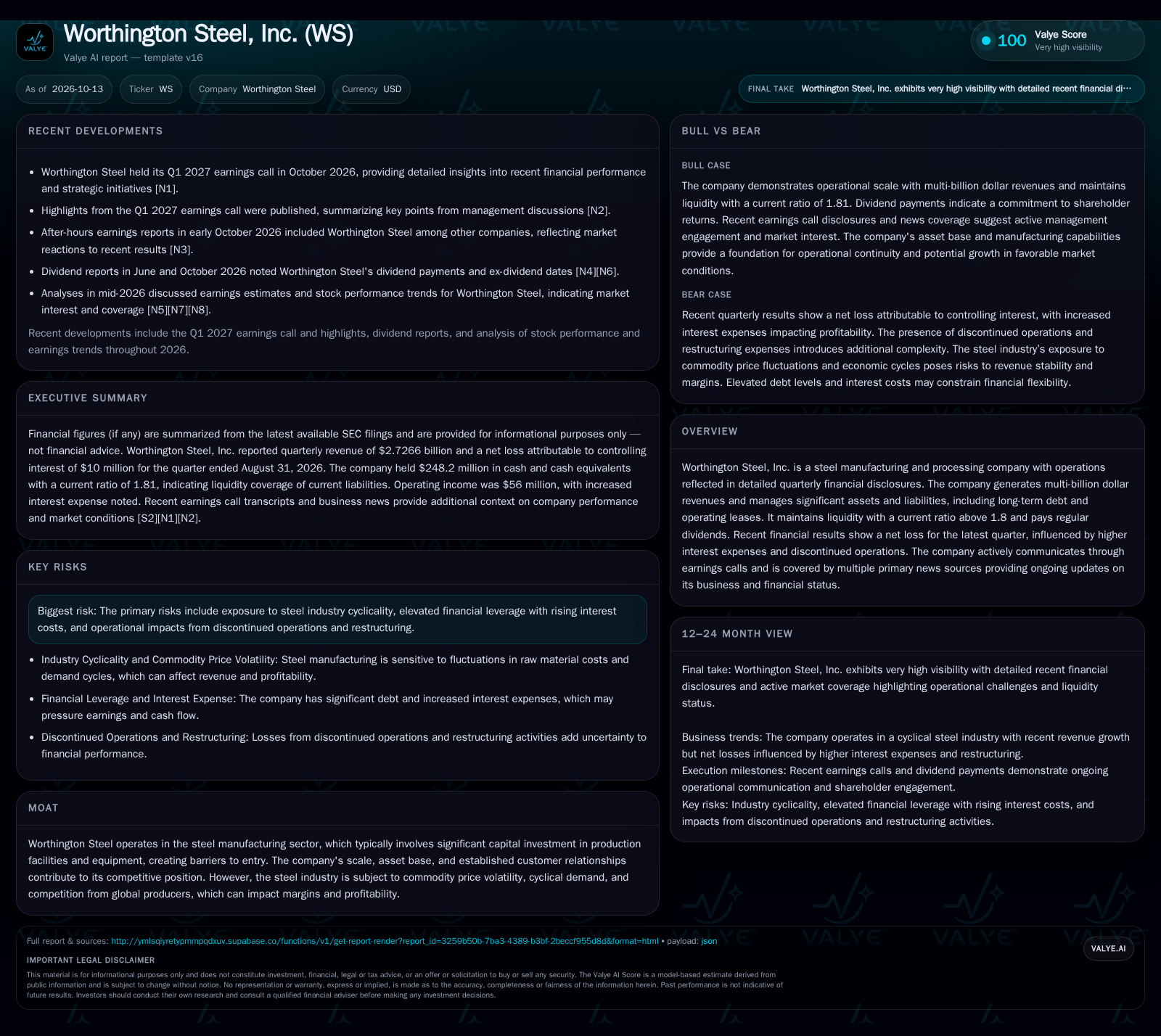
Worthington Steel reported $2.73B in quarterly revenue but posted a net loss of $10M attributable to controlling interest, driven by sharply higher interest expense and discontinued operations.
Worthington Steel’s latest financials offer a sharp illustration of the steel sector’s underlying volatility and the company’s evolving risk profile. While the business continues to generate multi-billion dollar quarterly revenue and maintains ample current assets, a swing to net loss on the back of surging interest expense and discontinued operations signals that operational scale alone is not enough to ensure earnings stability. The interplay between margin management, capital structure, and strategic execution will define whether Worthington Steel can turn its robust footprint into sustainable value as industry cycles play out.
Recent Results: Scale, Margin Pressure, and the Cost of Capital
Worthington Steel reported $2.73 billion in revenue for the quarter ending August 31, 2026, reaffirming the company’s considerable operating scale within the steel manufacturing sector. However, the quarter also saw a net loss of $10 million attributable to controlling interest, with diluted EPS of -$0.20 [S2]. The gross margin of $261.2 million and operating income of $56 million demonstrate that the company’s core operations remain profitable before financing and non-core items, but these were insufficient to overcome a marked increase in interest expense, which reached $38.8 million for the quarter [S2]. The company reported cash and liquidity metrics for the period; these figures do not by themselves establish operating runway, investment capacity, financial flexibility, or financing capacity. The cited source reports dividend-related activity; that disclosure alone does not establish dividend-policy continuity, management confidence, or a material constraint on capital flexibility. [S2]
How Worthington Steel’s Model Translates Scale into Earnings—And Where It Breaks Down
Steel manufacturing is intrinsically capital-intensive, with high fixed costs tied to equipment, plant maintenance, and labor. Worthington Steel’s multi-billion dollar quarterly revenue base reflects substantial throughput, and the reported gross margin of $261.2 million underscores its ability to generate value above raw material and direct production costs [S2]. However, the conversion of gross profit to operating and net income is highly sensitive to overhead, interest, and restructuring charges. The latest quarter’s operating income of $56 million, versus $38.8 million in interest expense, illustrates a precarious relationship between operating leverage and financial leverage: small shifts in margin or debt service can swing the company from profit to loss. Variable input costs (notably steel, energy, and logistics) and the cyclicality of end-market demand further complicate margin management. The business requires ongoing capital investment to maintain capacity and comply with regulatory or customer requirements, making free cash flow generation and capital allocation critical levers. The cited source reports dividend-related activity; that disclosure alone does not establish dividend-policy continuity, management confidence, or a material constraint on capital flexibility.
Barriers, Scale, and the Global Chessboard: Where Worthington Steel Stands
Worthington Steel operates in a sector defined by high capital barriers to entry, entrenched customer relationships, and economies of scale. Its asset base and processing capacity position it as a credible supplier to industrial, automotive, and construction end markets. However, the steel industry is globally competitive, with price-taking dynamics and periodic surges of low-cost imports from international producers. Product differentiation is limited, and contract terms may be short-cycle, exposing the company to abrupt shifts in demand and price. Domestic peers face similar cost structures, while global competitors may benefit from lower labor or energy costs and, in some cases, state support. The ability to secure long-term supply agreements, maintain high utilization rates, and invest in process innovation or downstream integration could provide incremental advantage, but switching costs for customers are generally modest. Regulatory shifts (e.g., tariffs, environmental mandates) can periodically reset the competitive calculus.
Margin Expansion and Debt Discipline: The Path to Earnings Recovery
A favorable scenario for Worthington Steel would involve a combination of margin expansion and disciplined capital management. If raw material input costs stabilize or decline, and end-market demand remains robust—particularly in infrastructure, automotive, or energy-related sectors—the company could drive higher gross margins on steady volumes. Successful execution of restructuring and the completion of divestitures (such as the sale of Becker operations, if finalized on favorable terms) would further streamline the cost base and potentially free up capital for debt reduction. Lower interest expense, either through refinancing, deleveraging, or improved credit terms, could restore the conversion of operating income into positive net earnings. Confirmation of this scenario would include sequential improvement in gross and operating margins, a sustained reduction in interest expense as a percentage of sales, and evidence that discontinued operations no longer act as a drag on consolidated results. Consistent free cash flow and dividend coverage from operations would lend further credibility.
Navigating Tight Margins and Cyclical Swings: The Most Probable Trajectory
The most plausible near-term outcome for Worthington Steel is continued revenue scale with recurring pressure on margins and net income, reflecting the sector’s inherent cyclicality and the company’s current capital structure. Operating income may remain positive but compressed, with interest expense and periodic restructuring or one-off charges eroding bottom-line results. Free cash flow generation will depend on working capital discipline and capital expenditure restraint. Evidence confirming this scenario would include stable (but not expanding) gross margins, ongoing but manageable losses or break-even net results, and incremental progress on restructuring or divestiture initiatives. A falsification would be a pronounced deterioration in liquidity metrics or a strategic shift away from dividend payments.
When Leverage and Volatility Collide: The Risk of Sustained Losses
A negative scenario would be triggered by a combination of persistent high interest expense, further margin compression, and weak end-market demand. If steel prices fall, input costs rise, or utilization rates decline, gross profit could erode faster than fixed costs can be rationalized. Elevated financial leverage would amplify the impact of any operational downturn, raising the risk of covenant breaches, credit rating downgrades, or forced asset sales. Discontinued operations and restructuring could consume management bandwidth and cash, while dividend payments may become unsustainable.
Milestones That Will Define Worthington Steel’s Next Chapter
Gross margin trend: Sustained improvement or further compression in gross margin would signal the effectiveness of cost control and pricing discipline.
Interest expense as a percentage of sales: A reduction would indicate successful debt management or refinancing; increases would heighten risk.
Status and terms of discontinued operations/divestitures: Updates on the completion and financial impact of asset sales (such as Becker operations) will clarify future earnings potential.
Utilization rates and order backlog (if disclosed): Higher plant utilization and a robust backlog would support volume stability.
Restructuring charges and outcomes: Clarity on the cost, timeline, and realized savings from restructuring initiatives will be critical.
Net leverage ratio (if disclosed): Tracking changes in net debt to EBITDA or similar metrics would quantify financial risk.
Market pricing for steel and input costs: External conditions in steel pricing and raw material markets will directly impact profitability.
Disclaimer: This is research-only, informational analysis and not investment advice. It may include AI-generated interpretation and general industry context. Always verify important details using primary sources.

Comments