
Park Aerospace: Scaling Capacity and Backlog, But Customer Concentration Raises Strategic Stakes
Park Aerospace has doubled its manufacturing capacity and more than doubled backlog within a year, leveraging its niche expertise in advanced aerospace composites. However, heavy dependence on a small number of major customers and the capital-intensive nature of its operations create both opportunity and risk as the company prepares for its next phase of expansion.
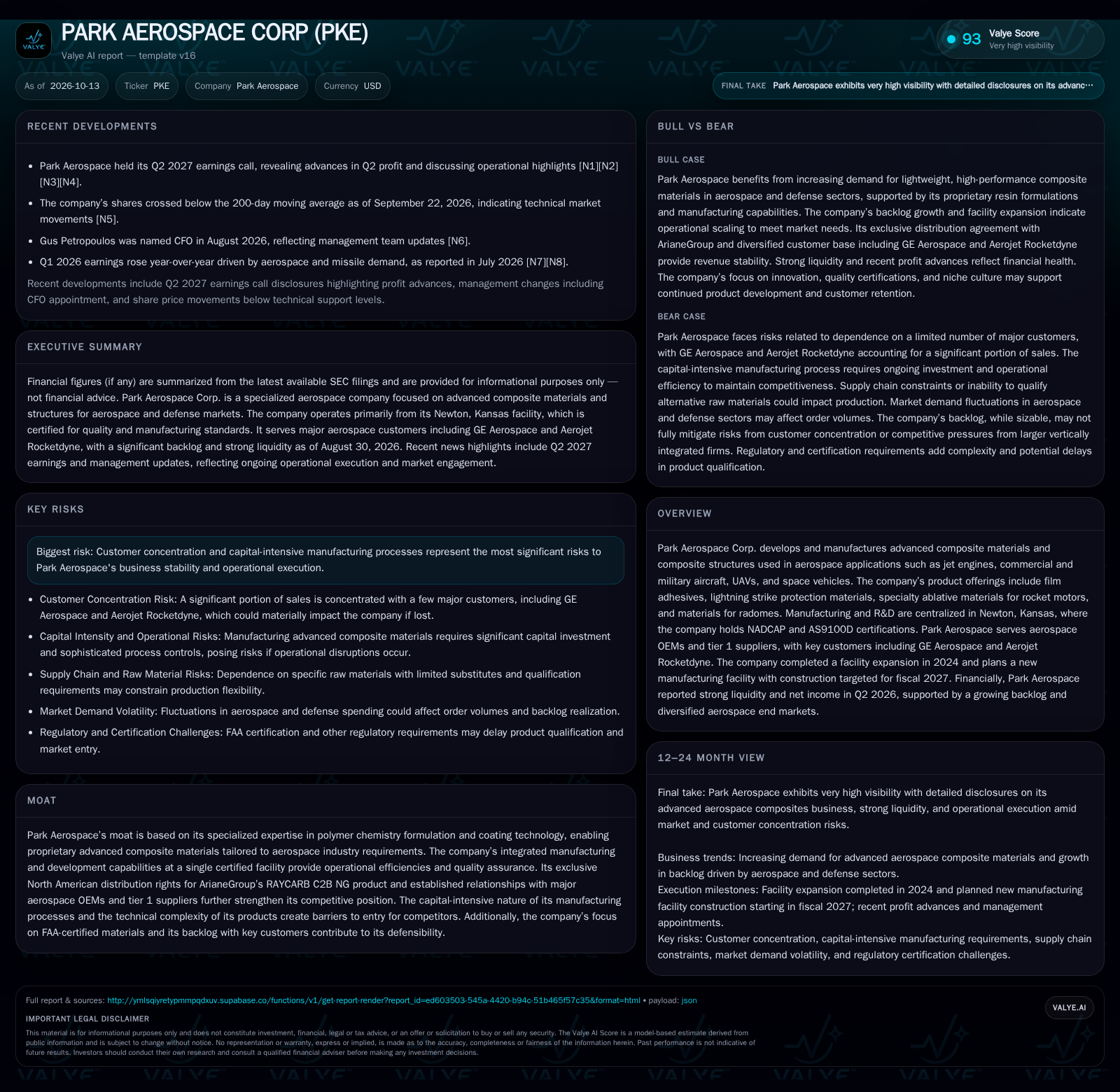
Park Aerospace’s backlog has surged to $51.4 million, up from $25.8 million a year prior, following a facility expansion that doubled manufacturing capacity. The company reported $98.3 million in cash and equivalents as of August 30, 2026, and serves major aerospace players such as GE Aerospace and Aerojet Rocketdyne. While these factors support operational momentum, Park’s reliance on a concentrated customer base and the ongoing need for capital investment heighten its sensitivity to market and execution risks. [S2] [N3]
Park Aerospace stands at a pivotal point after executing a major capacity expansion and securing a record backlog, positioning itself to capture ongoing demand for advanced composites across aerospace and defense markets. Yet, the company’s fortunes remain closely tied to a handful of large customers, and its capital-intensive manufacturing model means strategic decisions around future investment and customer diversification will be critical to sustaining momentum—and avoiding downside shocks.
Backlog Surge and Capacity Expansion Define Current Trajectory
Park Aerospace’s backlog reached $51.4 million as of May 18, 2026, more than doubling from $25.8 million a year earlier. This backlog growth coincides with the completion of a facility expansion in 2024 that doubled the company’s manufacturing capacity—an operational milestone that now enables Park to better serve increased demand from aerospace and defense customers. The company reported $98.3 million in cash and equivalents and a current ratio of 22.75 as of August 30, 2026. These developments collectively provide Park with greater revenue visibility and operational flexibility, but also raise the stakes for execution as it prepares to break ground on an additional composites facility in fiscal 2027. [S2]
The interplay between backlog growth and capacity expansion also underscores the importance of operational agility in Park Aerospace’s model. While the doubled manufacturing capacity provides a platform for scaling production, the company must carefully manage lead times and inventory levels to avoid bottlenecks or excess holding costs. Additionally, the timing of backlog conversion into revenue will be influenced by program-specific delivery schedules and certification cycles, which can introduce variability in cash flow and working capital needs. Hence, effective coordination between sales forecasting, production planning, and supply chain management will be critical to fully realizing the benefits of recent investments.
Composite Material Manufacturing: High Fixed Costs, High Barriers
Park Aerospace’s business model is defined by capital-intensive manufacturing, with significant fixed costs arising from specialized equipment, quality certifications (such as NADCAP and AS9100D), and proprietary process controls. The company formulates its own resins and employs complex coating technologies to produce thermoset prepregs and specialty materials, which serve a wide range of aerospace applications. This approach enables premium pricing, especially for products that meet stringent FAA or defense standards. However, operating leverage is a double-edged sword: while incremental revenue from a growing backlog can drive margin expansion as fixed costs are absorbed, any downturn in demand or production disruptions could quickly erode profitability. The upcoming investment in a new composites facility will likely increase capital requirements and heighten the importance of maintaining high utilization rates to preserve margins.
Furthermore, the capital intensity inherent in advanced composite manufacturing creates a high breakeven threshold, which can amplify the impact of demand fluctuations. This dynamic makes capacity utilization a key lever for profitability; operating below optimal levels risks diluting margins, while steady high utilization can enhance returns on invested capital. The company’s proprietary resin formulations and coating technologies, while differentiating, may also entail ongoing research and development expenditures to maintain technological leadership and meet evolving regulatory requirements. Consequently, balancing investment in innovation with disciplined capital deployment will be essential to sustaining competitive advantage and financial health.
Specialization and Certifications Offer Moat—But Not Immunity
Park Aerospace’s competitive edge stems from its deep expertise in polymer chemistry and its ability to deliver FAA-certified, high-performance composite materials tailored to aerospace OEMs and tier 1 suppliers. Its role as the exclusive North American distributor of ArianeGroup’s RAYCARB C2B NG product further differentiates its offering in the rocket and missile systems segment. Operational integration at a single, highly certified facility allows for tight quality control and responsiveness—attributes valued by customers dealing with mission-critical applications. However, Park’s reliance on a small number of large customers, notably GE Aerospace and Aerojet Rocketdyne, exposes it to significant concentration risk. Larger, vertically integrated competitors with broader product portfolios or global manufacturing footprints could leverage scale advantages or bid more aggressively on new programs. Regulatory hurdles and the technical complexity of qualifying new suppliers in aerospace do provide switching frictions, but these are not insurmountable if a customer’s strategic priorities change.
Leveraging Expanded Capacity for Sustained Revenue and Margin Growth
If Park Aerospace successfully ramps production at its newly expanded facility and delivers on its growing backlog, it could achieve sustained revenue and margin growth over the next several years. This scenario would likely be driven by robust demand for advanced composites in both commercial and defense aerospace markets, with additional wins from new or existing OEM programs. Operational leverage from higher throughput could enhance profitability, particularly if the new facility achieves high utilization quickly. Evidence supporting this upside would include continued backlog growth, new customer program announcements, and margin expansion in subsequent earnings reports. Conversely, any signs of underutilization, delays in facility ramp-up, or loss of major customer programs would challenge this scenario.
Balancing Growth Ambitions with Customer Concentration Risk
The most plausible path is that Park Aerospace benefits from elevated demand for aerospace composites, gradually ramps its new capacity, and maintains a stable—if concentrated—customer base. Revenue growth is likely to track backlog conversion, with profitability supported by stable production volumes and prudent cost management. However, the company’s fortunes remain closely tied to procurement cycles and platform decisions at GE Aerospace, Aerojet Rocketdyne, and other major clients. Confirmation of this scenario would come from steady quarterly earnings, backlog stability, and a successful start to construction on the planned new facility, while any abrupt order reductions or procurement pauses by a key customer would be early warning signs of deviation.
Customer Loss or Aerospace Downcycle Exposes Fixed Cost Base
A material adverse scenario would unfold if Park Aerospace lost a key customer contract or experienced a significant downturn in aerospace or defense demand. Evidence of downside would include a sharp drop in backlog, customer contract terminations, or missed production milestones. Inability to diversify the customer base or secure alternative programs would compound the risk.
What Will Determine Park Aerospace’s Next Chapter?
Backlog trend: Sustained growth or contraction in the reported backlog will be a critical indicator of demand visibility and revenue pipeline.
Customer concentration: Shifts in revenue share from GE Aerospace, Aerojet Rocketdyne, or the addition of new major customers would materially affect risk profile and bargaining power.
Facility utilization rates: If disclosed, utilization metrics for both the expanded and planned new facilities would clarify operating leverage and margin trajectory.
Gross and operating margin evolution: Margin trends will reveal the balance of fixed cost absorption, pricing discipline, and production efficiency.
Progress and capex on new facility: Updates on construction start, capex outlays, and timelines for the fiscal 2027 facility will test execution and capital allocation discipline.
New program wins or losses: Announcements regarding new OEM platforms, defense programs, or contract renewals would validate or challenge growth assumptions.
Supply chain stability: Any disclosures regarding raw material availability, qualification delays, or supply disruptions could affect production continuity and cost structure.
Workforce retention and safety: Given the specialized nature of Park’s manufacturing, trends in headcount, safety incidents, or skilled labor turnover would impact operational resilience.
Disclaimer: This is research-only, informational analysis and not investment advice. It may include AI-generated interpretation and general industry context. Always verify important details using primary sources.

Comments