
AZZ INC: Infrastructure Growth, Acquisition Integration, and the Liquidity Tradeoff
AZZ INC’s sharpened focus on infrastructure and data center markets, reinforced by ongoing acquisitions, underpins its raised outlook for 2026.
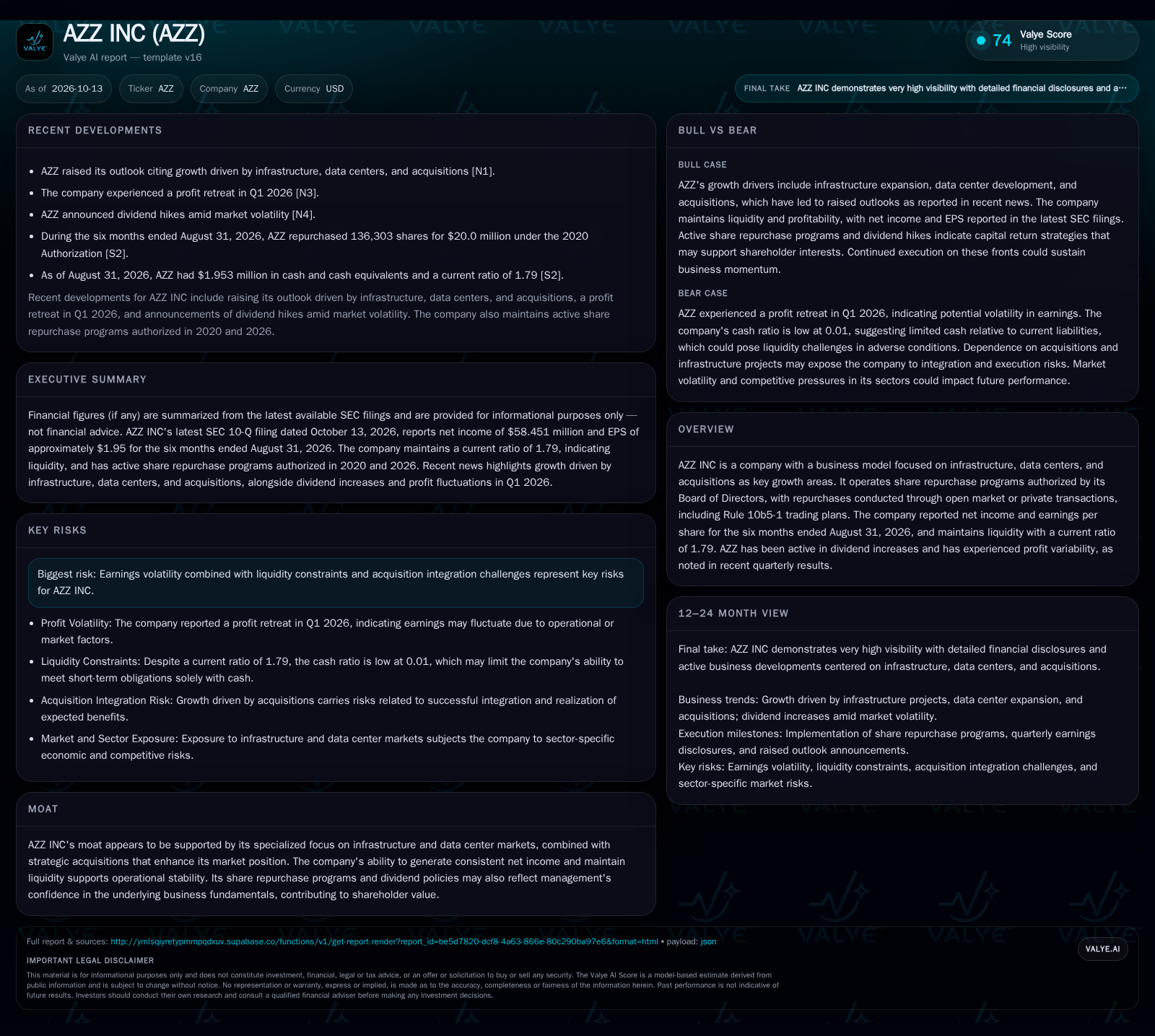
The company is actively returning capital via share repurchases, but its ability to sustain momentum depends on successful integration and execution in competitive, capital-intensive end markets. [S2] [N1] [N3]
AZZ INC’s 2026 trajectory is defined by a deliberate push into infrastructure and data center markets, augmented by a series of acquisitions that have prompted management to raise their outlook for the year. This approach has delivered solid net income and EPS for the most recent reporting period, but the company’s financial profile also reveals a razor-reported cash ratio and recent profit volatility.
Recent Developments: Growth Ambitions Meet Financial Constraints
AZZ INC reported net income of $58.451 million and basic EPS of $1.95 for the six months ended August 31, 2026, reflecting profitability in its recent operations. The company has increased its outlook, attributing momentum to infrastructure, data centers, and acquisitions, which collectively represent strategic growth pillars. However, Q1 2026 saw a profit retreat, highlighting earnings volatility. The company reported cash and liquidity metrics for the period; these figures do not by themselves establish operating runway, investment capacity, financial flexibility, or financing capacity. The Board authorized a new $100 million share repurchase program in January 2026, with $20 million in buybacks executed year to date. [S2] [N1] [N3]
Infrastructure and Data Centers: Balancing Expansion with Capital Discipline
AZZ’s business economics are shaped by its participation in infrastructure and data center end markets—sectors that are typically capital intensive, cyclical, and characterized by project-based revenue streams. The company’s growth strategy leans heavily on acquisitions, which can provide immediate revenue and capabilities but often require up-front integration costs and working capital. In theory, a successful acquisition strategy could yield operating leverage as fixed costs are spread over a larger revenue base, but this is contingent on effective integration and realization of synergies.
Pricing power in infrastructure and data center verticals tends to be moderate, as customers are often large, sophisticated buyers with the ability to negotiate. Volume growth may come from secular trends—such as increased digital infrastructure and electrification—but margins could be pressured by competitive bidding and cost inflation for materials and labor. The company’s ongoing share repurchases suggest management sees value at current valuations, but also consume capital that might otherwise serve as a buffer against short-term shocks.
While the current ratio above 1.7 suggests sufficient current assets to cover liabilities, most of these assets are likely tied up in inventory or receivables, not immediately deployable cash. This creates a tension between aggressive investment in growth and the need for potential financial flexibility, especially in the event of project delays, cost overruns, or acquisition missteps.
A nuanced consideration in AZZ's capital deployment strategy involves the tradeoff between funding acquisitions and organic growth initiatives. While acquisitions can rapidly scale revenue and market presence, organic investments in technology, workforce development, and process improvements may yield more sustainable competitive advantages over time. The optimal balance depends on the company's ability to identify acquisition targets that complement existing operations without diluting focus or overstretching management bandwidth. If acquisition integration demands escalate, the opportunity cost of foregone organic investments could impair long-term profitability and innovation capacity.
Competitive Dynamics: Specialized Markets, Integration Challenges, and Sector Risks
AZZ operates in specialized niches within infrastructure and data center markets, where scale, reputation, and technical expertise can provide some degree of differentiation. However, these sectors are crowded, with incumbent engineering firms, industrial conglomerates, and specialized contractors all vying for contracts. The acquisition-driven model carries the promise of expanding capabilities and customer reach, but it also introduces risks of cultural mismatch, operational redundancy, and distraction from core competencies.
Competitive advantages could arise if AZZ can consistently deliver complex projects on time and on budget, or if it develops proprietary processes that improve efficiency or compliance with regulatory standards. Yet, competitive intensity is heightened by customer bargaining power and potential technology/substitution threats—such as modular construction or automation in data center builds. The company’s ability to maintain or expand margins will depend on extracting value from acquisitions and avoiding the pitfalls of overextension.
In addition to operational execution, AZZ's competitive positioning may hinge on its capacity to adapt to evolving technological trends within infrastructure and data center markets. For instance, the adoption of automation, modular construction techniques, or advanced materials could alter cost structures and competitive dynamics. Firms that proactively integrate such innovations may achieve cost advantages or faster project delivery, raising the bar for competitors. Conversely, lagging in technology adoption could erode market share or compress margins. Thus, AZZ's strategic investments in R&D and partnerships could be pivotal in sustaining differentiation amid intensifying competition.
Customer concentration and contract structuring also influence competitive risk. Large infrastructure and data center clients often demand stringent performance guarantees, penalties for delays, and comprehensive compliance with regulatory and environmental standards. AZZ's ability to navigate these contractual complexities while maintaining profitability is essential. Furthermore, diversification across customer segments and geographies could mitigate exposure to sector-specific downturns or policy shifts. Failure to manage these dimensions effectively may result in margin erosion or reputational damage, emphasizing the need for robust risk management frameworks within the company's operational model.
When Integration Delivers: Accelerated Growth and Margin Expansion
In the most favorable scenario, AZZ successfully integrates recent acquisitions, unlocking operational synergies and cross-selling opportunities that drive both revenue growth and margin improvement. Sustained demand for infrastructure upgrades and data center capacity—underpinned by public funding, digital transformation, and energy transition trends—could provide a robust pipeline of projects. If AZZ can leverage its expanded footprint to win larger contracts and improve project execution, operating leverage could amplify EPS gains.
Confirmation would come from sequential improvements in gross and operating margins, continued top-line growth, and reduced volatility in quarterly earnings. Evidence of acquisition-related cost savings and retention of key customers would further support the bull case. Additional contract wins in data center or specialty infrastructure segments would signal that AZZ’s competitive position is strengthening.
Growth with Growing Pains: Moderate Expansion and Episodic Volatility
The most plausible path is that AZZ sustains moderate revenue growth from infrastructure and data center projects, while navigating the inherent variability of project-based businesses and the integration of acquired companies. Profitability may fluctuate quarter to quarter as new projects ramp and integration costs are absorbed, but underlying earnings remain positive. The company continues to manage its capital structure conservatively, balancing share repurchases with the need to preserve sufficient working capital.
This scenario would be confirmed by steady, if uneven, progress in reported net income, maintenance of a current ratio above 1.5, and the absence of major write-downs or project losses. Earnings calls that emphasize disciplined bidding, successful integration milestones, and robust project backlogs (if disclosed) would reinforce the base case. Conversely, sustained margin compression or repeated earnings disappointments would undermine it.
Liquidity Crunch and Integration Missteps: How Expansion Could Backfire
A negative outcome materializes if AZZ’s aggressive acquisition strategy encounters significant integration challenges—such as delayed synergies, customer attrition, or unforeseen liabilities—while project execution is hampered by cost overruns or demand shocks. Weak earnings or project losses could erode investor confidence and amplify volatility in the company’s equity.
Public disclosure of integration setbacks, major project delays, or covenant breaches would further validate the bear case. Persistent underperformance relative to peer benchmarks in margin and revenue growth would also be a red flag.
What Will Determine Whether AZZ’s Expansion Pays Off?
Gross and operating margin progression, especially in quarters following major acquisitions, would reveal the effectiveness of integration and operational discipline.
Updates on project pipeline size and composition, particularly in data centers and infrastructure, would help gauge future revenue visibility and sector concentration.
Any disclosures about acquisition integration milestones or cost savings achieved would provide direct evidence of synergy realization.
Announcements of major contract wins, renewals, or customer expansions in core markets would signal competitive traction.
Management commentary on capital allocation priorities—especially the balance between repurchases, dividends, and reinvestment—will clarify the sustainability of capital return strategies.
Comparative performance versus industry peers on revenue growth, margin, and project execution—if referenced in earnings calls or filings—would contextualize AZZ’s competitive standing.
Disclaimer: This is research-only, informational analysis and not investment advice. It may include AI-generated interpretation and general industry context. Always verify important details using primary sources.

Comments