
Solitron Devices: Niche Defense Semiconductor Supplier at a Strategic Crossroads
Solitron Devices’ deep specialization in military-grade semiconductors, strong certifications, and custom manufacturing underpin its relevance in defense and aerospace markets—but extreme customer concentration and reliance on external wafer supply create a fragile equilibrium where operational execution and relationship management are paramount.
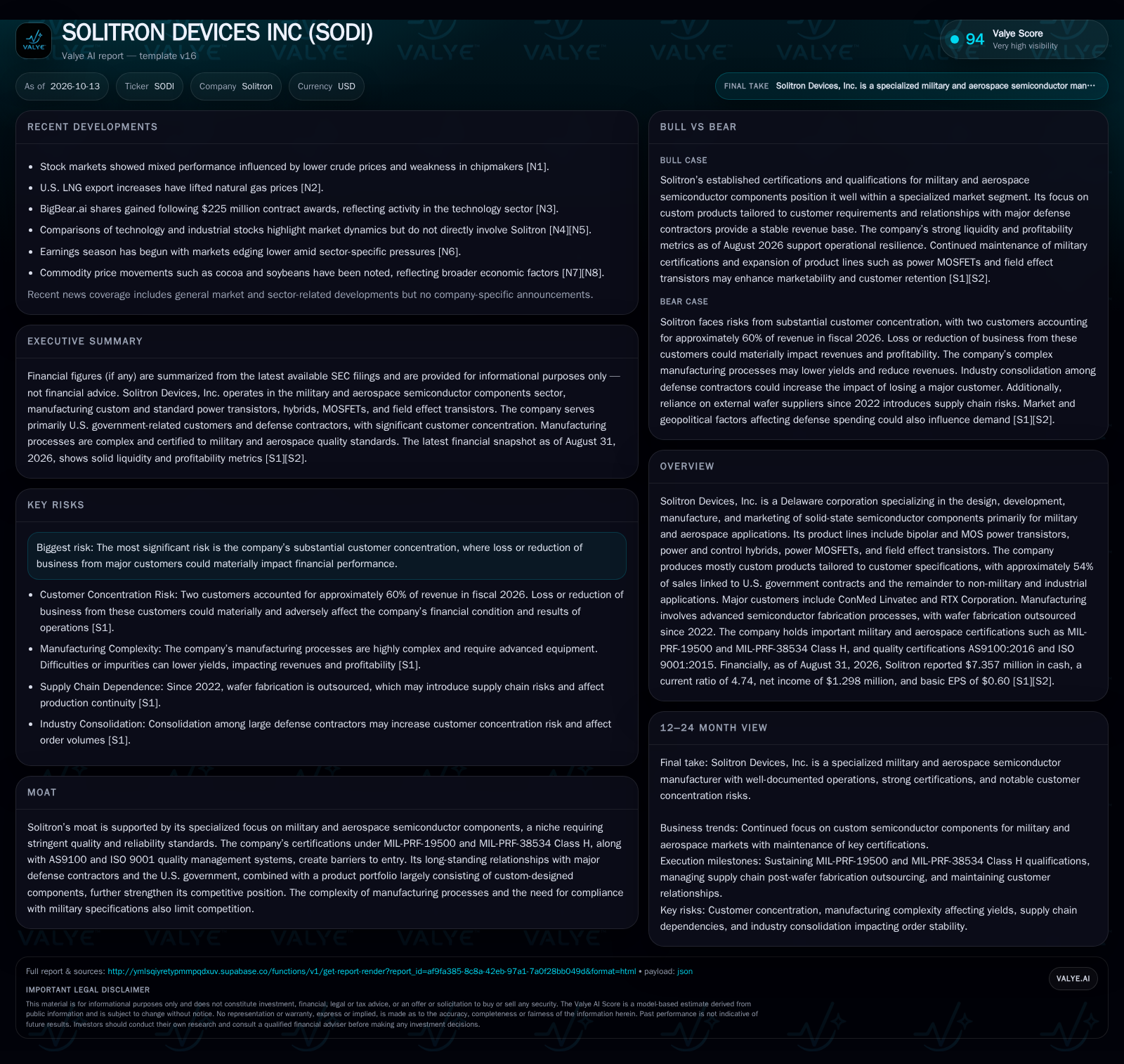
Solitron Devices, Inc. designs and manufactures highly specialized semiconductor components for military and aerospace applications, with 95% of sales from custom products and over half of revenue tied to U.S. government-related contracts. While the company boasts strong certifications and a reported cash position, its fortunes are tightly bound to just a few major customers and outsourced wafer suppliers, making execution and relationship management crucial for sustainability and growth [S1] [S2].
Solitron Devices, Inc. operates in one of the most demanding corners of the semiconductor industry, supplying custom power transistors and hybrids for mission-critical defense and aerospace systems. Its business is built on precision manufacturing, rigorous certifications, and deep integration with a handful of major customers—particularly U.S. government contractors. While this focus enables premium pricing and high barriers to entry, it also creates a fragile concentration risk and exposes the company to supply chain volatility after shifting wafer fabrication to external partners. The next phase for Solitron will hinge on its ability to sustain customer trust, manage supply dependencies, and defend its niche as industry dynamics evolve [S1] [S2].
Recent Performance and Strategic Positioning: What the Numbers Reveal
Solitron Devices reported revenue of $3.581 million and net income of $1.298 million for the period ending August 31, 2026, reflecting ongoing profitability in its specialized niche [S2]. The company reported cash and liquidity metrics for the period; these figures do not by themselves establish operating runway, investment capacity, financial flexibility, or financing capacity. [S2] However, customer concentration remains acute: ConMed Linvatec and RTX Corporation accounted for 33% and 27% of net sales, respectively, while nine customers represented approximately 91% of total sales [S1]. The company’s product mix is overwhelmingly custom—about 95% of sales—underscoring its integration into customer-specific programs [S1]. Since 2022, Solitron has relied on external wafer suppliers, introducing a new layer of supply chain risk [S1]. These facts position Solitron as a highly specialized, profitable, but operationally exposed supplier.
How Customization and Certification Shape Solitron’s Economic Model
Solitron’s revenue model is driven by the delivery of custom semiconductor components tailored to exacting defense and aerospace specifications. Customization allows for premium pricing and deep integration into long-cycle platforms—such as radar systems, missiles, and satellites—where switching suppliers is costly and disruptive. However, this also means that demand is closely tied to specific programs and replacement cycles, leading to lumpy order flows.
The company’s cost structure likely features high engineering and compliance costs (due to stringent certification requirements), but relatively modest sales and distribution expenses given the limited and concentrated customer base. Outsourcing wafer fabrication since 2022 has likely shifted some fixed costs to variable costs, but introduces margin risk depending on supplier pricing and reliability. Manufacturing complexity could limit yield and throughput, capping volume leverage but supporting higher unit margins where quality is non-negotiable.
Capital intensity is moderate—requiring investment in assembly, testing, and quality assurance rather than full-scale wafer fabs. Sustaining certifications (MIL-PRF-19500, MIL-PRF-38534, AS9100, ISO 9001) is non-optional and likely requires ongoing investment in processes and audits.
Barriers to Entry and the Role of Customer Lock-In in Defense Semiconductors
Solitron’s competitive position is anchored in its military and aerospace certifications, long-term customer relationships, and ability to meet highly specialized requirements. The regulatory and technical barriers to entry are formidable: new entrants must achieve and maintain MIL-PRF and AS9100/ISO certifications, develop custom design capabilities, and demonstrate proven reliability in mission-critical environments.
However, Solitron’s moat is not absolute. Larger defense-focused semiconductor suppliers, vertically integrated aerospace companies, and certain niche competitors could target overlapping programs, especially if they already possess required certifications. Industry consolidation among defense contractors could further concentrate purchasing power, increasing pricing pressure or shifting preferences to larger suppliers with broader product lines.
Customer lock-in is substantial due to the cost and risk of qualification changes, but not insurmountable: a major design change or shift in program requirements could open the door to competitors. The company’s heavy reliance on a few customers, while allowing for deep integration, increases vulnerability to program cancellations, contract renegotiations, or vendor rationalization initiatives.
What Would It Take for Solitron to Unlock Durable Growth and Margin Expansion?
A favorable trajectory for Solitron would involve strengthening and expanding its relationships with existing defense and aerospace customers, capturing follow-on orders from new or upgraded platforms, and possibly diversifying into adjacent markets such as space exploration or high-reliability industrial controls. Sustained or increased defense spending—particularly in modernization programs—could drive higher order volumes for custom components.
Margin expansion would be plausible if the company can balance higher unit pricing (reflecting its certifications and track record) with disciplined cost management, particularly in the face of outsourced wafer costs. Incremental wins with new customers or programs, or a successful move into higher-value product categories (such as advanced power management modules), would provide evidence of this scenario.
Confirmation would come from a broader customer mix (reduction in top-customer revenue share), multi-year contract wins, or increased backlog visibility. Also supportive would be improvements in gross margin, stable or growing net income, and disclosures of successful new product qualifications or certifications.
The Most Likely Outcome: Stable Niche Supplier with Episodic Volatility
The central scenario is that Solitron remains a profitable, specialized supplier to military and aerospace customers, with revenue and margin performance closely tied to customer program cycles. The company’s certifications and long-standing relationships provide some insulation against rapid displacement, but customer concentration and supply chain dependence produce ongoing volatility.
Periodic order lumpiness—driven by program timing, government budget cycles, or customer inventory adjustments—remains a feature, not a bug, of the business. Outsourced wafer sourcing may not be disruptive in the near term, but could compress margins if external pricing rises or if quality/yield issues emerge.
Evidence supporting this scenario includes stable or slightly fluctuating revenue and net income, a continued high proportion of sales to the top two or three customers, and maintenance of all major certifications. Falsification would involve a sudden loss of a key customer or a major supply chain disruption resulting in revenue or margin collapse.
How Customer Loss or Supply Chain Disruption Could Rapidly Erode Value
The primary risk to Solitron is abrupt revenue and earnings decline if either ConMed Linvatec or RTX Corporation significantly reduces orders, switches to a competitor, or faces their own program cuts. With 60% of revenue tied to these two customers, even a partial loss would materially impact operating leverage and could force cost cuts or strategic retrenchment.
A secondary but material risk is wafer supply chain disruption. Since the company no longer fabricates wafers in-house, any issue with external suppliers—price hikes, quality problems, lead time extensions, or geopolitical events—could halt production or erode margins. Given the company’s focus on highly reliable, certified products, any quality lapse could also damage reputation and future eligibility for defense programs.
Downside confirmation would include a sharp drop in revenue, customer disclosures of reduced orders or changed supplier status, or explicit management commentary about supply chain interruptions. Additionally, loss of a critical certification would likely preclude future defense business and could trigger program disqualification.
Metrics That Will Reveal Whether Solitron’s Niche Is Sustainable or Fraying
Customer concentration ratio: A useful metric would be the percentage of net sales from the top two and top five customers over time—declining concentration would indicate diversification.
Gross margin trend: If disclosed, changes in gross margin would reveal the impact of external wafer sourcing and pricing power.
Certification status: Maintenance or loss of MIL-PRF-19500, MIL-PRF-38534, AS9100, or ISO 9001 certifications would directly affect eligibility for mission-critical programs.
Wafer supplier stability: Any disclosure of changes to wafer sourcing partners, costs, or lead times would help test supply chain resilience.
New contract or program wins: Announcements of multi-year or larger-scale orders, especially with new customers, would signal traction beyond the current base.
Backlog or order book visibility: If disclosed, backlog figures and order pipeline updates would clarify future revenue stability.
Inventory levels and turns: Fluctuations in inventory could indicate demand volatility, supply chain issues, or customer program delays.
R&D or new product qualification disclosures: Evidence of investments in new technologies or successful product qualifications would suggest efforts to extend the company’s moat.
Disclaimer: This is research-only, informational analysis and not investment advice. It may include AI-generated interpretation and general industry context. Always verify important details using primary sources.

Comments