
NightFood Holdings: Robotics Innovation Rooted in Hospitality with Scaling Hurdles
NightFood Holdings is pursuing a bold vision to automate hospitality and foodservice through AI-enhanced robotics, leveraging owned hotel properties as both testbeds and revenue sources. With a strategy spanning robotics, packaging, and a nascent move into semiconductor equipment, the company faces acute financial constraints and must prove that operational expertise and recurring packaging revenue can translate into scalable, defensible growth.
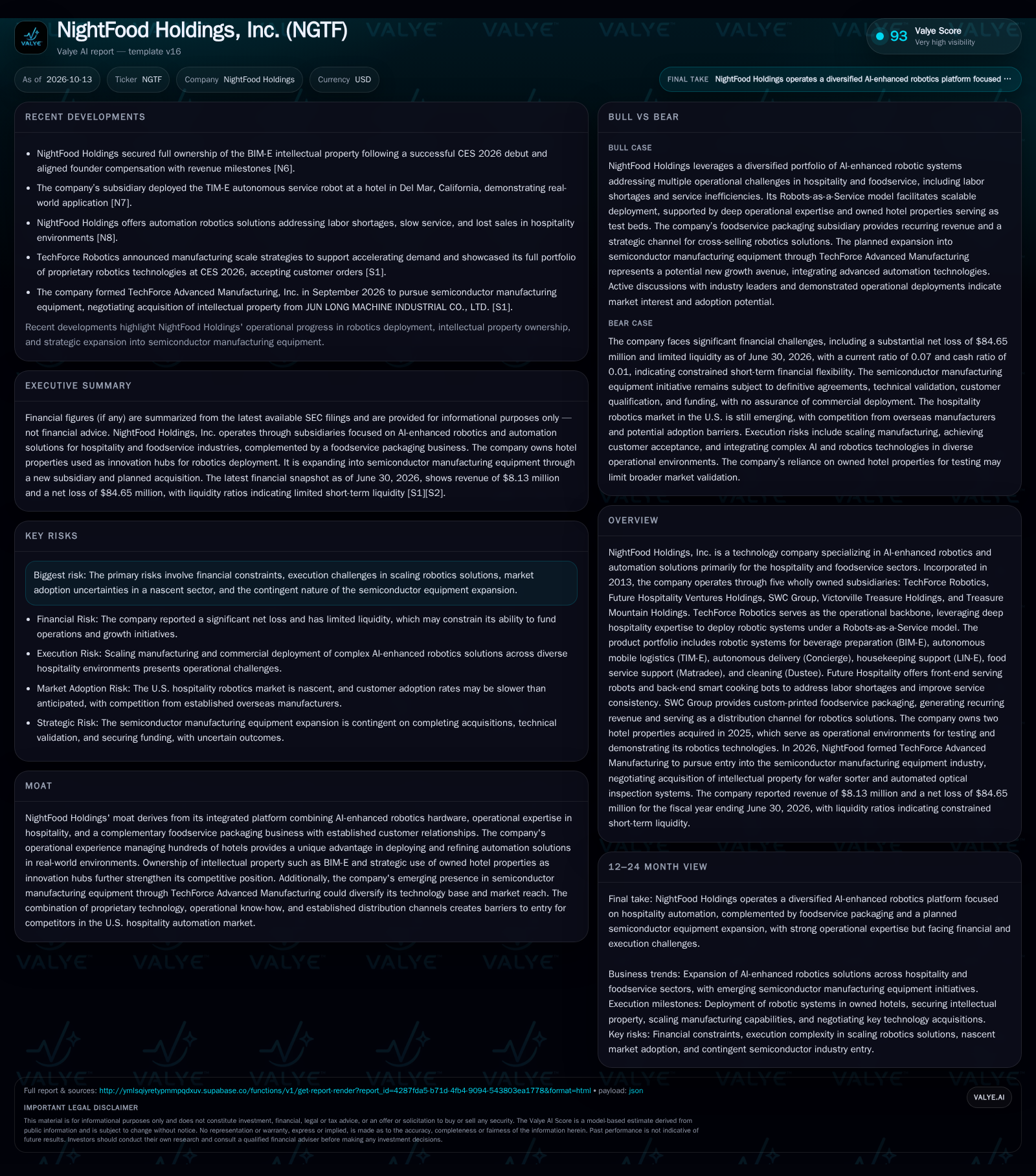
NightFood Holdings is an emerging player in hospitality and foodservice automation, integrating AI robotics, operational know-how, and a packaging business to address labor shortages and inefficiencies. The company’s hotel properties double as operational hubs for deploying and refining robotic solutions. A new push into semiconductor manufacturing equipment adds potential upside but also execution complexity and funding uncertainty. Near-term performance will hinge on customer adoption, the ability to monetize hotel-based pilots, and access to additional capital. [S1] [S2] [N6] [N7] [N8]
NightFood Holdings is betting that the future of hospitality lies at the intersection of robotics, artificial intelligence, and deep operational know-how. With a portfolio spanning AI-powered robots for service, cleaning, logistics, and food preparation, as well as a recurring-revenue packaging business and owned hotels as innovation hubs, the company is well positioned to capitalize on labor shortages and service inefficiencies in hospitality and foodservice. The coming quarters will test whether the company can translate its operational pilots and intellectual property into scalable, sustainable growth—or whether financial headwinds and market adoption hurdles will limit its ambitions. [S1] [S2] [N6] [N7] [N8]
Recent Progress and Pressures: Ownership, Deployments, and Financial Realities
NightFood Holdings has secured full ownership of the BIM-E robotic beverage system’s intellectual property, following its CES 2026 debut, and has aligned founder compensation with revenue milestones—an effort to signal commercial focus and incentivize near-term revenue delivery. The company reported cash and liquidity metrics for the period; these figures do not by themselves establish operating runway, investment capacity, financial flexibility, or financing capacity. [N6] [N7] [N8] [S1] [S2] The formation of TechForce Advanced Manufacturing, which aims to enter the semiconductor equipment market, remains in the negotiation and validation phase, adding both potential upside and execution risk. [S1]
How the Model Could Scale: Robotics-as-a-Service, Packaging Recurrence, and Hotel Synergies
NightFood’s business model is built around the integration of AI-enhanced robotics hardware, proprietary software, and operational expertise, deployed under a Robots-as-a-Service (RaaS) model. In theory, this allows customers to adopt automation with lower upfront capital costs, while NightFood collects recurring fees tied to robot usage, maintenance, and software updates. Margins in RaaS can be attractive if hardware costs decline with scale and if software and support revenue grows relative to initial deployment costs. However, capital requirements for manufacturing, deployment, and service infrastructure are substantial, especially in the early stages.
The SWC Group packaging business provides a stabilizing element, generating recurring revenue from over 6,000 U.S. customers and serving as a distribution channel for cross-selling robotics solutions. This segment likely carries lower margins than pure software or robotics, but the established customer base and order cadence could help smooth cash flows if growth in robotics deployments remains lumpy.
The ownership of hotel properties introduces both a source of operating revenue and a proving ground for robotics. These hotels generate traditional hospitality revenue (room, food, beverage), but their greater value may be as controlled pilot environments for refining automation solutions and demonstrating ROI to prospective customers. If successful, the insights and credibility gained could accelerate broader market adoption. Still, hotel operations are capital-intensive and exposed to cyclical risk, and their financial contribution may be limited unless robotics solutions are rapidly commercialized and scaled externally.
The planned move into semiconductor manufacturing equipment—if completed—would introduce a new, capital-intensive segment with long development cycles and high technical and customer-qualification hurdles. The economics here depend on successful IP acquisition, technical differentiation, and the ability to win business from established industry players.
NightFood’s Moat: Integration, Hospitality Know-How, and Barriers in a Nascent Market
NightFood’s potential competitive advantage lies in the integration of proprietary robotics hardware, AI-driven software, and operational expertise honed from managing hundreds of hotels and developing dozens of properties. This operational heritage allows for a more nuanced understanding of hospitality pain points and workflow dynamics, which could enable more effective deployment and customization of automation solutions.
The company’s ownership of intellectual property (such as BIM-E) and control over pilot environments (owned hotels) helps create technical and experiential barriers for new entrants. The recurring packaging business adds a channel advantage, offering a direct line to thousands of foodservice customers for cross-selling robotics.
However, the U.S. hospitality robotics market remains early-stage, and barriers to adoption persist: customers may be wary of operational disruption, integration complexity, or uncertain ROI. Competitive threats include established overseas robotics manufacturers (often with lower costs), as well as software-only automation platforms that can be deployed with less capital intensity. If NightFood can prove out its RaaS model at scale and demonstrate clear cost and service benefits, it may carve out a defensible niche. Otherwise, it risks being outmaneuvered by larger, better-funded, or more focused competitors.
If Pilots Translate to Platforms: A Path to Recurring Revenue and Market Expansion
The upside scenario for NightFood hinges on a virtuous cycle: successful deployments in owned hotels generate compelling case studies and operational data, which, when shared with the broader market, drive adoption by third-party hospitality and foodservice operators. As more customers sign up for RaaS contracts, NightFood could benefit from increasing operating leverage, with each new deployment contributing more to gross margin as fixed costs are spread across a larger base.
The recurring revenue from SWC’s packaging business could help fund working capital and buffer cash flow variability, while the cross-selling of robotics into this customer base accelerates adoption. If the company can successfully close and execute on the semiconductor equipment IP acquisition—and if technical validation and customer qualification follow—this could open a new, high-value revenue stream with less direct competition from hospitality-focused robotics firms.
Confirmation of this scenario would come from: multi-property or multi-chain RaaS contracts with recognized hotel or foodservice brands; sustained growth in robotics-related revenue; visible improvement in gross margin and operating leverage; and the successful launch or early orders for semiconductor equipment. Falsification would be evident if pilots fail to convert to commercial contracts, if revenue growth stalls, or if the company remains reliant on packaging as its main revenue driver.
Pilots Continue, but Scaling Remains Elusive Without Fresh Capital
The most plausible near-term outcome is that NightFood continues to deploy and refine its robotics solutions within its own hotels and with select early adopters, but struggles to achieve rapid, broad-based commercial scaling. Packaging revenue provides some stability, but is insufficient to offset continued investment in robotics R&D, manufacturing, and deployment. Liquidity constraints force the company to seek additional funding, whether through equity, debt, or strategic partnerships.
Progress in semiconductor equipment remains slow, with the initiative in extended negotiation, validation, or pilot phases, and no material revenue contribution in the short term. The company’s operational expertise and IP portfolio keep it in the conversation for larger deals, but customer adoption is gated by proof of ROI and integration support.
Evidence supporting this scenario would include incremental but modest growth in robotics deployments, continued financial losses, and fundraising activity. Falsification would come from either a sharp acceleration in commercial adoption (upside) or a failure to secure additional funding leading to operational retrenchment (downside).
Downside Scenario: Financial Constraints and Adoption Barriers Limit Execution
In the downside scenario, NightFood’s acute liquidity constraints and ongoing net losses force the company to curtail investment in robotics R&D and manufacturing, slowing or halting new deployments. Without sufficient capital, the company may be unable to support existing pilots, maintain its owned hotel operations at scale, or fulfill customer orders, leading to diminished credibility with potential partners.
If pilots in owned hotels fail to demonstrate compelling ROI or operational reliability, broader market adoption could stall, leaving the company reliant on its lower-margin packaging business. The semiconductor equipment initiative could remain in indefinite negotiation or be abandoned if funding or technical hurdles prove insurmountable.
This scenario would be confirmed by a lack of new RaaS contracts, declining robotics-related revenue, further deterioration in liquidity metrics, and possible asset sales or restructuring efforts. Falsification would require evidence of renewed capital access, successful customer conversions, or a strategic transaction that stabilizes the business.
What Will Determine NightFood’s Trajectory in Automation and Beyond?
The number and scale of RaaS contracts signed with third-party hospitality or foodservice operators—if disclosed—would show whether pilots are translating into commercial adoption.
The mix and growth rate of robotics-related revenue versus packaging revenue will reveal whether the core automation business is gaining traction or remains dependent on legacy lines.
Gross margin progression, particularly as robotics deployments scale, would indicate whether the business model is achieving operating leverage.
Progress milestones in the semiconductor equipment initiative: closure of the IP acquisition, technical validation, and any early customer pilots or orders.
Utilization rates and operational performance of robotics deployed in owned hotels—if disclosed—would help test the real-world impact and ROI of the solutions.
Customer retention and satisfaction metrics in both the packaging and robotics segments would provide insight into recurring revenue durability and competitive differentiation.
Disclaimer: This is research-only, informational analysis and not investment advice. It may include AI-generated interpretation and general industry context. Always verify important details using primary sources.

Comments