
Lunai Bioworks: AI-Driven Therapeutics Meet Financial Strain as Platform Diversifies
The next phase hinges on translating technical milestones into externally funded clinical progress.
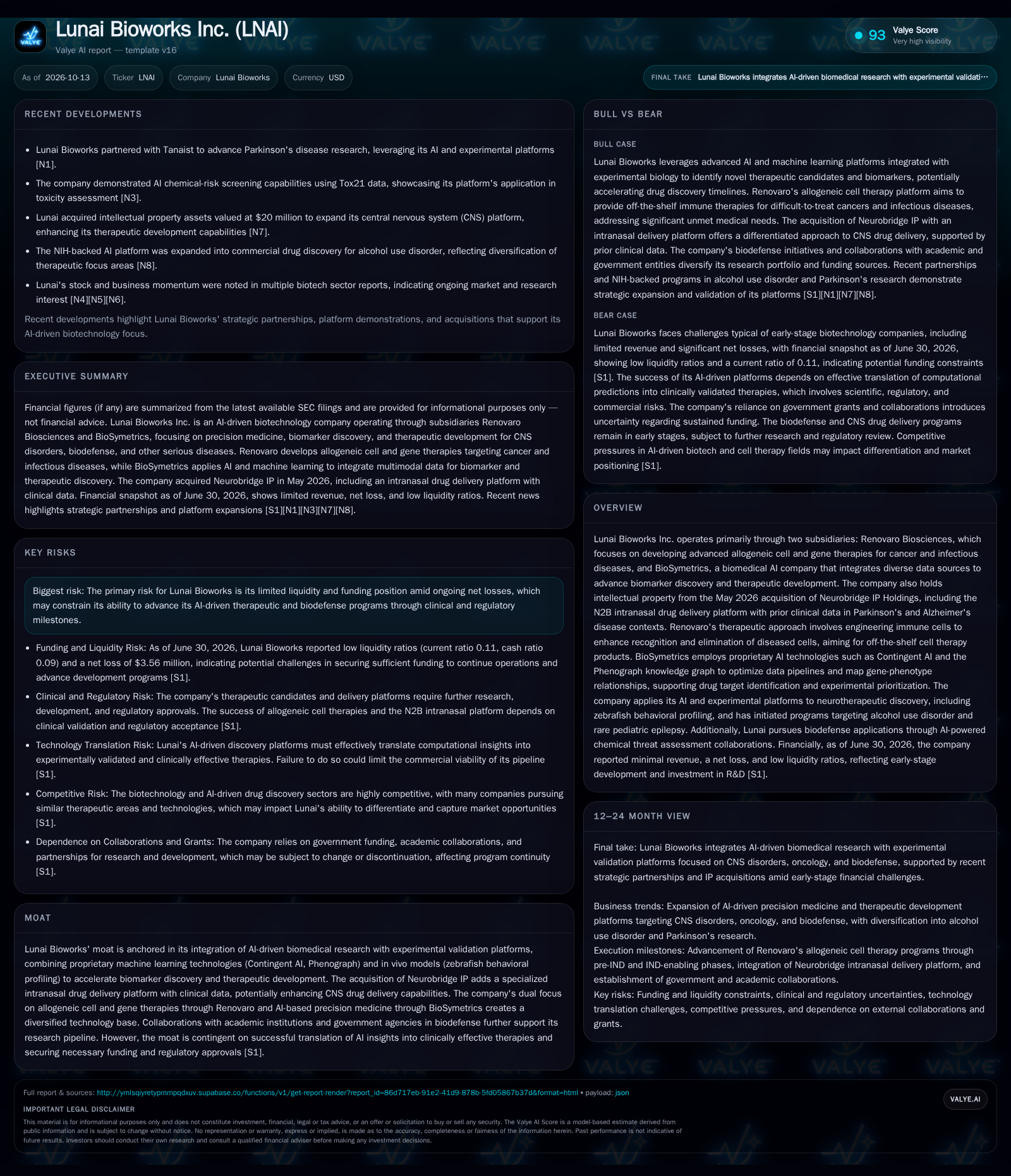
Lunai Bioworks is developing AI-powered platforms for precision medicine and experimental therapeutics, with recent expansion into CNS drug delivery and biodefense applications.
Lunai Bioworks stands at the intersection of AI, experimental biology, and high-need therapeutic areas, operating through subsidiaries focused on cell therapy and biomedical AI. The company’s expansion into CNS drug delivery and biodefense, highlighted by recent IP acquisitions and partnerships, positions it as an innovation-driven contender in precision medicine.
Recent Strategic Moves and Financial Realities Define the Stakes
Lunai Bioworks has recently expanded its intellectual property portfolio through the acquisition of Neurobridge IP Holdings in May 2026, adding the N2B intranasal drug delivery platform with clinical data for Parkinson’s and Alzheimer’s disease applications [S1] [N7]. This move broadens the company’s reach in central nervous system (CNS) therapeutics and reinforces its commitment to precision medicine. At the same time, Lunai has launched new grant-backed programs in alcohol use disorder and rare pediatric epilepsy, and entered strategic partnerships, notably with Tanaist for Parkinson’s research [N1] [N8].
Financially, as of June 30, 2026, the company reported $1.71 million in cash and equivalents against $18.91 million in current liabilities, producing a current ratio of 0.11 and a net loss of $3.56 million on minimal revenue ($51.9K) [S1]. The company reported cash and liquidity metrics for the period; these figures do not by themselves establish operating runway, investment capacity, financial flexibility, or financing capacity.
How Platform Integration Could Drive Value—If Funding and Validation Follow
Lunai Bioworks’ business model is built on the integration of proprietary AI (via BioSymetrics) and experimental biology (notably zebrafish profiling and cell therapy platforms) to accelerate discovery and de-risk development of therapeutics and biomarkers. The economic logic hinges on two levers: the potential for rapid, cost-efficient identification of drug candidates, and the generation of differentiated intellectual property that could be out-licensed, partnered, or advanced into later-stage clinical trials.
Revenue today is negligible, highlighting the early-stage, pre-commercial nature of the company’s programs [S1]. Most value creation is likely to be realized through milestone payments, grants, or licensing/partnership deals—rather than near-term product sales. The allogeneic cell therapy platform, if successfully validated, could create scalable, off-the-shelf products for oncology and infectious diseases, potentially reducing manufacturing costs and enabling faster market access compared to autologous approaches.
The addition of the N2B intranasal platform introduces a differentiated delivery mechanism for CNS drugs. If this platform can enable enhanced brain-targeted delivery and demonstrate safety/efficacy in future trials, it could command premium licensing terms or attract development partners. However, each of these economic pathways is capital-intensive, demanding substantial external funding for clinical trials, regulatory submissions, and commercialization. With current liquidity severely constrained, Lunai’s ability to realize operating leverage or capture high-margin economics is dependent on securing new funding or non-dilutive grants.
AI and Experimental Synergy: Source of Differentiation or Parity?
Lunai’s competitive pitch is the synergy between advanced AI (Contingent AI, Phenograph) and experimental platforms (zebrafish models, cell therapy), aiming for faster and more predictive drug discovery [S1]. In theory, this integration could enable the company to identify novel targets and compounds with higher translational potential and lower preclinical failure rates.
However, both the AI-driven biotech sector and allogeneic cell therapy space are crowded with well-funded competitors, including large pharma and specialized startups deploying similar data-centric and high-throughput approaches. The real differentiator will be Lunai’s ability to demonstrate that its AI predictions yield clinically actionable, experimentally validated results—especially as competitors also tout multimodal data integration and rapid iteration.
The Neurobridge N2B platform offers a potential edge in CNS drug delivery, yet this advantage is contingent on clinical validation and regulatory acceptance. Without clear superiority in efficacy, safety, or cost, Lunai risks being perceived as one of many platform biotechs rather than a category leader. Partnerships, such as those with Tanaist and government biodefense agencies, may help establish credibility, but do not guarantee recurring revenue or sustainable differentiation unless they mature into long-term contracts or exclusive development agreements.
What If AI-Driven Discovery and Platform Expansion Deliver Clinical Wins?
In a favorable scenario, Lunai’s AI and experimental platforms generate multiple high-value therapeutic candidates that progress into clinical trials with strong early efficacy and safety data. The N2B intranasal delivery platform could demonstrate clear advantages for CNS drug delivery, attracting licensing deals or co-development partnerships with larger pharma companies. Renovaro’s allogeneic cell therapies could show proof-of-concept in oncology or infectious disease, leading to milestone payments or non-dilutive grant funding.
Confirmation of this scenario would require: 1) successful IND filings and advancement of candidates into Phase I/II trials; 2) publication of robust preclinical and early clinical results; 3) announcement of new licensing, partnership, or grant milestones; and 4) evidence of increased external funding or strategic investment. If these milestones are met, Lunai could transition from a preclinical platform story to a pipeline company with tangible value inflection points and improved funding access.
Platform Progress Amid Cash Constraints: The Most Likely Path Forward
A more probable outcome is that Lunai continues to advance its technical platforms and early-stage programs, but progress is gated by access to capital and the pace of external validation. The company may secure additional grant funding or small partnerships that extend runway but do not fully resolve liquidity pressures.
In this scenario, Lunai demonstrates incremental technical milestones—such as preclinical candidate identification, successful pilot collaborations, or limited experimental validation—but is forced to prioritize programs and potentially delay costly clinical development. The company’s strategic value may improve if it can show that its AI-driven approach yields reproducible, experimentally validated discoveries, but commercial momentum and valuation will remain constrained by ongoing net losses and the need for further funding rounds.
Evidence for this scenario would be continued news flow around technical progress, grant awards, and new partnerships, but with persistent low revenue, high net losses, and recurring capital raises.
Liquidity Crunch and Program Delays: When Funding Risks Dominate
A negative scenario is characterized by Lunai’s inability to secure sufficient external funding—via grants, partnerships, or equity/debt raises—leading to urgent cost-cutting, program suspension, or even bankruptcy protection.
If the company fails to translate its AI-driven discoveries into clinical candidates with commercial interest, or if partners and grant agencies withdraw support, Lunai’s differentiated technology may not be enough to sustain operations. Confirmation of this scenario would include missed payroll or vendor payments, reduced R&D activity, public disclosure of going-concern risks, or emergency financing at highly dilutive terms.
Milestones That Will Define Lunai’s Ability to Convert Platform Into Pipeline
Progression of lead therapeutic candidates from preclinical to IND or Phase I status—if disclosed, would validate the platform’s translational potential.
New non-dilutive funding awards (government grants, foundation support) that extend runway and reduce reliance on equity raises.
Announcement of licensing deals, co-development partnerships, or collaborations with upfront payments.
Publication of peer-reviewed data demonstrating the efficacy and safety of the N2B intranasal delivery platform in CNS indications.
Updates on the pace of cash burn, including any significant reduction in net loss or improvement in current ratio—if disclosed.
Evidence of continued or expanded partnerships with biodefense or academic entities, particularly those with multi-year commitments.
Any public disclosure of going-concern warnings, program suspensions, or emergency financing events.
Disclaimer: This is research-only, informational analysis and not investment advice. It may include AI-generated interpretation and general industry context. Always verify important details using primary sources.

Comments