
Treasure Global Inc: Digital Asset Ambitions and the Challenge of Profitability in Malaysian E-Commerce
Treasure Global’s strategic push into AI-powered platforms, digital assets, and logistics partnerships could reshape its economics—if execution matches ambition. The company’s recent financial results show both the scale of the challenge and the potential leverage if new growth engines take hold.
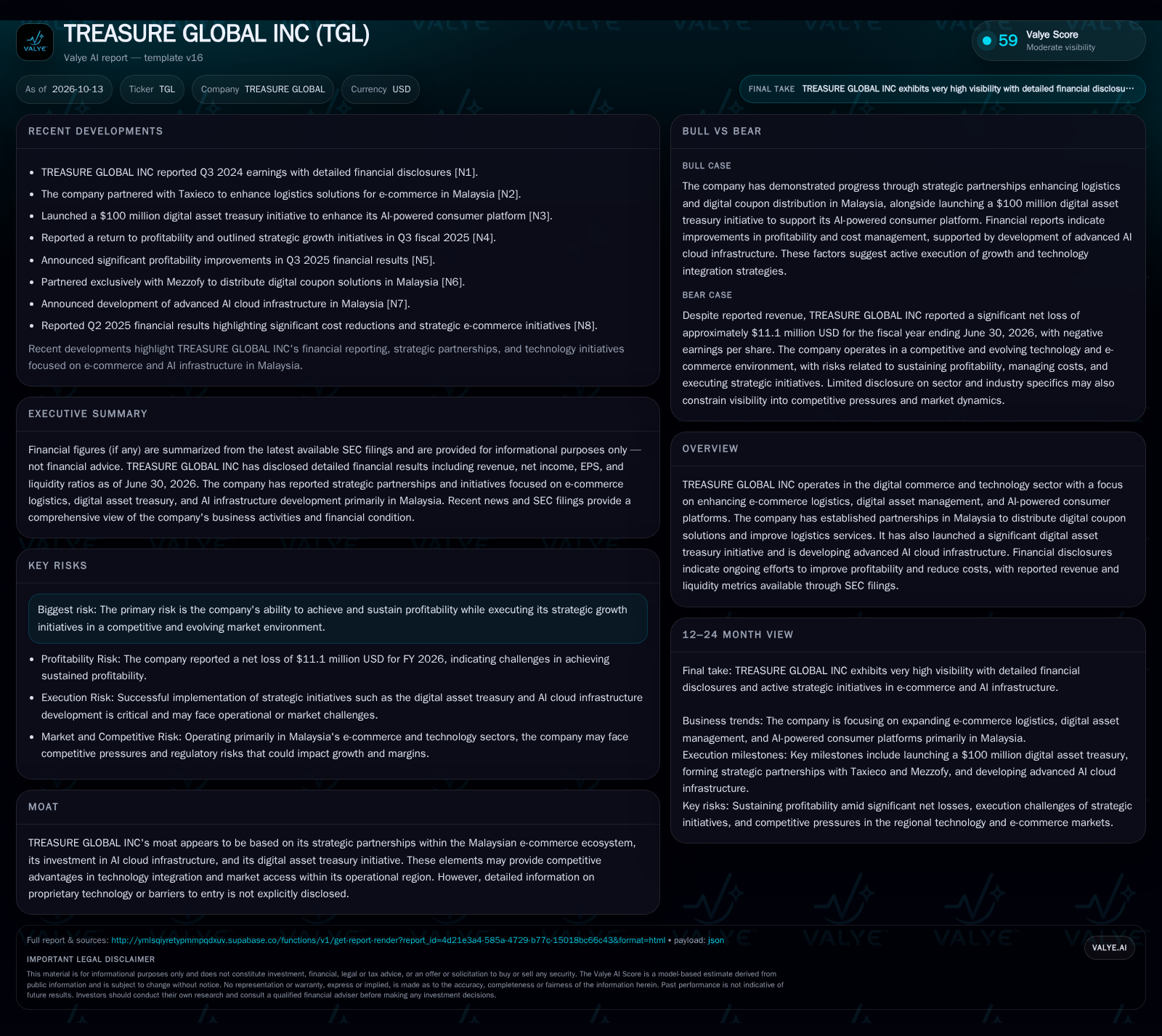
Treasure Global Inc. is pursuing a technology-driven strategy in Malaysia, blending e-commerce, AI, and digital assets.While revenue reached $5.17 million with a reported current ratio, the company posted a large net loss for FY 2026. Recent partnerships and infrastructure initiatives offer upside optionality, but sustained profitability remains unproven and will depend on operational execution and competitive intensity. [S1] [N3] [N4] [N5]
Treasure Global Inc. is attempting to carve out a differentiated position in Malaysia’s rapidly evolving e-commerce and technology market through a combination of AI-powered consumer platforms, digital asset management, and logistics innovation. While the company’s recent financial results expose the tension between ambitious technology investment and persistent net losses, a series of strategic partnerships and infrastructure initiatives suggest a pivot toward higher-margin, defensible business lines. The next phase will test whether these moves can translate into durable profitability amid intensifying competition and rapid technological change. [S1] [N2] [N3] [N4] [N5] [N6] [N7]
Recent Results Highlight Both Progress and Persistent Challenges
As of June 30, 2026, Treasure Global reported $5.17 million in revenue and a net loss of $11.1 million, with basic and diluted EPS of -9.63. The company’s liquidity position included $2.62 million in cash and equivalents and a current ratio of 2.16. While the Q3 2025 period saw a reported return to profitability and notable cost reductions, the full-year loss underscores the challenge of translating growth initiatives and technology investments into sustained earnings. The launch of a $100 million digital asset treasury, exclusive partnerships with logistics and digital coupon providers, and the development of AI cloud infrastructure in Malaysia represent a strategic pivot but also introduce execution risk and ongoing capital requirements. [S1] [N2] [N3] [N4] [N6] [N7]
The interplay between Treasure Global’s ambitious technology investments and its financial outcomes highlights a classic challenge in platform-driven businesses: balancing upfront capital expenditures with the timing of revenue realization. The reported net loss, while significant, must be contextualized within the framework of building scalable infrastructure and user ecosystems that typically require sustained investment before profitability emerges.
How Technology and Platform Bets Could Shift the Profit Equation
Treasure Global’s business model aspires to move beyond traditional e-commerce margins by integrating AI, digital assets, and logistics optimization. The company’s partnerships with Taxieco and Mezzofy suggest a strategy to embed proprietary digital coupons and streamlined last-mile delivery into the broader Malaysian e-commerce value chain. If these efforts yield higher take rates or platform fees, gross margins could expand—but this depends on adoption, pricing power, and the ability to scale user engagement.
The $100 million digital asset treasury initiative indicates a potential move toward monetizing digital wallets, loyalty programs, or asset-backed consumer platforms. Such models, if successful, can generate high-margin transaction or float-based revenue streams. However, capital needs for technology buildout, regulatory compliance, and customer acquisition are likely to remain elevated in the near term.
Operating leverage could emerge if fixed costs in AI infrastructure and logistics can be spread over a growing user base, but the company’s FY 2026 net loss signals that scale efficiencies have not yet offset upfront investment. The path to positive cash flow will likely require both revenue mix improvements and tight cost discipline.
The potential for AI and digital asset integration to shift the profit equation fundamentally depends on the company’s ability to could create network effects and lock in users through differentiated value propositions. For instance, AI-driven personalization may increase customer lifetime value and reduce churn, but only if the technology translates into meaningful improvements in user experience and merchant ROI. Similarly, the monetization of digital assets hinges on regulatory clarity and consumer trust, which can vary widely across emerging markets. The scalability of logistics partnerships also depends on operational execution and the ability to optimize delivery costs without sacrificing service quality. Therefore, the realization of operating leverage will be contingent on the successful orchestration of these interdependent components rather than isolated technology deployments.
Strategic Partnerships as a Wedge Against Larger E-Commerce and Logistics Players
Treasure Global operates in a Malaysian market crowded by regional e-commerce giants, logistics specialists, and fintech upstarts. Its exclusive partnerships with Taxieco and Mezzofy are designed to create differentiated logistics and digital coupon distribution capabilities—potentially offering merchants and consumers a more integrated, value-added experience.
However, the durability of these advantages hinges on execution: larger competitors may rapidly replicate logistics or coupon innovations, eroding early mover benefits. The company’s investment in AI cloud infrastructure could create switching frictions if it yields unique data-driven personalization or operational efficiencies. Still, the absence of disclosed proprietary technology or deeply entrenched network effects means the moat is likely to be narrow and contestable.
Regulatory, cultural, and infrastructure factors in Malaysia may also shape the competitive landscape. Local partnerships can be a source of resilience, but the company must continually demonstrate superior user acquisition, retention, and merchant value proposition to maintain relevance.
In a competitive landscape dominated by large incumbents with deep pockets, Treasure Global’s strategic partnerships serve as a tactical wedge but may not guarantee sustainable competitive advantage. The company’s ability to leverage AI cloud infrastructure for unique data insights or operational efficiencies could increase switching costs, but these must be substantial enough to deter replication. Additionally, the reliance on external partners for critical components like logistics and digital coupons introduces dependency risks that could be exploited by competitors through exclusive deals or pricing strategies. To maintain relevance, Treasure Global will need to continuously innovate and possibly expand its ecosystem to include complementary services that enhance stickiness and create multi-sided network effects, thereby moving beyond a narrow moat toward a more defensible market position.
AI Integration and Digital Asset Platform Achieve Scale, Driving Margin Expansion
The upside scenario unfolds if Treasure Global’s AI-powered consumer platform and digital asset initiatives achieve broad adoption among merchants and consumers. Successful integration of digital coupons and logistics solutions—backed by AI-driven personalization—could enable the company to capture a premium take rate or platform fee, improving gross margins and driving operating leverage.
Confirmation of this scenario would require evidence of accelerating user and merchant adoption, rising platform revenue as a share of total sales, and increasing contribution from digital asset-related services. Sustained positive operating income and cash flow, alongside new customer wins or expanded partnerships, would further validate the thesis.
Falsification would be signaled by stagnant user growth, limited merchant engagement, or failure to generate incremental revenue streams from AI and digital asset investments.
Incremental Progress Amid Ongoing Cost and Adoption Pressures
The most plausible outcome is that Treasure Global achieves incremental improvements in profitability and operational efficiency, but remains constrained by the high costs and competitive pressures inherent in Malaysia’s e-commerce and technology sectors. Revenue may grow modestly as partnerships mature and platform enhancements roll out, but gross margins are likely to remain under pressure unless the company can convert innovation into defensible pricing or scale.
Key confirming evidence would include stable or improving gross margins, recurring revenue growth tied to digital asset services, and continued cost discipline. Conversely, persistent net losses, lack of traction for new offerings, or rising customer acquisition costs would suggest the company remains in a cycle of reinvestment without clear path to sustained profitability.
Escalating Investment Cycle Without Sufficient Platform Adoption
The bear case materializes if Treasure Global’s digital asset, AI, and logistics initiatives fail to generate meaningful market adoption or if competitors neutralize its early advantages. In this scenario, the company faces ongoing net losses, cash burn, and potential pressure to raise additional capital under less favorable terms.
Concrete evidence supporting the downside would include declining cash balances, deteriorating current ratios, flat or shrinking revenue despite continued investment, and lack of new or renewed merchant partnerships. Regulatory headwinds or customer attrition would further compound challenges, potentially forcing retrenchment or strategic review.
Milestones and Metrics That Will Reveal If Treasure Global’s Platform Can Deliver
Quarterly revenue growth and the proportion attributable to platform, digital asset, or AI-driven services, if disclosed.
Gross margin trends as a signal of pricing power or operational efficiency improvements from technology investments.
User and merchant adoption rates for logistics and digital coupon platforms—a useful metric would be active users or transaction volume, if reported.
Operating cash flow and net income progression, particularly signs of sustained positive results after Q3 2025’s reported profitability improvements.
Partnership expansion or renewal with logistics, fintech, or retail players, indicating competitive traction or network effects.
Updates on the deployment and monetization of the $100 million digital asset treasury (e.g., wallet usage, transaction volume, or asset yields).
Capital expenditure and R&D trends, which may reveal the pace and sustainability of technology buildout.
Regulatory developments or disclosures related to digital assets and AI infrastructure in Malaysia, as these could impact adoption or compliance costs.
Disclaimer: This is research-only, informational analysis and not investment advice. It may include AI-generated interpretation and general industry context. Always verify important details using primary sources.

Comments