
Zeo ScientifiX: Platform Shift, Margin Leverage, and the Challenge of Financing Innovation
Zeo ScientifiX is navigating a strategic transition from legacy biologic products toward its higher-margin PPX™ service platform, but persistent losses, tight liquidity, and reliance on external capital highlight the fragility of its growth ambitions. The company's ability to scale its platform revenue, manage costs, and access funding will determine whether its service-led pivot can translate into durable value.
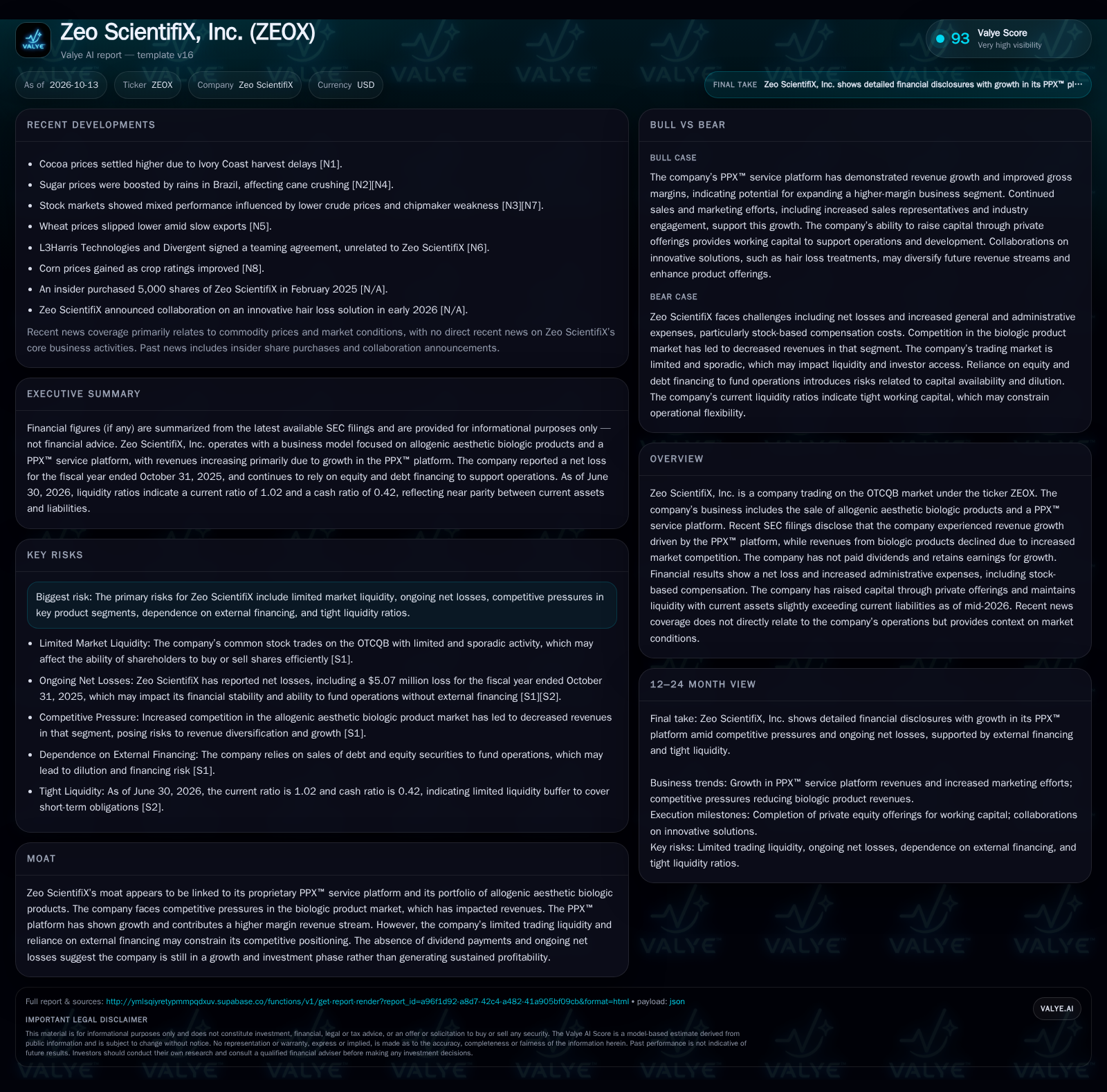
Zeo ScientifiX (OTCQB: ZEOX) is shifting its revenue base toward the PPX™ service platform, which now constitutes a growing share of total sales and supports high gross margins. However, the company continues to post significant net losses, faces rising administrative costs, and operates with minimal liquidity buffer, making it heavily reliant on new equity or debt financing. Competitive pressures in its original biologic products segment add urgency to the successful scaling and monetization of its platform business. [S1] [S2]
Zeo ScientifiX, Inc. is at a crossroads: its pivot from allogenic aesthetic biologic products to the proprietary PPX™ service platform is beginning to bear fruit, with platform revenues accelerating and supporting robust gross margins. The core question is whether Zeo ScientifiX can scale its service platform fast enough—and with sufficient operating leverage—to outpace ongoing cash burn and reduce its reliance on external capital, all while fending off intensifying competition in its legacy business lines. [S1] [S2]
Recent Results Underscore Platform Pivot and Persistent Losses
For the fiscal year ended October 31, 2025, Zeo ScientifiX reported revenues of $5.2 million, a 12.5% increase from the prior year, primarily driven by its PPX™ service platform. This pivot is further evidenced by the PPX™ platform accounting for 29.4% of total revenues in 2025, up from 13.3% in 2024. However, the company continues to post significant net losses, with a $5.07 million deficit in both fiscal 2025 and the trailing twelve months as of June 30, 2026. Gross margin remains robust at 82.0%, but elevated general and administrative expenses—particularly stock-based compensation, lab, and professional fees—keep the company in the red. Liquidity remains tight, with a current ratio of 1.02 and cash ratio of 0.42 as of June 2026, reflecting near parity between current assets and liabilities. These facts highlight both the momentum in the service platform and the ongoing challenge of achieving sustainable profitability. [S1] [S2]
How Platform Economics Could Reshape Zeo ScientifiX’s Profit Model
Zeo ScientifiX’s business economics are in transition. Historically, the company relied on allogenic aesthetic biologic products—a category subject to commoditization, regulatory hurdles, and price competition. The emergence of the PPX™ service platform introduces an opportunity for recurring, higher-margin revenue streams. Service platforms in the life sciences and aesthetics sector can command premium pricing if they deliver measurable value or proprietary outcomes for practitioners. With PPX™ contributing an increasing share of revenue and supporting an 82% gross margin, the platform could theoretically enable significant operating leverage if revenue scales faster than fixed costs.
However, the company’s cost structure remains a barrier: general and administrative expenses are high relative to revenue, and stock-based compensation, lab investments, and professional fees are sizable. Operating leverage will only materialize if Zeo ScientifiX can increase platform volume and utilization without a commensurate rise in overhead. Capital intensity is moderate, but the company’s persistent cash burn makes ongoing access to external financing a necessity. If the PPX™ platform can be adopted widely—potentially through SaaS-like or pay-per-use models—the business could shift toward a more scalable, asset-light profile. The key question is whether customer adoption and retention can accelerate fast enough to outpace the current rate of expense growth.
Competitive Dynamics: Platform Differentiation vs. Biologic Product Headwinds
Zeo ScientifiX faces intensifying competition in its legacy biologic products segment, as evidenced by declining revenues in that line. This reflects broader industry trends where biologics—especially in aesthetics—face commoditization, regulatory scrutiny, and price-based competition from both established medtech firms and new entrants. The company’s platform pivot is a response to these pressures, seeking to carve out a differentiated position via proprietary technology and potential service integration.
In platform-based business models, defensibility can stem from unique data, workflow integration, or network effects if the solution becomes a standard in practitioner workflows. However, with limited evidence on customer lock-in, renewal rates, or integration depth, it remains unclear whether PPX™ has achieved a sustainable moat. Competitors may include both traditional biologic suppliers and emerging digital or platform-based service providers targeting the same practitioner base. Zeo ScientifiX’s ability to build switching costs or data advantages will be critical to avoid competing solely on price or distribution reach.
If Platform Adoption Accelerates: Self-Funding Growth and Margin Expansion
A favorable scenario for Zeo ScientifiX hinges on rapid adoption and scaling of its PPX™ service platform. If the company can convert a critical mass of practitioners or clinics to recurring or high-frequency platform usage, revenue growth could accelerate while gross margins remain elevated. In this scenario, operating leverage would emerge as fixed administrative costs are spread over a larger revenue base, potentially enabling the company to approach break-even or positive cash flow without perpetual reliance on external capital.
Evidence that would confirm this trajectory includes: sustained quarter-over-quarter growth in platform revenues, improvement in gross and operating margins, and a declining ratio of administrative expenses to sales. Early signs could also include significant new customer wins, an expanding pipeline of platform integrations or partnerships, and reduced dilution from equity offerings. Falsification would occur if platform revenue growth stalls, customer retention is poor, or if cost containment fails to materialize as scale increases.
Incremental Platform Gains Counterbalanced by Persistent Cash Burn
The most plausible scenario over the next 12-24 months is one of incremental, but not transformative, progress. PPX™ platform revenues may continue to grow as a share of total sales, but at a pace insufficient to overcome ongoing net losses and cash burn. Biologic product revenues likely remain under pressure from competition, and administrative costs stay elevated given the company’s need to invest in sales, compliance, and R&D to support the platform business.
In this trajectory, Zeo ScientifiX will likely need to continue periodic equity or debt raises to fund operations, with dilution risk persisting for shareholders. Confirmation would include steady (but not exponential) platform growth, stable or slightly improving margins, and repeated small-scale financings. Falsification would be evident if platform revenues plateau or if the company is unable to secure needed capital on reasonable terms.
Capital Scarcity and Platform Stagnation Could Trigger Strategic Review
In a negative scenario, Zeo ScientifiX fails to meaningfully scale its PPX™ platform, either due to slow customer adoption, competitive displacement, or technical/regulatory setbacks. Biologic product sales continue to decline, and administrative expenses remain stubbornly high. With a thin liquidity buffer, the company might struggle to raise additional capital on acceptable terms, leading to severe dilution, operational cutbacks, or even a forced sale or wind-down.
Confirmation of this scenario would include flat or declining platform revenues, deteriorating gross margins (suggesting pricing pressure or cost inflation), delayed or failed product launches, and signs of financial distress such as missed payments or going concern warnings. An inability to raise new capital or secure strategic partnerships would be the clearest indicator of downside risk materializing.
Milestones That Will Define Zeo ScientifiX’s Transition to a Platform Business
Quarterly growth rate of PPX™ service platform revenues, ideally broken out separately in disclosures, to gauge adoption momentum.
Gross margin trends—whether the company can sustain or expand margins as platform revenue mix increases.
General and administrative expenses as a percentage of revenue: improvement here would signal emerging operating leverage.
Frequency and terms of new equity or debt financings—the smaller and less frequent, the closer to self-sufficiency.
Customer retention and renewal rates for the PPX™ platform (if disclosed), indicating whether practitioners see lasting value.
Updates on collaborations or new product/service launches, particularly in areas like hair loss solutions, which could broaden the addressable market.
Evidence of customer concentration or diversification, as reliance on a few large clients could increase risk.
Disclaimer: This is research-only, informational analysis and not investment advice. It may include AI-generated interpretation and general industry context. Always verify important details using primary sources.

Comments