
BAB, INC.: Franchise Economics and Competitive Dynamics in Specialty QSR
BAB, INC. The company’s future hinges on its ability to expand its franchise base, sustain brand relevance, and manage competitive and operational headwinds as consumer preferences and cost structures evolve.
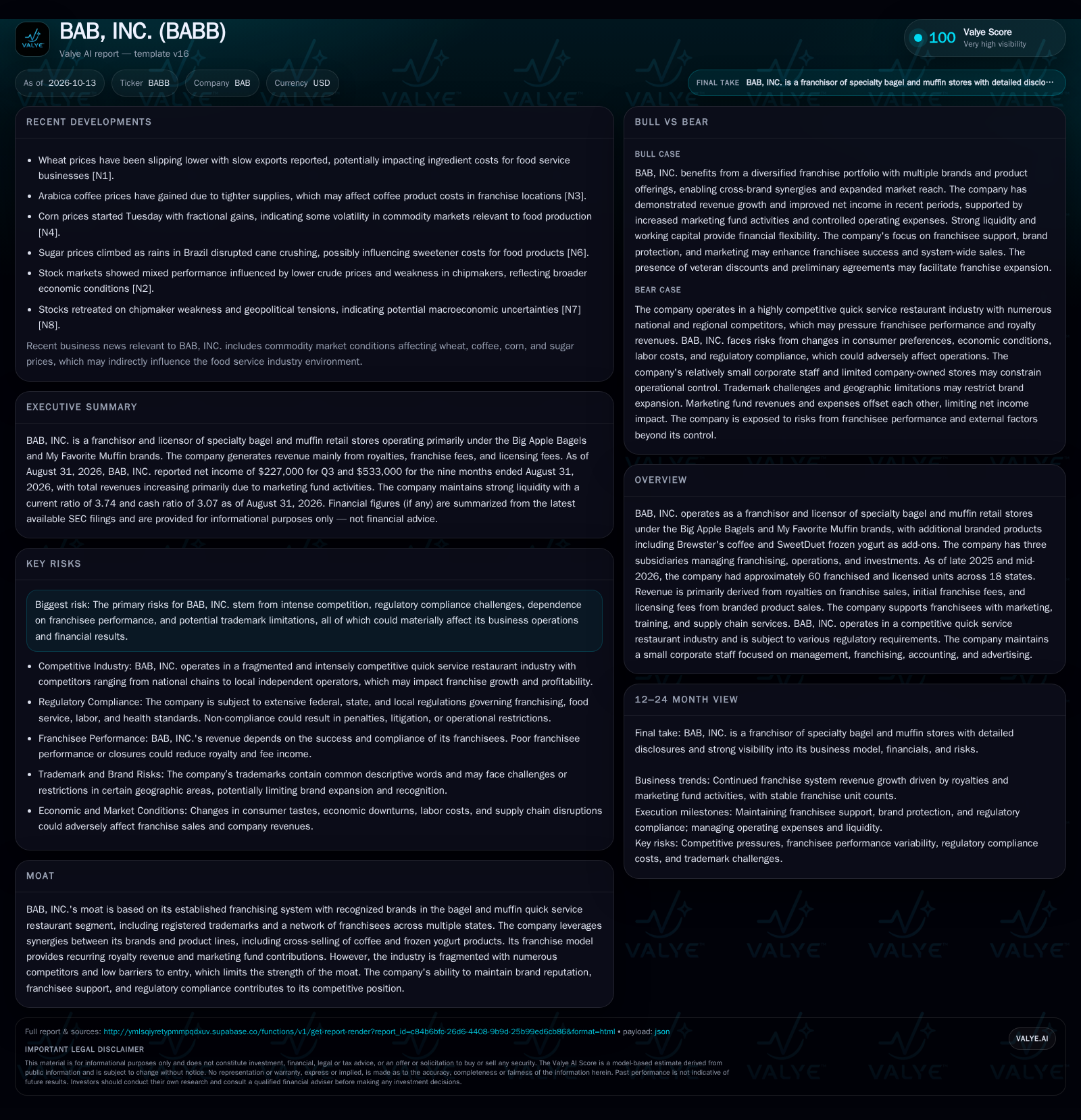
BAB, INC. operates as a franchisor of bagel and muffin stores under the Big Apple Bagels and My Favorite Muffin brands, reporting 18% revenue growth in Q3 2026 on the back of increased marketing fund activity, while royalty revenues grew 3.7%. With a current ratio of 3.74 and $2.4M in cash, the company remains financially stable but faces intense competition and depends on franchisee performance to drive future growth [S2].
BAB, INC. stands as a modest yet established player in the specialty bagel and muffin quick service restaurant space, operating nearly entirely through franchised and licensed units under the Big Apple Bagels and My Favorite Muffin brands. The company’s latest quarter saw notable top-line growth, largely driven by marketing fund activity, while core royalty revenues advanced more modestly. With a reported liquidity position and a tightly managed corporate structure, BAB, INC. is positioned to weather near-term volatility, but its long-term trajectory will depend on its ability to stimulate franchise growth, navigate competitive threats, and adapt to shifting consumer and cost dynamics [S2].
Recent Performance and Strategic Position Overview
BAB, INC. reported Q3 2026 net income of $227,000 and total revenue of $908,000, an 18.1% year-over-year increase, primarily attributed to higher marketing fund revenues and expenses that largely offset each other on the bottom line [S2]. Core royalty fee revenue rose 3.7% to $531,000, indicating stable but modest growth in underlying franchisee sales activity [S2]. The company reported $2.4 million in cash and a current ratio of 3.74 as of August 31, 2026 [S2]. Franchise network size was largely unchanged, with 59 franchised and 3 licensed units, reflecting slow system expansion. These facts highlight a business with stable core operations, sound financial footing, but limited near-term growth momentum.
Revenue Streams and Franchise Model Characteristics
BAB, INC. generates the majority of its revenue from ongoing royalties, typically set at 5% of franchisee net sales, as well as initial franchise fees and licensing fees from branded products sold to franchisees and licensees [S2]. Because the company does not operate company-owned stores, its earnings are highly leveraged to the performance and expansion of its franchise base. Royalty streams provide recurring, relatively high-margin revenue, while initial franchise fees and product licensing offer modest, less predictable contributions. The company’s cost structure is predominantly fixed at the corporate level, with only 7 full-time and 2 part-time employees as of August 31, 2026 [S2], and variable marketing fund revenues and expenses that pass through the income statement but have little impact on net income. Operating leverage is limited by slow franchise growth, and capital needs are low due to the asset-light model, but sustained growth requires successful franchisee recruitment and retention. The key economic question is whether the company can meaningfully increase its unit count or same-store sales in a crowded market.
The franchise model’s reliance on third-party operators introduces both scalability advantages and operational risks. While BAB, INC. benefits from limited capital expenditure and fixed overhead, the company’s revenue growth is inherently tied to franchisees’ ability to maintain consistent product quality, customer service, and local marketing execution. Variability in franchisee performance can lead to uneven revenue streams and complicate forecasting. Moreover, the relatively low initial franchise fees compared to ongoing royalties mean that the company’s financial health depends on sustained same-store sales growth and unit-level profitability rather than upfront cash infusions. This dynamic underscores the importance of robust franchisee training, support systems, and incentive alignment to mitigate attrition and stimulate organic growth within existing units.
Market Fragmentation and Brand Differentiation Challenges
BAB, INC. operates in a highly competitive quick service restaurant landscape, facing direct competition from both national bagel-focused chains (such as Panera Bread, Bruegger’s, and Einstein Bros. Bagels) and broader QSR players (like Dunkin’ and McDonald’s) [S2]. The company’s brands, while established, do not enjoy the same scale, marketing muscle, or real estate access as larger players. The franchise model allows for capital-efficient expansion, but also exposes BAB, INC. to risks from inconsistent franchisee execution, limited control over unit-level operations, and slower system-wide innovation. The company’s registered trademarks and bundled offerings (including Brewster’s coffee and SweetDuet frozen yogurt) may provide some incremental customer draw and cross-selling opportunity, but barriers to entry in the segment remain low and consumer switching costs are minimal. The competitive intensity and the lack of unique product or experiential differentiation are persistent challenges to outsized growth.
Potential Catalysts for Significant Franchise System Value Growth
A favorable outcome for BAB, INC. would likely require a combination of accelerated franchise unit growth and improved same-store sales, achieved through enhanced franchisee support, more effective national marketing, or new product innovation. If the company were able to sign and successfully open several new franchisees per year, especially in underpenetrated markets or through nontraditional locations (e.g., airports, colleges), the royalty base could expand meaningfully. Additionally, leveraging digital ordering, loyalty programs, or partnerships to drive traffic and ticket size could lift average unit volumes. Confirmation of this scenario would come from a sustained increase in royalty revenue growth rates, a visible uptick in franchise openings under development, and evidence of higher same-store sales versus prior years. Falsification would be continued stagnation in unit count and royalty revenue.
Expected Path of Modest Organic Growth and Stability
The most plausible outcome is continued stability in the core franchise base, with low single-digit royalty revenue growth and minimal net new unit additions. Marketing fund revenues and expenses are likely to continue offsetting each other, providing system support but not driving profit expansion. Licensing and initial franchise fee income may add some increment, but are unlikely to materially change the earnings profile unless a new channel or partnership is secured. This scenario would be confirmed by continued flat-to-slightly-up royalty revenue, a steady franchisee count, and stable profit margins. A deviation would be either a visible acceleration in openings or a spate of franchise closures.
Risks from Franchisee Performance and Market Changes
BAB, INC. is exposed to a range of downside risks, most notably franchisee underperformance or attrition, which would directly reduce royalty streams and could trigger negative operating leverage due to the fixed nature of corporate costs. Broader economic downturns, commodity cost spikes (wheat, coffee, sugar), or shifts in consumer preferences away from carb-heavy breakfast foods could compound pressures. Additionally, increased competition or regulatory changes could raise compliance costs or limit expansion. Confirmation of a downside scenario would be a decline in royalty revenues, a shrinking franchise base, or material increases in legal, marketing, or compliance costs relative to revenue. Falsification would be resilience in system sales and unit counts during periods of macro or sector stress.
Operational and Market Factors Influencing BAB, INC.'s Outlook
Quarterly and annual changes in royalty fee revenue—especially compared to system-wide sales and inflation—would help test whether underlying franchisee performance is improving or deteriorating.
Net change in franchised and licensed unit counts, as well as the number of stores under development, would provide direct evidence of expansion or contraction in the system.
Same-store sales growth (if disclosed) across the franchise network would indicate the health of existing units and the effectiveness of marketing and product initiatives.
Levels of new franchise agreements signed and pipeline development activity, particularly in new geographic markets or nontraditional venues, would signal franchise system momentum.
Changes in marketing fund contributions and expenses as a percentage of system-wide sales could shed light on the intensity and efficiency of system marketing efforts.
Gross margin trends on licensing fees from branded products (if disclosed) would help assess incremental profitability beyond royalties.
Material changes in regulatory, legal, or compliance costs, and any adverse outcomes related to trademark protection or franchise disputes, would be important warning signs.
Disclaimer: This is research-only, informational analysis and not investment advice. It may include AI-generated interpretation and general industry context. Always verify important details using primary sources.

Comments