
NRUC: Stability and Funding Strategies in Rural Utility Finance
Recent financial disclosures show NRUC managing a $35.9 billion diversified debt portfolio and earning $134.9 million in net income, amid market signals of oversold conditions and investor focus on dividends. The company's cooperative structure and risk management framework underpin its stability but also expose it to unique capital allocation and regulatory risks.
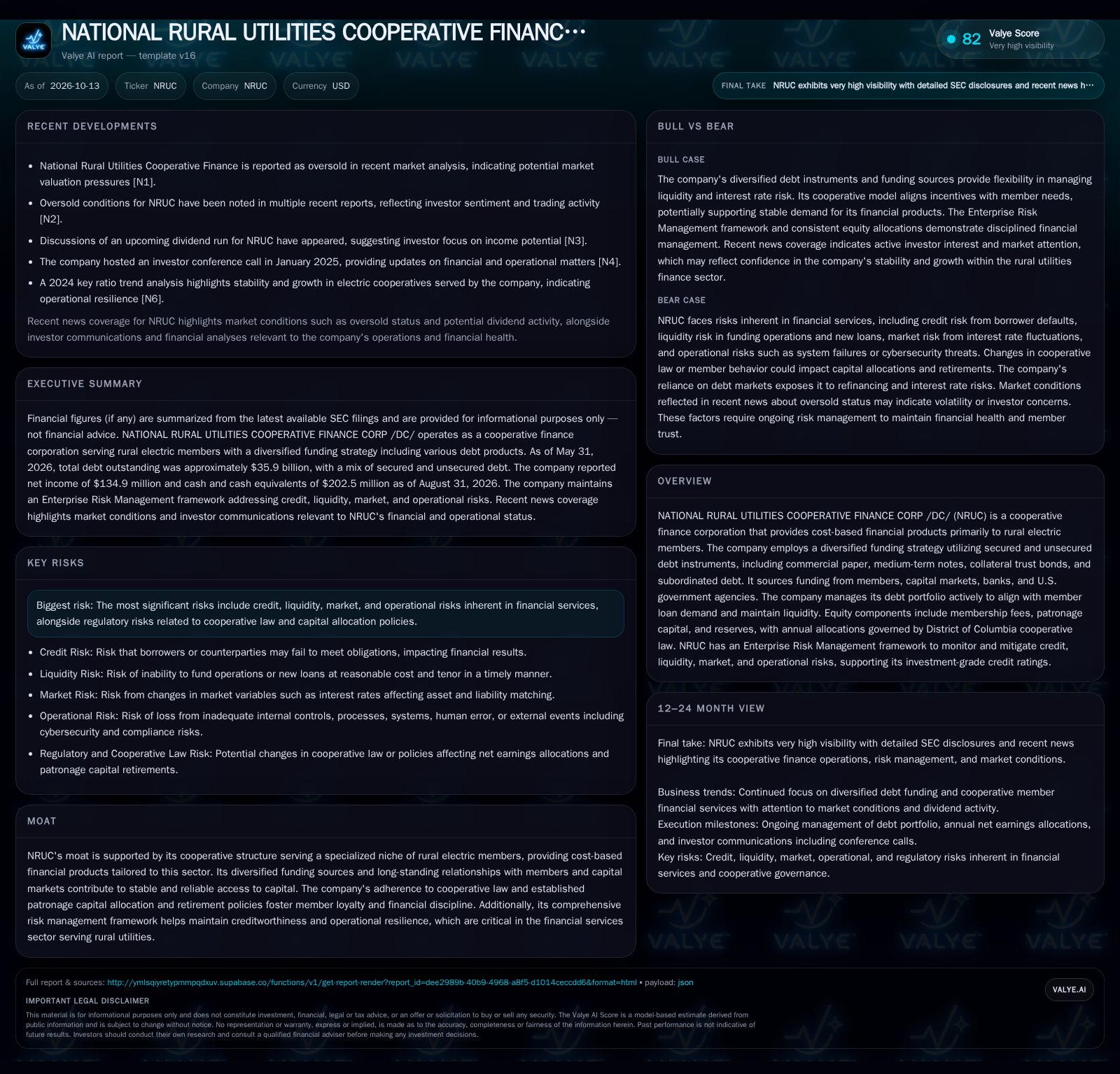
NRUC continues to serve rural electric cooperatives with a wide array of cost-based financing options, maintaining a substantial $35.9 billion debt portfolio and generating $134.9 million in net income as of mid-2026. Recent market sentiment highlights potential valuation pressures and heightened attention to dividend distributions. The sustainability of NRUC’s model will depend on continued prudent risk management, responsiveness to member needs, and adaptability to evolving funding environments. [S1] [S2] [N1] [N2] [N3]
National Rural Utilities Cooperative Finance Corp (NRUC) stands at the intersection of rural infrastructure finance and cooperative capital management, supporting electric cooperatives with a diversified suite of financial products. The company’s latest filings show a $35.9 billion debt portfolio, predominantly long-term, and a stable net income profile. Recent news of oversold market conditions and dividend speculation highlight both the defensive appeal and sensitivity of NRUC’s model to capital markets sentiment. The durability of its cooperative approach, risk controls, and funding diversification will be tested as credit and regulatory headwinds evolve.
Financial Overview and Market Trends Inform Near-Term Prospects
NRUC’s most recent financials show total debt outstanding of $35.9 billion as of May 31, 2026, with the portfolio split between 44% secured and 56% unsecured instruments. Short-term borrowings comprise 14% of this debt, while the majority is long-term or subordinated. Member investments account for 12% of total debt, cementing the cooperative alignment. Net income for the period was $134.9 million, and the company held $202.5 million in cash and cash equivalents as of August 31, 2026. [S1] [S2]
Externally, NRUC has been characterized as oversold in recent market analyses, suggesting equity market pressure or possible undervaluation. In parallel, investor discussions around a potential dividend run underscore the importance of capital returns for current holders. These signals reflect both the defensive qualities of the cooperative finance model and the market’s sensitivity to liquidity, payout, and valuation narratives. [N1] [N2] [N3]
Economic Strengths and Limits of NRUC’s Cooperative Funding Approach
NRUC operates as a financial intermediary for rural electric cooperatives, sourcing funds from a mosaic of secured and unsecured debt instruments, including commercial paper, medium-term notes, collateral trust bonds, and member-issued subordinated certificates. Its cost-based product strategy is designed to serve member needs rather than maximize profit, which typically leads to narrower net interest margins relative to for-profit lenders. This structure can foster loyalty and stable demand, but also limits upside from aggressive pricing or fee-based services.
With 86% of its debt classified as long-term or subordinated, NRUC’s funding strategy reduces rollover risk and supports asset-liability matching. Member investments—at 12% of total debt—provide a stable, low-cost capital source, but also tie the company’s funding base to the financial health and preferences of rural electric cooperatives. The cooperative’s annual net earnings allocations, required by District of Columbia law, mandate disciplined capital management but constrain retained earnings growth, potentially limiting NRUC’s ability to build equity buffers organically.
Operating leverage is moderate: while scale helps spread fixed costs (such as risk management and compliance), the cost-based model and regulatory capital allocations cap margin expansion. Capital needs are dictated by both member loan demand and capital market conditions, meaning NRUC must continually balance liquidity risk, interest rate risk, and the expectations of both members and external creditors.
NRUC’s Competitive Role Within the Rural Finance Landscape
NRUC’s primary advantage lies in its deep relationships and tailored offerings for rural electric cooperatives—a market segment underserved by traditional banks and capital market lenders. Its cooperative structure and cost-based lending philosophy create significant alignment with member interests, translating to high retention and network stability. The diverse funding base and established risk management practices further underpin its competitive resilience.
However, NRUC is not without threats. Alternative funding sources for rural utilities—such as federal programs, regional banks, or private credit funds—could become more attractive if interest rates or regulatory environments shift. Technology-driven lending platforms, while less common in this niche, could eventually lower transaction costs or offer more flexible products. Additionally, any erosion of the cooperative model’s perceived value, possibly due to regulatory change or member dissatisfaction with capital allocations, could open the door to competitors.
In summary, NRUC’s moat is real but not unassailable. Its continued advantage depends on maintaining member trust, favorable funding access, and operational excellence in risk management.
Growth Potential Fueled by Member Needs and Capital Market Conditions
A favorable scenario for NRUC emerges if rural electrification initiatives and infrastructure upgrades spur increased demand for financing from member cooperatives. Coupled with benign credit conditions and stable or declining interest rates, NRUC could deploy more capital at attractive spreads while keeping funding costs manageable.
Confirmation would come from rising loan volume, stable or improving net interest margins (even if modest), and continued low default rates among members. Additional evidence would include successful refinancing of maturing debt at favorable terms and further market recognition of NRUC’s defensive qualities, such as credit rating affirmations or sustained investor inflows.
Falsification would involve a slowdown in member loan demand, tightening spreads, or signs of member defections to alternative lenders. Adverse credit events or a sudden spike in funding costs would also challenge the upside thesis.
Ongoing Lending Activity Amid Funding and Regulatory Challenges
The most plausible trajectory for NRUC is continued steady lending activity, supported by routine refinancing and disciplined risk management. Member loan demand is likely to remain stable, barring major shifts in rural utility sector fundamentals. Funding will continue to come from a mix of member investments and capital markets, with the company actively managing its maturity ladder and interest rate exposures.
Net income is expected to show modest growth, constrained by the cooperative’s cost-based pricing and annual earnings allocations. Capital market access should remain reliable as long as NRUC preserves its investment-grade credit ratings and communicates transparently with investors.
Confirmation would be reflected in flat to slightly rising loan balances, consistent coverage of interest and principal obligations, and a stable equity base. Signs of regulatory or member-driven change to the capital allocation model, or difficulty in rolling over debt, would falsify the base case.
Risks from Credit Issues or Funding Interruptions Highlight Structural Weaknesses
The main risk for NRUC is a material deterioration in member credit quality, triggered by economic distress among rural electric cooperatives or exogenous shocks (e.g., commodity price swings, weather events, regulatory changes affecting utility revenues). A spike in member defaults would erode both earnings and capital, potentially leading to stricter lending standards or higher funding costs.
A secondary risk is disruption in capital markets—such as a sharp rise in interest rates or a liquidity crunch—making it difficult or expensive to refinance maturing debt. This could force NRUC to curtail lending, tap more expensive backup facilities, or adjust its balance sheet in ways that are unfavorable to members.
Confirmation would be visible in rising non-performing loans, negative earnings trends, widening funding spreads, or a downgrade in credit ratings. Member withdrawals of capital or a freeze in new loan activity would also signal acute stress.
Key Developments Reflecting NRUC’s Cooperative Finance Resilience
Loan growth or contraction among member cooperatives: Quarterly disclosure of total outstanding loans and new loan origination volume would help gauge underlying demand and sector health.
Net interest margin trends: If disclosed, this metric would clarify the impact of funding costs and pricing discipline on profitability.
Non-performing asset ratios: Increases here would signal credit quality deterioration and rising risk of capital impairment.
Funding cost and maturity profile: Updates on the weighted average cost of capital and debt maturity schedule would indicate refinancing risk and market access.
Changes in member capital investments: Shifts in member participation would illuminate confidence in the cooperative structure and internal funding stability.
Credit rating actions by major agencies: Any upgrades, downgrades, or outlook changes would provide an external view of NRUC’s risk profile.
Regulatory or cooperative law changes: New rules affecting earnings allocation, capital requirements, or patronage policies could materially alter the economic model.
Dividend or patronage capital retirement announcements: The scale and frequency of these distributions affect member satisfaction and retained capital for future lending.
Disclaimer: This is research-only, informational analysis and not investment advice. It may include AI-generated interpretation and general industry context. Always verify important details using primary sources.

Comments