
Iron Horse Acquisition II: SPAC Leverage Meets the AI Battery Intelligence Opportunity
Iron Horse Acquisition II Corp. is poised at a pivotal juncture, with its future now tied to the successful merger with Electra Vehicles and the realization of commercial value in AI-powered battery intelligence. The outcome will hinge on execution, adoption, and the ability to turn strategic partnerships into scalable, defensible revenue streams.
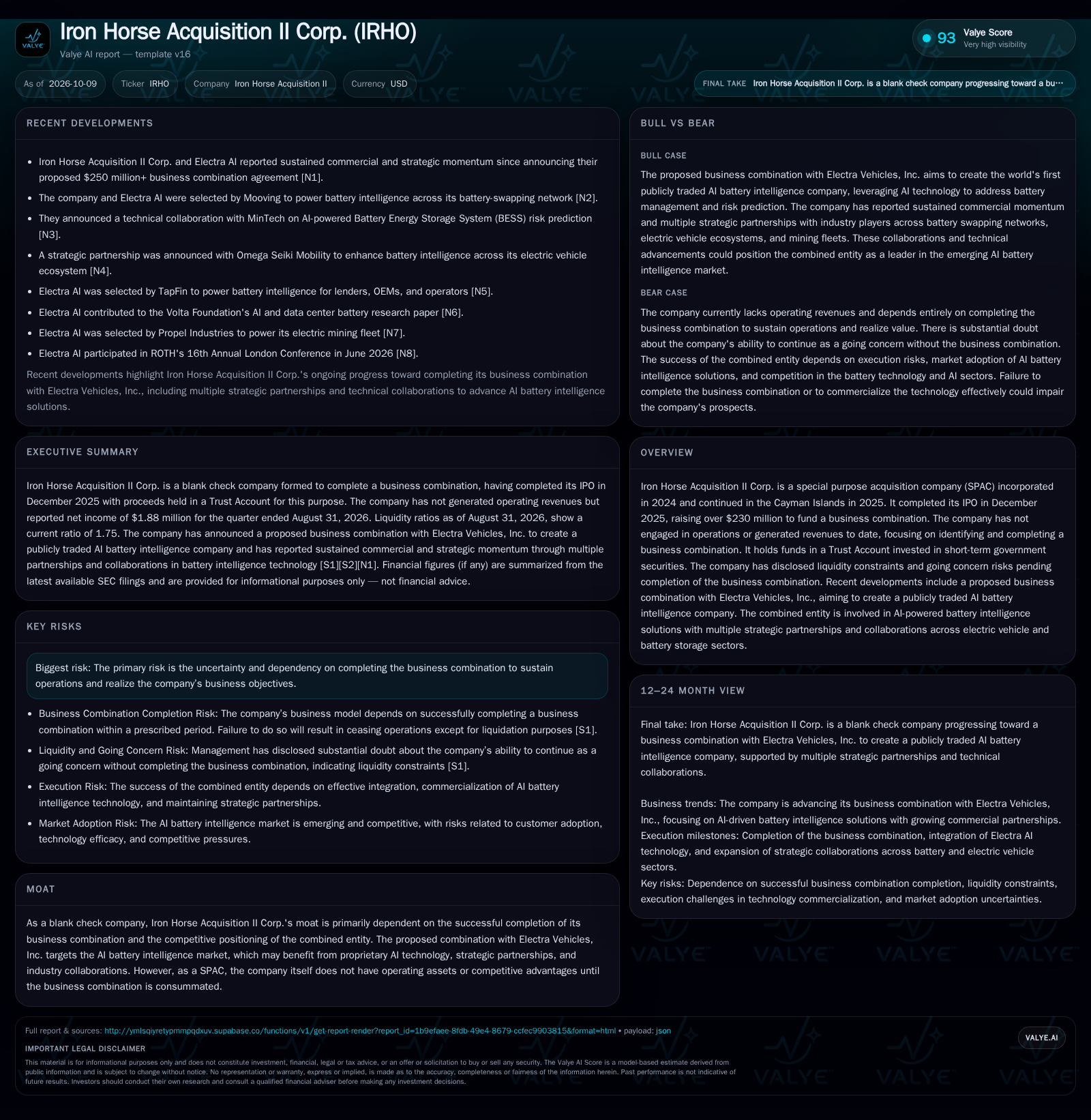
Iron Horse Acquisition II Corp. is a SPAC nearing a proposed $250M+ business combination with Electra Vehicles, aiming to form a public AI battery intelligence company. The thesis now rests on whether this combination can deliver sustainable differentiation and growth in a nascent, competitive market with high execution risks. [S1] [S2] [N1]
Iron Horse Acquisition II Corp. stands at the classic inflection point for a SPAC: with its trust account funds and public listing, the company's entire value proposition now rides on the successful completion of its proposed business combination with Electra Vehicles. This merger aims to birth a first-of-its-kind public company focused on AI-powered battery intelligence, a sector with credible long-term tailwinds but also daunting execution and adoption risks.
Material Developments: From SPAC Uncertainty to Electra AI Ambitions
Iron Horse Acquisition II Corp. has not generated any operating revenue since inception and remains wholly reliant on completing its proposed business combination with Electra Vehicles, Inc. to realize its business purpose [S1] [S2]. At the end of August 2026, the company reported current assets of $386,190 and current liabilities of $220,952, producing a current ratio of 1.75 [S2]. However, management has explicitly disclosed substantial doubt about the company’s ability to continue as a going concern without the business combination, citing acute liquidity constraints [S1].
The company has entered into a definitive and amended merger agreement with Electra Vehicles, targeting the creation of a publicly traded AI battery intelligence company [S1]. Since this announcement, Electra AI and Iron Horse have reported sustained commercial and strategic momentum, including several partnerships across EV battery swapping, energy storage, and mining fleet electrification [N1] [N2] [N4] [N7]. These developments are material as they shift the narrative from SPAC existential risk to a tangible—though still unproven—operating thesis.
How the Combined Entity Could Monetize Battery Intelligence
The proposed business combination will only create value if Electra AI can translate its suite of battery intelligence solutions into recurring, scalable revenue streams. The business model for AI-powered battery management typically hinges on software-as-a-service (SaaS) or data analytics platforms provided to OEMs, fleet operators, battery swapping networks, and energy storage providers. These solutions may be priced on a subscription basis, per-vehicle or per-device, or as part of multi-year service agreements, but the exact commercial mechanics for Electra AI are not publicly disclosed.
Capital requirements for scaling such a platform are significant: data infrastructure, ongoing R&D, and customer integration drive fixed costs, while incremental deployments may offer high gross margins once core software and data pipelines are in place. The challenge is to achieve sufficient volume—across vehicles, battery packs, or storage sites—to unlock operating leverage and justify investments. Early partnerships with players like Mooving, TapFin, and Propel Industries suggest potential for sector-specific volume ramp, but the conversion of pilots to broad adoption and multi-year contracts remains to be proven [N2] [N5] [N7].
The SPAC structure provides initial trust capital, but the go-forward entity will likely require additional funding for commercialization, integration, and working capital during the transition from pre-revenue to recurring revenue. This increases execution risk in the near term, especially if customer adoption cycles are long or contract economics are less favorable than anticipated.
Competitive Landscape and Differentiation Challenges in AI Battery Intelligence
The AI battery intelligence market is rapidly attracting startups, legacy battery analytics firms, and large industrial tech players seeking to capitalize on the electrification boom. Barriers to entry are moderate: while advanced AI models and proprietary datasets can provide an edge, many core algorithms are increasingly commoditized, and the true differentiator lies in real-world data access, integration depth, and customer trust.
Electra AI’s reported partnerships and technical collaborations across battery swapping, EV ecosystems, and mining fleets hint at sectoral breadth, but these must be converted into sticky, revenue-generating relationships to build a defensible moat [N2] [N4] [N7]. Larger competitors, including established battery management system vendors and vertically integrated OEMs, may bundle analytics with hardware or leverage existing customer relationships, pressuring margins and limiting pricing power.
Switching frictions are likely modest in software-driven analytics unless deeply embedded into operational workflows or regulatory reporting. Network effects could emerge if Electra AI aggregates the largest, most diverse battery datasets, improving predictive accuracy and creating lock-in, but this will require significant customer scale and data rights. The question is whether the combined entity can move quickly enough to carve out a leadership position before competitive convergence.
If Strategic Partnerships Accelerate Adoption: What a Winning Outcome Looks Like
The bullish scenario hinges on Electra AI successfully converting its announced technical collaborations and commercial pilots into multi-year, recurring software or data services contracts. If OEMs, fleet operators, and battery swap networks standardize on Electra’s AI platform for battery management, the company could achieve rapid scaling, with high-margin SaaS economics and strong retention driven by integration depth and continuous improvement of predictive models.
Industry-wide adoption could be catalyzed if Electra’s technology delivers measurable improvements in battery lifespan, performance, and risk mitigation—especially if validated by third-party studies or regulatory endorsements. Positive evidence would include public disclosure of multi-year contracts, rapid expansion of existing partnerships into new geographies or platforms, and case studies demonstrating customer ROI. Accelerating revenue growth, improving gross margins, and growing backlog (if disclosed) would further confirm thesis momentum.
This scenario would be falsified if partnerships stall at the pilot stage, if churn is high, or if larger players rapidly capture key accounts through bundling or price competition.
Plausible Middle Path: Gradual Commercialization with Ongoing Execution Risks
The most likely outcome is a gradual ramp in commercial deployments, with some partnerships expanding into limited production contracts while others remain in development or pilot phases. Revenue growth could be lumpy, reflecting the slow adoption cycles typical in the mobility and energy sectors. The combined entity may face periods of operating losses as it invests in technology, customer integration, and go-to-market capacity.
Sustained progress would be indicated by incremental increases in customer count, pilot-to-contract conversion rates, and the breadth of use cases supported (e.g., from EVs to grid storage to mining fleets). However, margin expansion could be constrained by the need to offer customized solutions, competitive discounting, or integration support. The company’s ability to access additional capital—either through secondary offerings or strategic investors—will be critical for bridging the gap from early deployments to self-sustaining cash flow.
This scenario could be falsified by persistent delays in closing the business combination, slow customer adoption, or evidence that technical differentiation is insufficient to command premium pricing or retention.
Risks If the Business Combination Falters or Adoption Stalls
The primary adverse scenario is failure to complete the business combination, which would trigger SPAC liquidation and loss of any upside optionality for current shareholders [S1]. Even if the merger closes, the combined entity could struggle if Electra AI’s technology fails to deliver clear operational or financial benefits, if market adoption is slow, or if competition compresses margins and erodes customer stickiness.
Evidence confirming this scenario would include further disclosures of liquidity strain, inability to secure additional working capital, attrition or non-renewal of major partnerships, or negative industry feedback on product efficacy. A lack of new contract announcements, or repeated delays in commercial deployments, would also signal trouble.
This scenario would be partially offset if the company can pivot to new verticals or secure bridge financing, but the overall risk profile would remain elevated until recurring revenue and customer validation are demonstrably established.
Operational and Strategic Milestones That Will Define the Post-Merger Thesis
Completion of the business combination with Electra Vehicles, including SEC and shareholder approvals and closing timelines.
Disclosure of commercial contract terms—such as contract length, pricing structure, and renewal/churn rates—for key partnerships and reference customers (if disclosed).
Growth in the number and depth of strategic partnerships or customers, particularly expansions from pilot projects to multi-year, revenue-generating agreements.
Evidence of recurring revenue, backlog, or annualized contract value (if disclosed), which would clarify the durability and scalability of the business model.
Gross margin trends and cost structure evolution as the company transitions from pilot deployments to scaled commercial operations.
Technical milestones, such as published case studies, third-party validations, or regulatory endorsements of Electra AI’s platform.
Customer adoption metrics across diverse verticals (EVs, grid storage, mining), highlighting breadth of applicability and potential for network effects.
Disclaimer: This is research-only, informational analysis and not investment advice. It may include AI-generated interpretation and general industry context. Always verify important details using primary sources.

Comments