
Global-Smart.Tech Inc.: Specialized Cloud Rendering Ambitions Collide with Severe Liquidity Constraints
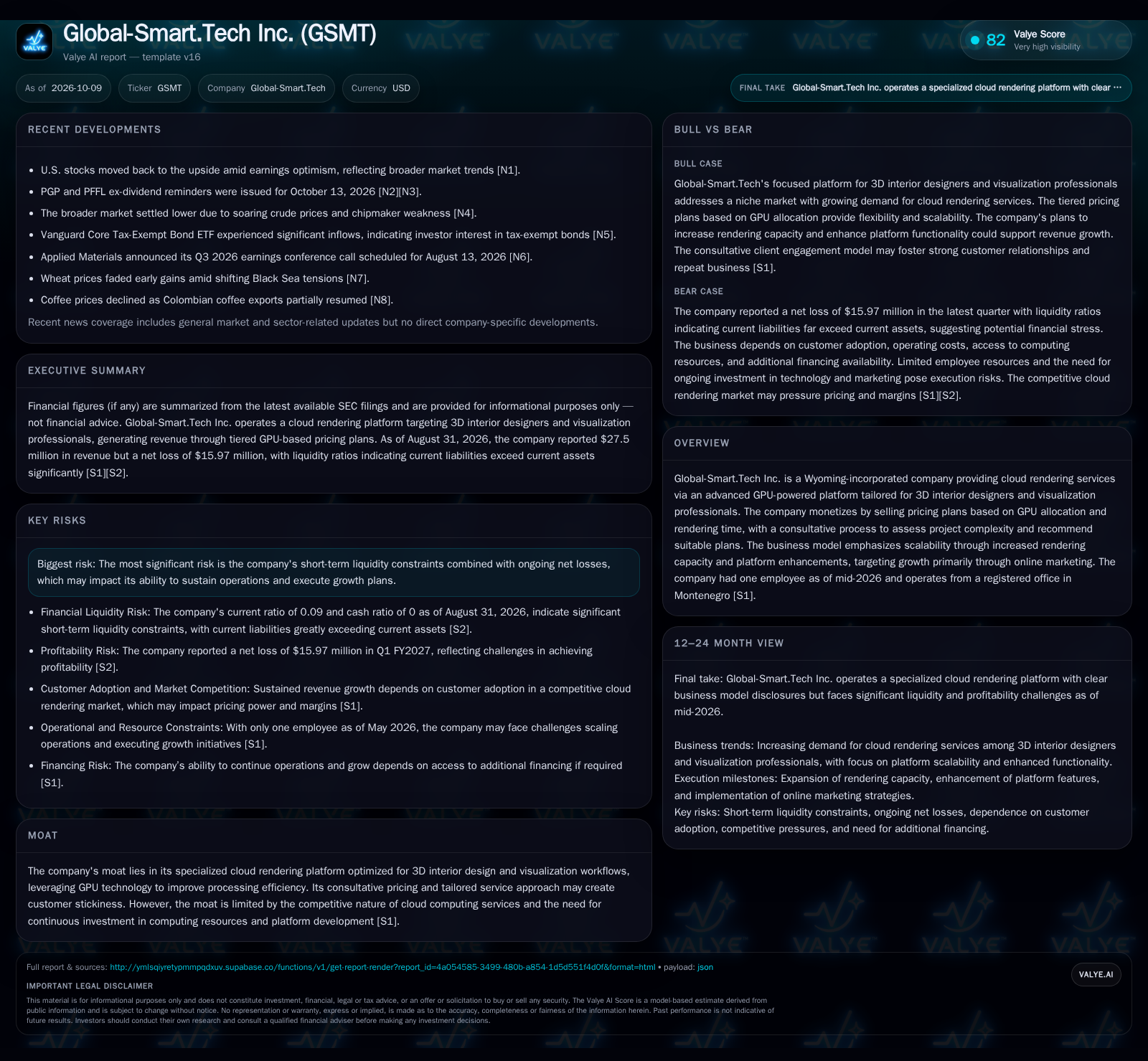
Global-Smart.Tech Inc. targets the 3D interior design and visualization niche with a GPU-powered cloud rendering platform and flexible, project-based pricing. Despite evident revenue traction, the company faces acute liquidity pressure, operating with a single employee and a current ratio of just 0.09 as of August 2026.
Global-Smart.Tech Inc. serves 3D interior designers and visualization professionals with GPU-based cloud rendering services, offering flexible, scalable pricing plans. As of August 2026, it reported $27.5 million in revenue but remains under heavy financial strain, with liabilities far exceeding assets and a net loss of $15.97 million. [S1] [S2]
Global-Smart.Tech Inc. has positioned itself as a specialist in cloud rendering for the 3D interior design and visualization market, leveraging GPU technology to deliver high-performance rendering services through a flexible, project-based pricing model. While the company has demonstrated an ability to generate revenue, its operational structure—essentially a one-person business with a heavy liability load—raises fundamental questions about scalability, resilience, and long-term viability. Acute liquidity shortfalls and ongoing losses mean that even as demand for cloud-based rendering grows, Global-Smart.Tech faces an urgent need to resolve its financial imbalances and operational bottlenecks to avoid being eclipsed by better-capitalized competitors.
Liquidity Crunch, Revenue Growth, and an Ultra-Lean Workforce: The Q3 2026 Snapshot
As of August 31, 2026, Global-Smart.Tech reported $27.5 million in revenue, reflecting some market traction in its target segment of 3D interior designers and visualization professionals. Operationally, the company is extremely lean, with only one employee—the President/CEO—and two independent directors. These facts frame a business that has established a specialized product and some revenue but is running at a significant financial deficit and with minimal operational infrastructure. [S1] [S2]
How the Cloud Rendering Model Could Scale—and Where Economics May Break Down
Global-Smart.Tech’s business model is transactional and project-based: clients submit 3D interior design or visualization projects, receive a tailored quote based on GPU allocation and estimated render time, and prepay before work begins. This structure allows for flexible pricing and could, in principle, support efficient scaling as more rendering projects are processed through the platform. Pricing tiers based on GPU count (10, 25, or 40) and minimum hourly commitments create a mechanism for both small and larger jobs, potentially improving platform utilization. Variable costs are likely dominated by GPU compute expenses—either leased from cloud providers or maintained in-house—while fixed costs are unusually low given the single-employee structure.
However, the economic model faces several pressure points. Operating leverage is limited if each project requires significant manual evaluation or customer support. Margins are vulnerable to fluctuations in GPU cloud costs and competitive pricing pressure from larger, more diversified cloud rendering incumbents. If the business depends on prepayment but must settle large supplier bills before collecting significant customer volume, working capital could become a persistent bottleneck.
A critical factor in the scalability of Global-Smart.Tech’s model lies in the balance between automation and manual intervention. Should the project evaluation and pricing process remain labor-intensive, the company risks bottlenecks that limit throughput and inflate customer acquisition costs. Conversely, investing in automated project analysis tools that estimate GPU requirements and render times could streamline operations and reduce overhead. However, such automation demands upfront development costs and technical expertise, which may be challenging given the company’s current resource constraints. The trade-off between operational efficiency and capital investment will be pivotal in determining whether the platform can achieve sustainable growth.
Specialization vs. Scale: Can Niche Focus Withstand Broader Cloud Rendering Competition?
Global-Smart.Tech’s competitive positioning is built around a specialized platform targeting 3D interior designers and visualization professionals—a segment that values high-fidelity, rapid-turnaround rendering but may lack in-house GPU resources. The consultative, project-based quoting and delivery model could foster customer loyalty and differentiate from generic compute platforms.
However, barriers to entry in cloud rendering are modest, and established cloud infrastructure providers or dedicated rendering services can often offer deeper pools of GPUs, more automation, and broader integration with creative software tools. If larger incumbents move aggressively into the 3D design rendering niche, pricing and margin pressures could intensify. The company’s single-employee structure limits its ability to build relationships, enhance platform features, or provide high-touch support at scale. In this context, any early-mover advantage may be fleeting unless the platform achieves network effects or sticky workflows.
Another dimension influencing competitive resilience is the platform’s ability to integrate seamlessly into existing workflows used by 3D interior designers and visualization professionals. If Global-Smart.Tech can develop or partner to offer plug-ins or API integrations with popular design software, it could increase switching costs and improve customer retention. However, these integrations require ongoing development and support, which may be difficult to maintain with a minimal team. Furthermore, larger competitors with broader resources could replicate such features quickly, eroding differentiation unless the company builds a strong community or proprietary technology that is difficult to replicate.
What a Turnaround Would Require: From Survival to Scalable Growth
A favorable outcome for Global-Smart.Tech hinges on rapidly converting its niche specialization into sustainable, high-margin revenue while resolving its immediate liquidity crisis. This would likely require a significant capital infusion—either through equity, debt restructuring, or strategic partnership—to cover current liabilities and fund platform development and marketing. If the company can automate client onboarding, pricing, and rendering workflows, it could process higher project volumes with minimal incremental cost, unlocking operating leverage.
Evidence supporting this scenario would include the announcement of new financing, a multi-quarter trend toward positive operating cash flow, and growth in repeat customer volume. Additional hires in engineering, sales, or customer support would indicate capacity to execute on growth plans. Platform enhancements—such as integration with leading 3D design software or self-service project management tools—would further support the upside case.
Stalled by Financial Strain: Survival Mode Amid Competitive Pressures
The most plausible near-term scenario is that Global-Smart.Tech remains financially constrained, operating at subsistence levels while seeking external capital or partnership opportunities. Revenue may grow incrementally if niche demand holds, but persistent losses and a lack of operational depth limit the company’s ability to scale or defend its market position. The risk of customer attrition rises if service quality, reliability, or platform innovation stagnate.
This scenario would be confirmed by continued net losses, flat or declining cash balances, and the absence of new hires or major platform upgrades. Any evidence of delayed supplier payments, customer complaints, or service interruptions would further validate a 'survival mode' trajectory. Conversely, a reduction in liabilities, new funding, or improved profitability metrics would challenge this base case.
Liquidity Exhaustion and Strategic Options Narrow: The Risk of Forced Restructuring
If Global-Smart.Tech is unable to secure new financing or restructure its liabilities, the acute liquidity shortfall could result in insolvency or a forced sale of assets. The company may face mounting pressure from creditors or suppliers, leading to service disruptions, project delivery failures, or reputational damage. In a highly competitive market, customers may quickly migrate to alternative rendering providers, eroding any remaining revenue base.
Signs of this scenario unfolding would include further deterioration in liquidity ratios, disclosure of legal or creditor actions, or abrupt service suspensions. A fire-sale of technology assets or a management statement regarding 'strategic alternatives' would confirm the downside case. The lack of new business or publicized customer wins would also be a red flag.
Milestones That Will Determine Whether Global-Smart.Tech Can Bridge the Gap Between Vision and Viability
Disclosure of new financing rounds, debt restructuring, or strategic partnerships would be the clearest signals that the company can address its liquidity crisis.
Sustained growth in repeat customer volume and project throughput—if disclosed—would indicate market acceptance and platform scalability.
A shift from single-employee operation to a more robust hiring plan, particularly in engineering and customer support, would suggest operational scaling.
Gross margin trends and cost structure disclosures—if provided—would help clarify the sustainability of the business model as rendering volumes rise.
Announcements of platform enhancements, automation features, or integrations with popular 3D design tools would demonstrate competitive investment.
Reduction in current liabilities or improvement in current/cash ratios would signal progress in addressing acute financial pressure.
Evidence of customer churn, negative reviews, or project delivery delays (if disclosed) would be early warnings of eroding market position.
Any new legal proceedings, supplier disputes, or regulatory disclosures would heighten concern about business continuity.
Disclaimer: This is research-only, informational analysis and not investment advice. It may include AI-generated interpretation and general industry context. Always verify important details using primary sources.

Comments