
Huineng Technology: Small-Scale Digital Services Provider Confronts Liquidity Strain and Market Fragmentation
With only two significant customers and a current ratio below 1, Huineng Technology’s ambitions to expand its workforce and marketing face sharp counterforces in a low-barrier, price-sensitive digital services market. Recurring maintenance contracts provide some revenue stability, but concentration and financial pressures loom large.
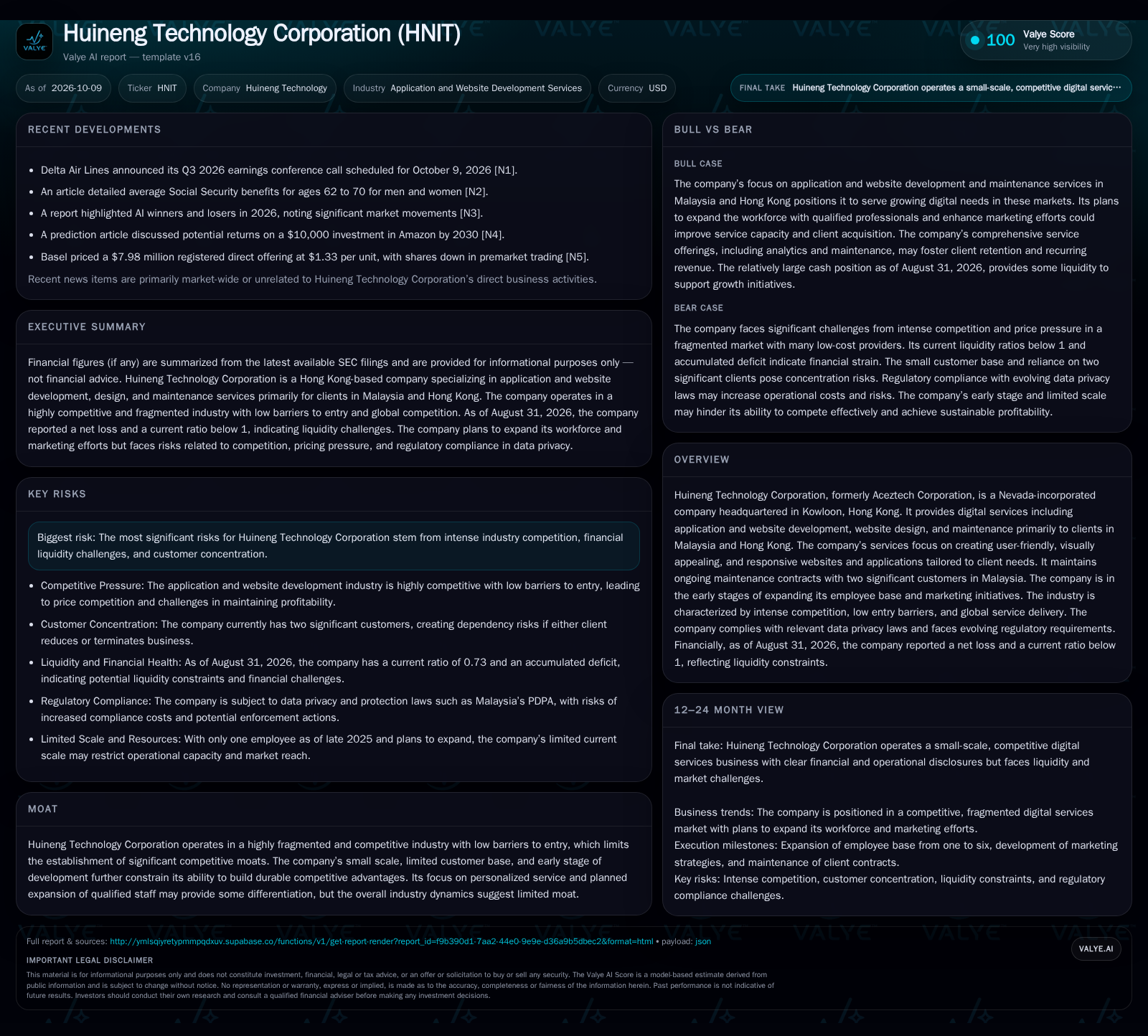
Huineng Technology Corp is a Hong Kong-based application and website development firm serving Malaysia and Hong Kong, with just one employee as of late 2025 and two major Malaysian clients. Despite $14.1M in cash, its current liabilities exceed current assets, and it posted a $9.8M net loss for the nine months ended August 2026. [S2]
Huineng Technology Corporation stands at a strategic crossroads: it provides application and website development services to a small customer set in Malaysia and Hong Kong, but its financials and operational infrastructure are not yet scaled for sustainable growth. With only one employee as of late 2025 and a reliance on two major clients, the company faces acute concentration and execution risk. Despite a seemingly robust cash balance, its current liabilities outstrip its current assets and it continues to operate at a loss. [S2]
Liquidity Strain and Customer Concentration Define the Immediate Outlook
As of August 31, 2026, Huineng Technology reported $14.1 million in cash and cash equivalents, $18.7 million in current assets, and $25.6 million in current liabilities, resulting in a current ratio of 0.73 and a cash ratio of 0.55. The company also posted a net loss of $9.8 million for the nine months ended August 2026, with a shareholders’ deficit of $5.6 million. Operationally, Huineng relies on two significant Malaysian customers with ongoing annual website maintenance agreements. The company had only one employee as of late 2025 but intends to expand to six by the end of 2026, focusing on management, marketing, and technical roles. These facts highlight a business with acute liquidity pressure, high client concentration, and a need to execute on expansion plans under financial strain. [S2]
Revenue Model, Cost Structure, and the Challenge of Scale
Huineng’s core revenue streams derive from custom application and website development services, recurring website maintenance contracts, and ancillary offerings such as design and analytics. In digital services, revenue is typically project-based (for new builds or major redesigns) or recurring (for maintenance, updates, and analytics). Margins for project work can be variable, while maintenance contracts offer greater predictability but are vulnerable to price competition.
The company’s tiny current headcount implies operational bottlenecks and limited capacity to take on new business. Fixed costs are likely minimal at this scale, but labor is the primary variable expense, and the planned team expansion would increase operating expenses before any guaranteed revenue uplift. The industry’s low capital requirements mean Huineng does not need heavy investment in physical assets, but working capital management is critical—especially with current liabilities exceeding current assets. Operating leverage may be limited in the near term until the company builds a broader, more stable client base and achieves sufficient scale to amortize fixed costs over more revenue.
Differentiation Difficulties in a Fragmented, Price-Sensitive Market
Huineng operates in an intensely competitive environment, facing freelancers, small agencies, and large digital consultancies—often competing remotely for the same clients. Barriers to entry are low: technical skills are widely available, and customers can easily switch providers. Price competition is common, and commoditization of basic website and app development services makes it difficult to sustain above-average margins or build strong customer lock-in.
The company’s only plausible differentiation is personalized service and potential responsiveness, given its small size and focus on ongoing maintenance. However, with limited staff and resources, even this edge is fragile. Larger agencies may offer broader capabilities, brand trust, or bundled digital marketing. The company’s current reliance on two Malaysian clients leaves it highly exposed to client churn and unable to claim any durable network effects or switching costs.
If Client Diversification and Execution Unlock Operating Leverage
The most favorable outcome for Huineng would flow from successfully expanding its workforce, executing on its marketing strategy, and converting new leads into recurring maintenance contracts. If the company can diversify its customer base beyond the current two significant clients—especially into higher-value or multi-year relationships—it may begin to dilute concentration risk and smooth revenue volatility.
Operating leverage could emerge if incremental revenue from new clients outpaces the growth in payroll and marketing costs. Evidence for this scenario would include: (1) the signing of additional significant clients, (2) an increase in the proportion of recurring maintenance revenue, (3) improvement in gross margin, and (4) a reduction in net losses or a move toward breakeven. Additionally, successful recruitment and retention of skilled employees would be a leading indicator that the company is building the operational capacity to scale.
Incremental Growth Amid Persistent Constraints
The most plausible outcome is slow, incremental progress. Huineng is likely to make some headway in expanding its team and marketing outreach, but customer acquisition may be challenging given the industry’s competitiveness and the company’s limited brand presence. Recurring revenue from the two existing Malaysian clients may provide a modest foundation, but concentration and pricing pressure will persist.
Under this scenario, Huineng might reduce—but not eliminate—its net loss as it brings on a handful of new clients and makes selective hires. However, absent a breakthrough in client diversification or a major upswing in demand, liquidity constraints may continue to limit flexibility. Evidence would include gradual increases in headcount, slow growth in revenue, and persistent—but narrowing—operating losses. A failure to materially improve the current ratio or reduce dependence on major clients would confirm this middling trajectory.
Escalating Financial Pressure and Potential Customer Loss
The most adverse scenario would see Huineng unable to win new business or retain its two significant customers, leading to a further decline in revenue and mounting losses. Inability to execute on hiring and marketing plans—due to either cash constraints or operational missteps—would exacerbate the strain. If one or both core clients terminate their maintenance agreements, the company would be left with little recurring revenue and fixed costs that cannot be covered.
In this scenario, liquidity could deteriorate further, potentially triggering the need for emergency financing, asset sales, or retrenchment. Concrete evidence for this downside would include a shrinking cash balance, rising payables, layoffs or hiring freezes, and the loss or non-renewal of existing client contracts. Regulatory compliance failures or data privacy incidents could also impose unforeseen costs or reputational damage, compounding financial stress.
What Will Determine Huineng’s Viability Over the Next Year?
The pace and success of the planned expansion from one to six employees, including whether hires are made in technical, marketing, and management roles as intended.
Acquisition of new significant customers, particularly those generating recurring maintenance or development revenue, and reduction in client concentration if disclosed.
Retention or renewal status of the two major Malaysian maintenance contracts, as the loss of either would materially impact revenue stability.
Changes in gross margin, operating loss, and cash burn rate—especially any evidence that new business offsets increased operating expenses.
Progress on marketing execution, including the launch and effectiveness of paid online advertising, search engine marketing, and client referrals, if disclosed.
Improvement in current and cash ratios, or evidence of new financing or capital infusions to address liquidity constraints.
Compliance with evolving Malaysian data privacy regulations and any costs or incidents related to regulatory enforcement or data breaches.
Disclaimer: This is research-only, informational analysis and not investment advice. It may include AI-generated interpretation and general industry context. Always verify important details using primary sources.

Comments