
Greenlit Ventures: Navigating Liquidity Pressures and Strategic Pivots in Consulting and Encryption
The company’s survival and potential upside hinge on capital-raising, customer traction, and its ability to carve out defensible value against dominant consulting and cybersecurity rivals.
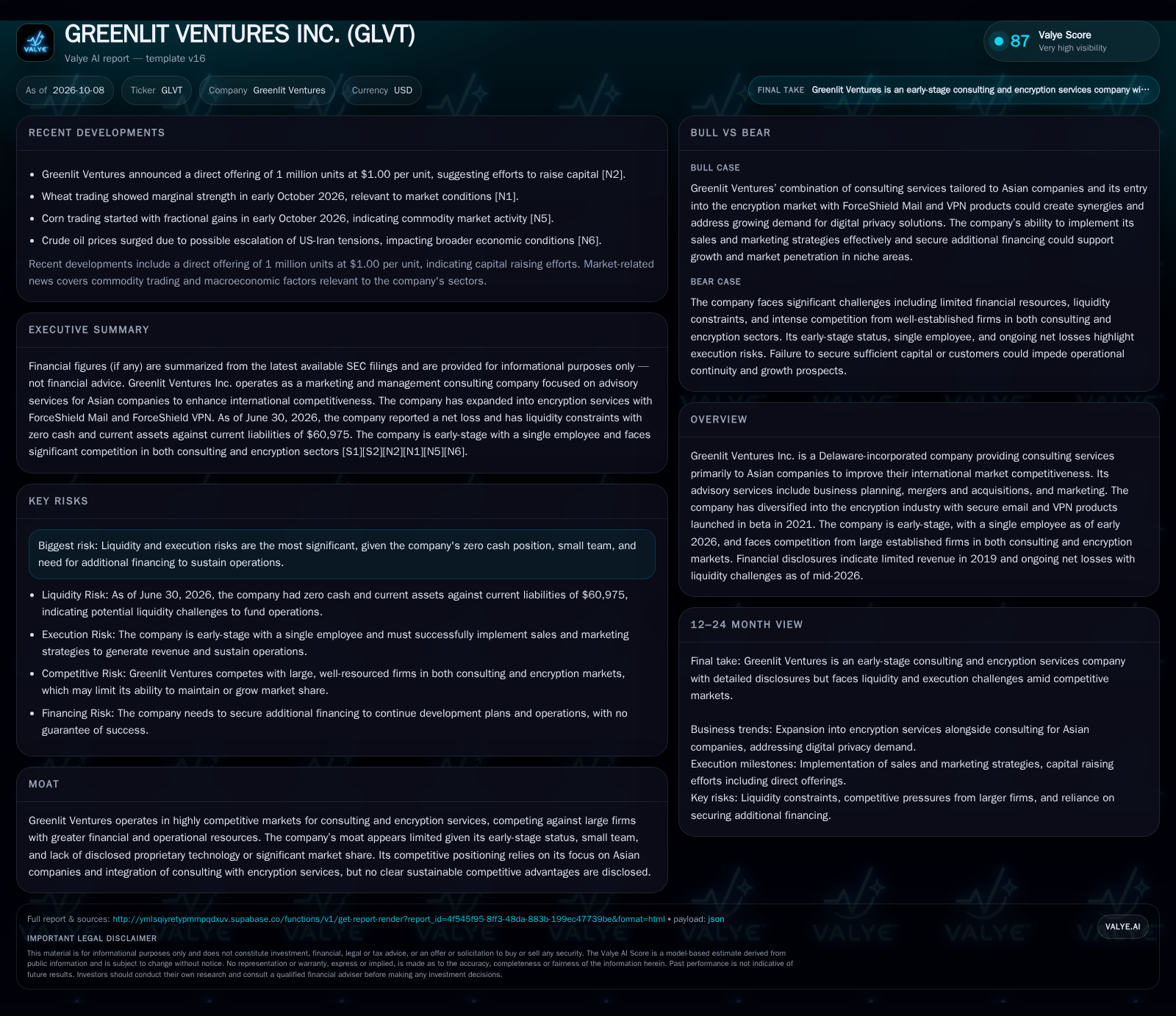
Greenlit Ventures is an early-stage consulting and encryption services company with a single employee, zero cash, and notable net losses as of mid-2026. Its future depends on raising capital, gaining customers, and differentiating itself in highly competitive markets. The company’s attempt to unify Asian-focused advisory with secure communications could unlock value if execution and funding hurdles are overcome. Liquidity and operational continuity remain immediate concerns. [S2]
Its dual focus—advising Asian firms and launching secure communication tools—offers a differentiated story, but the gap between vision and commercial reality is wide. [S2]
Severe Liquidity Crunch and Capital-Raising Efforts Define the Present
As of June 30, 2026, Greenlit Ventures reported zero cash and current assets, with current liabilities of $60,975, resulting in a current ratio and cash ratio of zero. This acute liquidity shortfall places the company at risk of operational disruption, making immediate capital-raising or revenue generation imperative for continuity. The company posted a net loss for the quarter ended June 30, 2026, and remains an early-stage entity with only one employee, underscoring the scale of execution risk. In response, Greenlit recently initiated a direct offering of 1 million units at $1.00 per unit, a move that highlights its urgent need for funding and may serve as a short-term lifeline if fully subscribed. [S2]
How Greenlit Could Monetize: Revenue Levers and Cost Structure Challenges
Greenlit Ventures’ business model blends traditional consulting (business planning, M&A, marketing) for Asian clients with emerging encryption services (secure email and VPN). Consulting revenue is typically project-based or retainer-driven, but in a fragmented market dominated by large incumbents, pricing power is limited for a small, single-employee firm. The encryption segment, still in beta, could—if commercialized—adopt a subscription or per-seat model, but customer acquisition costs are likely high given the need for trust, integration, and ongoing support.
With minimal fixed overhead (one employee), the company’s cost base is low, but scale-dependent operating leverage is unattainable until meaningful recurring revenue is established. Capital needs remain high, especially for product development, marketing, and regulatory compliance in cybersecurity. Without a credible customer base or proprietary IP, the company is unlikely to command premium pricing or benefit from network effects. Absent near-term revenue growth or successful fundraising, the risk is that fixed obligations (even if modest) outpace inflows, leading to ongoing losses and potential insolvency.
The dual revenue streams—consulting and encryption services—introduce complexity in resource allocation and strategic prioritization. Given limited capital and personnel, Greenlit must carefully balance investment between nurturing consulting relationships, which may provide short-term cash flow, and advancing encryption product development, which carries longer-term growth potential but higher upfront costs. This tension could lead to suboptimal outcomes if one area is underfunded. Furthermore, the company’s reliance on a single employee constrains scalability and operational resilience, increasing vulnerability to execution delays or talent gaps. In such a scenario, partnerships or outsourcing might be necessary to supplement capabilities, but these come with trade-offs in control and margins.
Competing Against Giants: Structural Disadvantages and Niche Opportunities
Greenlit Ventures occupies two highly competitive sectors. In consulting, it faces global banks and advisory firms with deep client networks and broad service portfolios, such as Morgan Stanley, Wells Fargo, and Bank of America. In encryption, the market is dominated by established cybersecurity vendors like Trend Micro, Cisco, Sophos, and Zoho Mail, all of whom offer mature, trusted solutions with significant R&D and support infrastructure.
Greenlit’s only plausible differentiator is its targeted focus on Asian companies and the potential integration of consulting with digital privacy solutions. However, the absence of disclosed proprietary technology, client roster, or demonstrable product-market fit limits defensibility. Switching frictions in consulting are low for small clients, and in encryption, trust and compliance drive stickiness—areas where a new entrant with limited resources is structurally disadvantaged. The company’s moat is thus tenuous; unless it can rapidly demonstrate unique value or secure anchor clients, competitive pressures will remain acute.
Unlocking Value Through Niche Synergies and Successful Capitalization
Greenlit’s best-case scenario would see it leverage its Asia-focused consulting relationships to cross-sell encryption services, creating a bundled value proposition for clients seeking both international expansion and digital privacy. If the direct offering is fully subscribed and followed by disciplined cash management, the company could fund targeted marketing, accelerate ForceShield product development, and close initial customer contracts.
Confirmation of this scenario would come from disclosed customer wins, recurring revenue from encryption subscriptions, and evidence of product-market fit (such as testimonials or renewal rates, if disclosed). Falsification would be signaled by continued cash burn without customer traction, inability to close the direct offering, or further dilution at unfavorable terms. If Greenlit can carve out a defensible niche—such as small-to-mid-sized Asian firms underserved by global consultancies and cybersecurity vendors—it could achieve modest, sustainable growth.
If Greenlit successfully leverages its niche focus, it could exploit under-served segments within Asian markets that are overlooked by global consultancies and cybersecurity vendors due to scale or strategic priorities. This could allow for premium pricing or longer-term contracts anchored by bundled offerings. Additionally, network effects might emerge if encryption solutions gain traction among consulting clients, facilitating cross-selling and reducing customer acquisition costs over time. However, this scenario depends on disciplined execution in product development, marketing, and customer support, as well as the ability to secure regulatory approvals and certifications that enhance credibility. The timing and scale of capital infusion will be pivotal in enabling these capabilities.
Struggling for Traction: Survival Hinges on Modest Fundraising and Incremental Progress
The most plausible path is one of ongoing struggle: Greenlit raises some capital via its direct offering, but the amount is only enough to fund basic operations and incremental product development. Sales cycles remain long, and customer acquisition is slow amid intense competition and limited brand recognition. Consulting engagements, if secured, are sporadic and low-margin, while encryption products remain in beta with limited user adoption.
Evidence supporting this scenario would include partial but not full subscription of the direct offering, continued net losses, and a lack of major customer announcements. If the company can keep operating, it may buy time for a future pivot, partnership, or asset sale, but the risk of operational disruption remains elevated unless revenue inflection or significant fundraising occurs.
Liquidity Exhaustion and the Risk of Operational Disruption
The adverse scenario is that Greenlit fails to raise new capital or generate meaningful revenue in the coming quarters. With zero cash, no current assets, and ongoing net losses, the company could default on obligations, be forced to suspend operations, or enter restructuring. The single-employee structure means even minor setbacks can have outsized impact, and lack of customer traction could erode any residual value in the consulting or encryption offerings.
Signs of this scenario would be the failure of the direct offering, increasing payables or legal notices (if disclosed), or management statements regarding going-concern uncertainty. In this case, Greenlit’s remaining options would be a distressed asset sale, wind-down, or seeking acquisition by a better-capitalized entity interested in its nascent products or Asia-focused relationships.
Milestones That Will Determine Greenlit’s Survival and Strategic Trajectory
Subscription outcome of the 1 million unit direct offering and any subsequent capital-raising events.
Quarterly revenue figures and customer count for both consulting and encryption products, if disclosed.
Updates on ForceShield Mail and VPN commercialization: user adoption, retention rates, or partnership announcements.
Any disclosed client wins, particularly among Asian firms, and the duration/value of such engagements.
Cash burn rate and updated liquidity disclosures in future filings.
Management commentary or filings referencing going-concern risk, operational continuity, or restructuring.
Evidence of differentiation—such as integration of consulting and encryption—or proprietary technology, if developed.
Changes in competitive landscape (e.g., new entrants, pricing pressure) affecting Greenlit’s addressable market.
Disclaimer: This is research-only, informational analysis and not investment advice. It may include AI-generated interpretation and general industry context. Always verify important details using primary sources.

Comments