
SolarMax Technology: Tight Liquidity, Bold Solar-Crypto Bets, and the Risk-Reward Equation
SolarMax Technology, Inc. sits at a precarious crossroads: recent moves into cryptocurrency-linked solar projects and pockets of revenue growth are overshadowed by persistent losses and a working capital shortfall, leaving the company’s future hanging on execution and fresh capital.
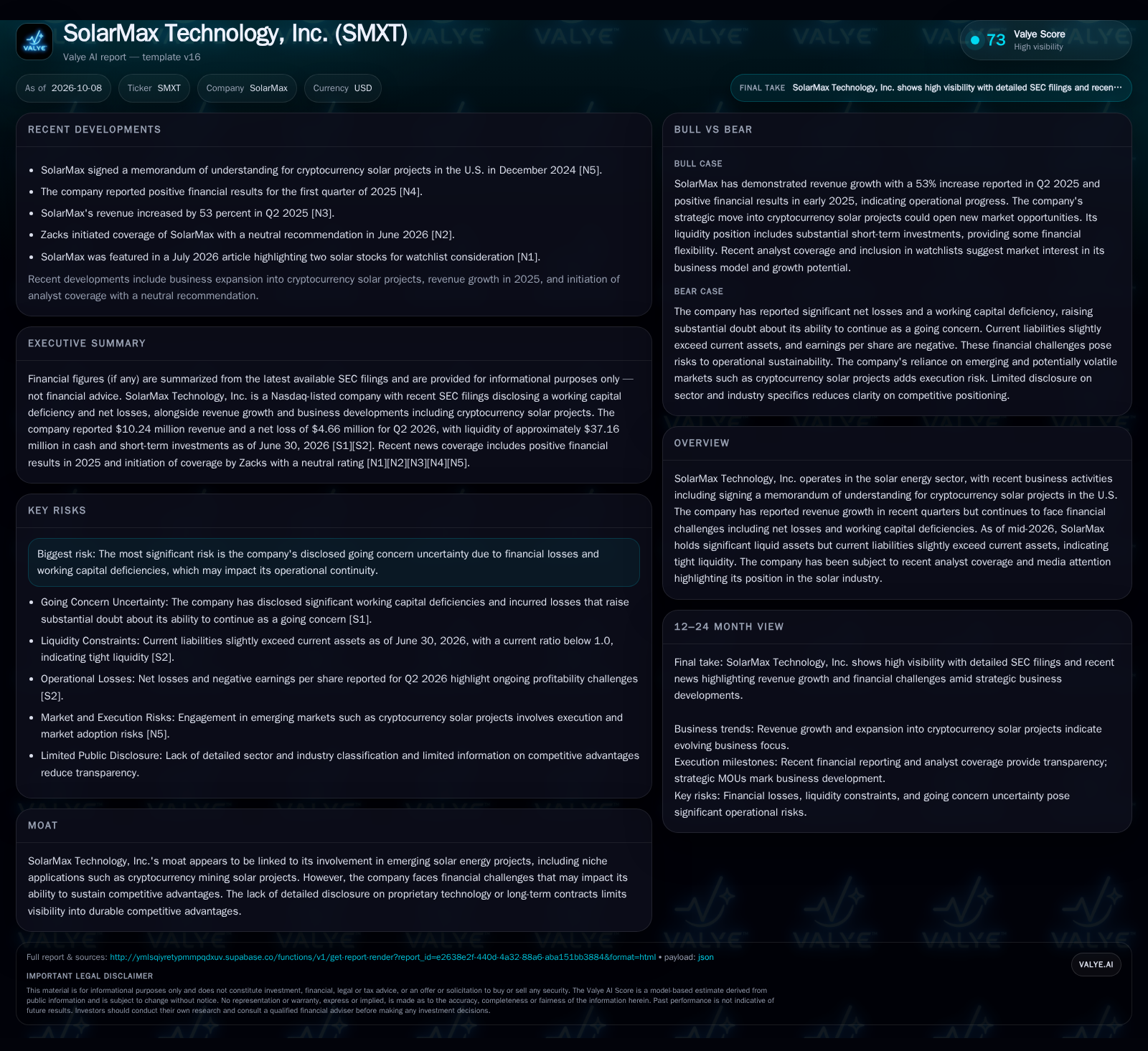
SolarMax Technology, Inc. faces substantial doubt about its ability to continue as a going concern, with current liabilities exceeding current assets and continued net losses. Near-term prospects hinge on the ability to monetize new business lines and secure financial stability amid structural industry competition and limited margin for error. [S1] [S2] [N5]
SolarMax Technology, Inc. is at a strategic inflection point, balancing new business ventures in the fast-evolving intersection of solar energy and cryptocurrency with the harsh realities of tight liquidity and persistent operating losses. While the company’s recent memorandum of understanding for U.S.-based cryptocurrency solar projects signals ambition to tap emerging demand, SolarMax’s financial disclosures underscore a critical vulnerability: current liabilities outstrip current assets, raising explicit going concern doubts. As revenue growth alone has not yet translated to sustainable profit or financial stability, SolarMax’s path forward depends on converting innovation into cash flow and shoring up its capital position before financial constraints become existential.
Liquidity Squeeze and Strategic Pivots Define the Present
As of June 30, 2026, SolarMax reported $10.24 million in quarterly revenue but a net loss of $4.66 million, with cash and short-term investments totaling $37.16 million. Critically, current liabilities ($49.51 million) slightly exceeded current assets ($48.31 million), resulting in a current ratio of just 0.98 and a cash ratio of 0.75. The company’s own disclosures explicitly raise substantial doubt about its ability to continue as a going concern, citing a significant working capital deficiency and recurring net losses [S1] [S2].
Amid these financial strains, SolarMax has sought to reposition itself by signing a memorandum of understanding in December 2024 for the development of cryptocurrency solar projects in the U.S. [N5]. This move aims to leverage the growing demand for renewable-powered crypto mining, but the commercial details and near-term revenue impact remain undisclosed.
Revenue Sources, Cost Pressures, and the Levers of Profitability
SolarMax’s core economics are shaped by the capital-intensive nature of solar project development, which typically involves significant upfront investment, long payback periods, and exposure to both commodity and regulatory cycles. The company’s $10.24 million in quarterly revenue demonstrates some commercial traction, but persistent net losses highlight a cost structure that has yet to achieve operating leverage or scale economies [S2].
In the context of cryptocurrency-linked solar projects, potential profitability hinges on capturing value from either the sale of turnkey solar infrastructure to mining operators, power purchase agreements, or direct participation in mining operations. Each model faces distinct margin and working capital demands: direct asset sales may offer near-term cash inflows but low recurring revenue; power purchase agreements could provide steadier cash flow but require larger capital outlays and counterparty risk; mining participation introduces volatility and speculative exposure.
Given the current liquidity squeeze, SolarMax has little margin for error. The company’s ability to fund project execution, absorb cost overruns, or weather delays is constrained by a working capital deficit. Unless new external financing is secured or project monetization accelerates, the company may face forced scaling back or asset sales.
SolarMax’s Niche Solar-Crypto Play: Moat or Mirage?
SolarMax’s strategic direction toward cryptocurrency-linked solar projects is a differentiator within the broader solar sector, where most peers focus on utility-scale, commercial, residential, or industrial deployments. If executed successfully, this niche could enable SolarMax to capture early-mover advantages in a market with high energy intensity and growing pressure for renewable solutions.
However, barriers to entry in both the solar and crypto-mining segments are relatively low in terms of technology, and larger, better-capitalized competitors could quickly replicate offerings or outbid SolarMax for key contracts. The company’s moat appears modest: no evidence of proprietary technology, exclusive partnerships, or locked-in long-term contracts is disclosed. Instead, SolarMax’s competitive position relies on speed, execution, and the ability to secure first-mover business in emerging verticals. Without distinctive intellectual property or established customer lock-in, competitive pressure is likely to intensify as the niche matures or if established energy and infrastructure firms target similar opportunities.
A Breakthrough in Project Monetization Could Reset the Trajectory
The most favorable scenario for SolarMax is a rapid conversion of its cryptocurrency solar project pipeline into signed, revenue-generating contracts—preferably with upfront payments or milestone-based funding that alleviates working capital strain. If the company can demonstrate that its MOU results in executable deals, and if early projects validate the economics of renewable-powered crypto mining, SolarMax could unlock a virtuous cycle: improved liquidity, investor confidence, and access to less expensive capital.
Evidence that would confirm this scenario includes: (1) disclosures of executed contracts stemming from the MOU with credible counterparties, (2) material increases in deferred revenue or project backlog, (3) sequential improvement in gross margins and cash from operations, and (4) successful project completions with positive case studies or reference customers. A clear pathway to recurring project wins or scalable revenue models would further support a durable turnaround.
Incremental Progress, Persistent Constraints: The Most Likely Course
In the most plausible scenario, SolarMax achieves modest execution on new project initiatives, generating some incremental revenue but not enough to fundamentally shift its financial profile in the next 12-18 months. The company may announce additional partnerships or pilot projects within the crypto-solar niche, but these are likely to come with long sales cycles, lumpy revenue recognition, and continued quarterly losses.
The company’s liquidity position remains tight, with working capital constraints forcing careful prioritization of projects and operating spend. External financing—through equity, convertible debt, or project-level funding—may be required to sustain operations. Investor sentiment and analyst coverage remain neutral, reflecting the balance of potential upside with unresolved going concern risk [N2].
Confirmation of this scenario would be seen in continued, but uneven, revenue growth, persistent net losses, and repeated references to liquidity management in SEC filings. Falsification would require a decisive inflection in either project wins or new capital that materially improves the balance sheet.
Liquidity Exhaustion or Project Delays Could Trigger a Crisis
If SolarMax is unable to secure new project wins, accelerate monetization, or attract external funding, its working capital deficit could quickly become unmanageable. The company’s current ratio below 1.0 and explicit going concern warning suggest that even minor project setbacks, cost overruns, or delayed customer payments could precipitate payment defaults or forced asset sales [S1] [S2].
A negative scenario could be triggered by any combination of: (1) customer or partner delays in finalizing contracts, (2) higher-than-expected project costs, (3) inability to raise additional capital on acceptable terms, or (4) broader crypto or solar sector downturns affecting demand for new projects. In this environment, SolarMax could face delisting risk, creditor actions, or the need to pursue distressed restructuring.
Evidence confirming this downside would include a further deterioration in current ratio, reduced cash balances without offsetting financing, disclosures of missed payments or covenant breaches, and negative going concern updates in regulatory filings.
Milestones That Will Determine If SolarMax Can Defy Gravity
Execution and public disclosure of binding contracts (not just MOUs) for cryptocurrency solar projects; contract size, terms, and counterparties would help assess commercial traction.
Quarterly trends in gross margin and operating cash flow; improvement would indicate progress toward sustainable economics.
Updates on capital raising activities—debt, equity, or project-level financing—including terms, dilution, and runway impact.
Announcements of project completions, reference customers, or case studies validating SolarMax’s niche offering.
Evidence of proprietary technology, long-term contracts, or customer lock-in that could support a durable competitive advantage, if disclosed.
Sector-level developments in U.S. crypto mining demand for renewable power, including regulatory changes or competitor announcements.
Any disclosure of asset sales, restructuring, or cost-cutting measures signaling acute financial stress.
Disclaimer: This is research-only, informational analysis and not investment advice. It may include AI-generated interpretation and general industry context. Always verify important details using primary sources.

Comments