
Cintas: Margin Expansion and Service Breadth Anchor Growth as Integration and Cost Headwinds Loom
Cintas delivered strong top-line growth and margin gains in fiscal 2026, but future outperformance will depend on successfully navigating merger integration risks, sustained operational efficiency, and competition in the business services landscape.
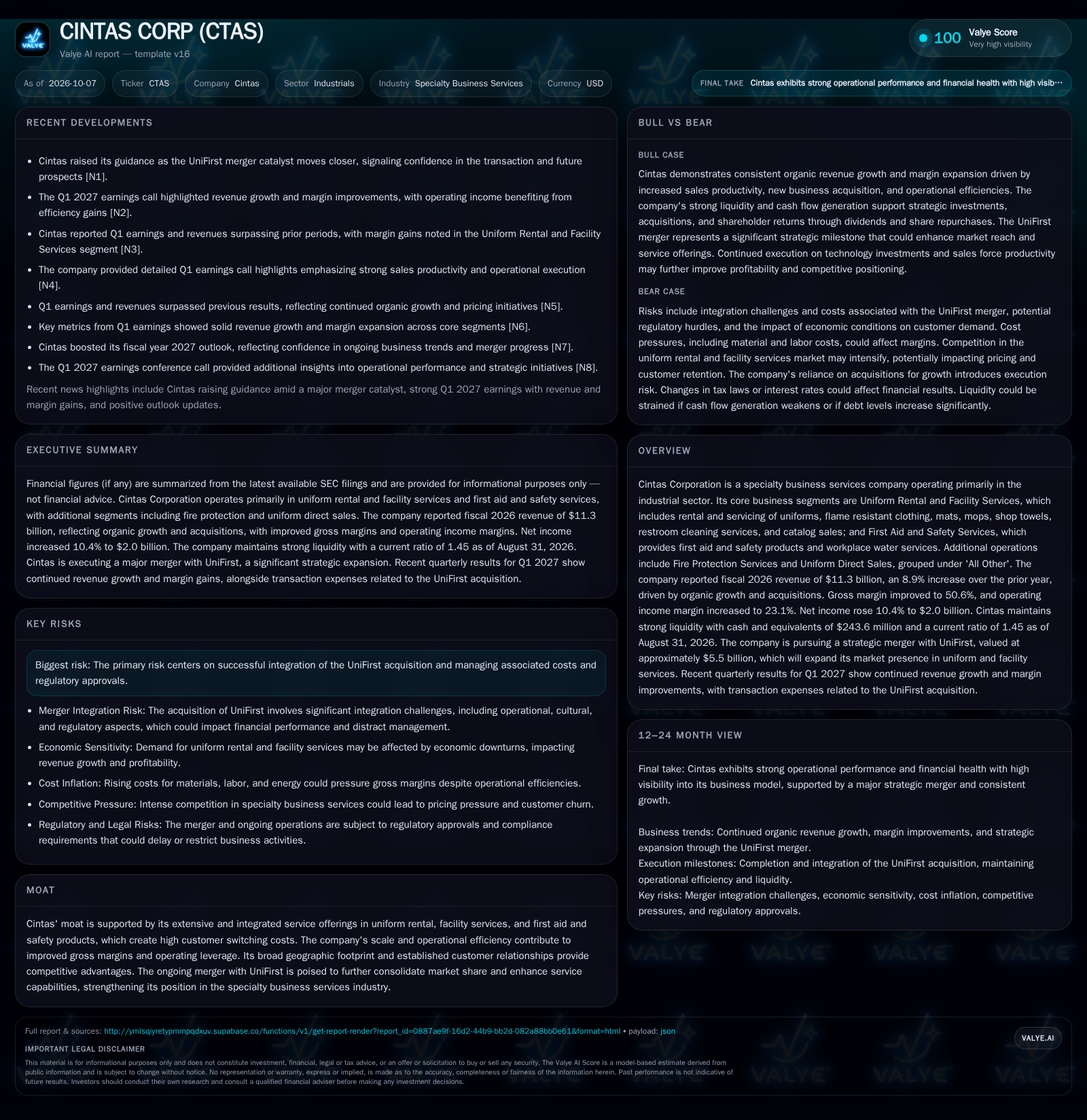
Cintas reported fiscal 2026 revenue of $11.3 billion, up 8.9%, with organic growth and margin expansion across core segments. Net income rose 10.4% to $2.0 billion, and gross margin improved to 50.6%. Looking forward, integration of strategic transactions, cost pressures, and competitive intensity remain key watchpoints for the thesis.[S1] [S2]
Cintas Corporation has continued its multi-year run of revenue and profit growth, reporting robust fiscal 2026 results led by its Uniform Rental and Facility Services segment, while also expanding its First Aid and Safety Services. Margin expansion and disciplined capital allocation—including dividends and share repurchases—underscore Cintas’ operational strength. However, with merger integration expenses already appearing in recent quarters, and ongoing investments in technology and sales resources, the company now faces a more complex operating environment where cost inflation and competitive intensity could challenge its trajectory. The next phase will test whether Cintas can translate scale and efficiency gains into durable competitive advantage amid evolving industry dynamics.
Recent Performance: Margin Gains and Strategic Investments Define Fiscal 2026
Cintas closed fiscal 2026 with $11.3 billion in revenue, marking an 8.9% year-over-year increase driven by both organic growth (8.3%) and contributions from acquisitions. The Uniform Rental and Facility Services segment delivered $8.6 billion in revenue with 7.6% organic growth, while First Aid and Safety Services and other segments grew 11.8% to $2.6 billion. Gross margin improved to 50.6% (up from 50.0% in fiscal 2025), and operating income margin ticked up to 23.1%. Net income rose to $2.0 billion, a 10.4% increase, with diluted EPS up 11.6%. Recent quarters saw increased investment in technology and sales resources, as well as $14.4 million in transaction expenses related to the UniFirst deal in Q1 2027. The company reported a current ratio of 1.45 for the period. [S1] [S2]
How Cintas’ Service Model Drives Recurring Revenue—and Where Leverage Emerges
Cintas’ business model is anchored in the recurring nature of uniform rental, facility services, and first aid solutions. Customers typically enter multi-year service agreements for uniforms, cleaning supplies, and safety products, leading to predictable revenue streams and high route density, which supports operational leverage. Fixed costs—such as fleet, plant infrastructure, and route servicing—are leveraged over a growing customer base, while variable costs (materials, labor, fuel) are managed through process efficiencies and technology investments.
Recent margin improvements suggest that operating leverage is being realized, likely from route optimization, automation, and favorable sales mix (with First Aid and Safety outpacing core uniform rental). Gross margin gains, even as S&A expenses rose with technology and sales investments, point to productivity improvements outpacing cost inflation for now. However, the model is sensitive to labor and input costs, and margins could compress if those pressures outpace efficiency gains.
The company reported cash and liquidity metrics for the period; these figures do not by themselves establish operating runway, investment capacity, financial flexibility, or financing capacity. The company’s access to a $2.0 billion revolver provides flexibility, but sustained investments—integration, technology, and sales—will test free cash flow durability if organic or acquired growth stalls.
Service Breadth, Route Density, and Switching Costs: Defending the Moat
Cintas’ competitive position is built on its scale, service breadth, and integrated offering across uniforms, facility services, and workplace safety. Route density allows for cost-effective servicing of a large, geographically diverse customer base, driving down per-unit delivery costs and enabling local responsiveness. The company’s extensive product and service suite increases customer stickiness—switching providers often requires significant operational disruption and retraining, especially for multi-service contracts.
However, the uniform rental and facility services sector remains fragmented, with regional players and national competitors vying for share. Price-based competition is common, especially in slower economic periods. Cintas’ technology investments and operational efficiency may provide a near-term edge, but these advantages are not insurmountable. Substitution risk exists from in-house uniform management or alternative facility service models, though these typically lack Cintas’ scale-driven cost structure.
The company’s ability to cross-sell ancillary services (e.g., first aid, fire protection) could further entrench customer relationships, but success depends on continued execution and service quality. M&A activity, such as the UniFirst transaction, could bolster market share but also introduces integration risk if operational or cultural alignment falters.
What If Cintas Converts Scale into a Self-Reinforcing Growth Loop?
If Cintas successfully integrates recent acquisitions, leverages technology to further optimize routes and service delivery, and continues cross-selling its expanded service suite, the company could drive above-industry growth and margin expansion. Sustained improvements in operating leverage—through automation, AI-driven logistics, and further route density—could mitigate inflationary pressures and unlock additional cash flow.
Upside confirmation would come from continued organic revenue growth above 7%, further gross and operating margin expansion, and evidence of rising customer retention or increased contract penetration rates (if disclosed). Successful integration of the UniFirst deal, with cost and revenue synergies realized ahead of plan, would also validate this scenario.
Additionally, if Cintas’ technology investments yield measurable productivity gains and customer satisfaction improves, the company could widen its competitive moat, further reducing churn and enhancing pricing power.
Sustained Growth with Margin Stability—But Rising Integration and Cost Management Demands
The most plausible trajectory is for Cintas to sustain mid-single-digit organic growth, with periodic boosts from acquisitions and continued margin discipline. Operating leverage from scale and technology investments should help offset moderate input cost inflation, while S&A expenses rise modestly as the company invests in sales and digital capabilities.
Margin expansion may slow as the easiest efficiency gains are realized, and further improvements depend on successful integration of acquired businesses and ongoing process enhancements.
Confirmation of this scenario would be steady revenue and EPS growth in line with recent trends, stable or modestly rising margins, and evidence that capital allocation remains balanced between growth investments and shareholder returns.
Integration Snags, Cost Surges, or Competitive Churn: Pathways to Margin Compression
The primary downside risk is that Cintas faces integration challenges with recent acquisitions, leading to elevated costs, distraction, or customer attrition. If labor or material costs surge and cannot be offset by efficiency gains, gross and operating margins could contract. Intensifying competition—especially from regional players willing to undercut pricing—could force Cintas to defend share at the expense of profitability.
A macroeconomic slowdown could reduce demand for uniforms and facility services in key end markets, leading to slower revenue growth or even contraction. If customer retention weakens or contract renewal rates fall (if disclosed), the company could see higher churn and lower route density, eroding operational leverage.
Evidence of this scenario would include declining or flat organic growth, margin compression, rising S&A as a percentage of sales without corresponding revenue gains, or unexpected increases in integration or restructuring charges.
Milestones That Will Determine Whether Cintas’ Growth Engine Stays on Track
Organic revenue growth rate in core segments—especially Uniform Rental and Facility Services—remains a critical indicator of demand and pricing resilience.
Gross and operating margin trends: Further expansion would confirm successful efficiency initiatives; contraction could signal cost or competitive pressures.
Integration progress and expense related to the UniFirst transaction—updates on synergies, costs, and operational alignment will be key.
S&A expenses as a percentage of revenue: A useful metric to assess whether technology and sales investments are scaling efficiently.
Customer retention or contract renewal rates (if disclosed): Higher retention would support the recurring revenue thesis, while slippage would be a warning sign.
Free cash flow generation and capital allocation between dividends, buybacks, and reinvestment—sustained flexibility will support the company’s strategic options.
Changes in competitive pricing dynamics, especially in regional markets, could indicate intensifying rivalry or margin pressure.
Macroeconomic indicators in key end markets, as demand for business services often tracks broader employment and business formation trends.
Disclaimer: This is research-only, informational analysis and not investment advice. It may include AI-generated interpretation and general industry context. Always verify important details using primary sources.

Comments