
Levi Strauss & Co.: Advancing Direct-to-Consumer Channels and Lifestyle Brand Expansion
Levi Strauss & Co. is leveraging its iconic brand and reported liquidity position to accelerate a direct-to-consumer strategy and broaden its lifestyle offerings. While recent earnings confirm operational stability, the company faces execution risk as it pushes for international growth and deeper consumer engagement in a highly competitive apparel landscape.
Levi Strauss & Co. enters late 2026 with a reported balance sheet position, positive earnings, and a sharpened focus on direct-to-consumer and lifestyle category expansion. The company’s global brand and multi-channel distribution provide a foundation for growth, but execution in new product categories and international markets remains a critical challenge. Competitive pressures, consumer demand volatility, and supply chain uncertainties are key variables for the next phase.
Levi Strauss & Co. is at a pivotal moment, balancing its deep brand equity and reported liquidity position with the need to execute on ambitious growth strategies. The company’s push into direct-to-consumer channels and lifestyle categories, alongside renewed international expansion, shapes the next chapter for this apparel icon. While recent financials underscore resilience and operational momentum, the real test lies in sustaining relevance and margin strength amid industry disruption, evolving consumer tastes, and relentless competitive pressure.
Recent Financial Results Highlight Strategic Momentum
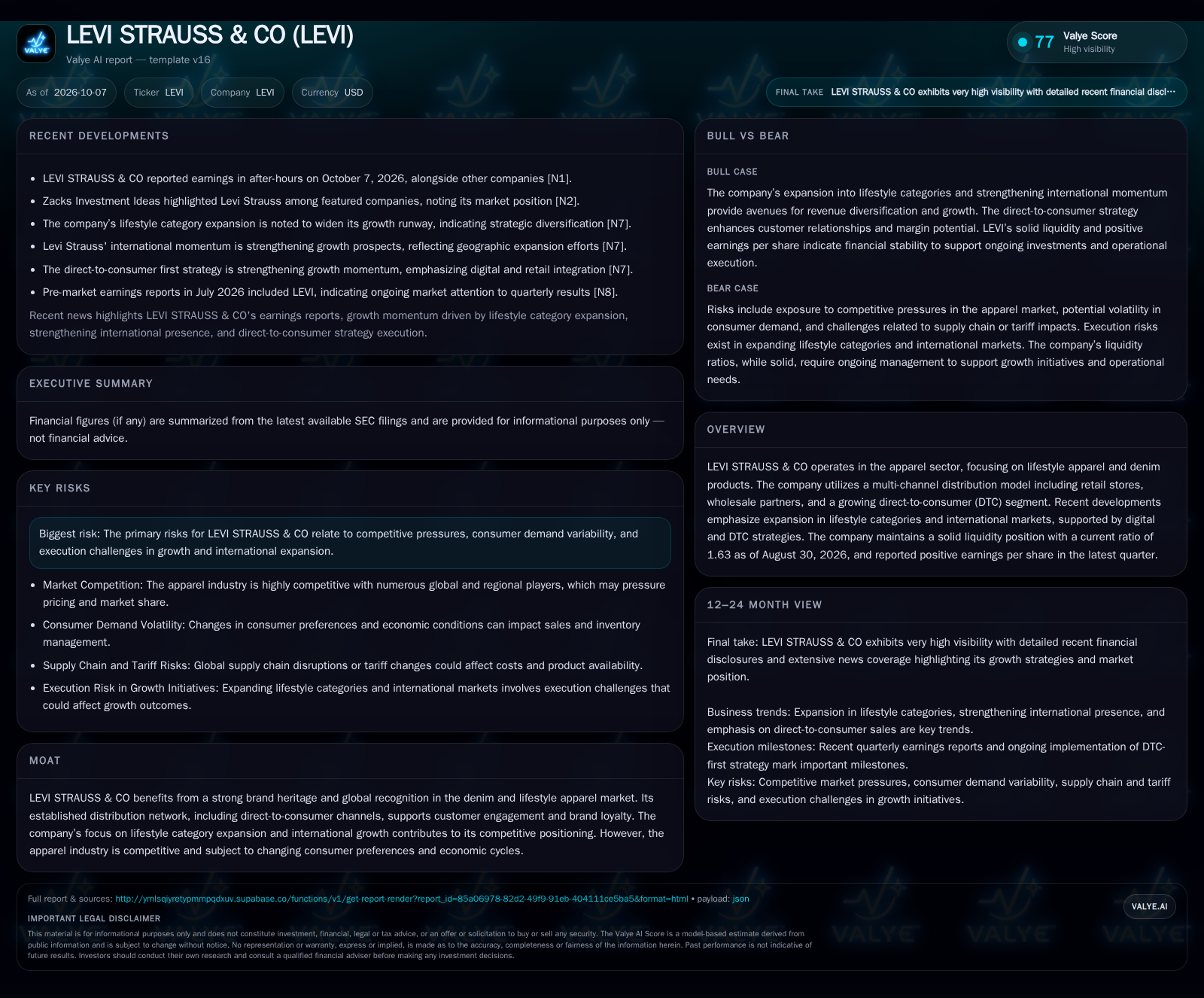
As of August 30, 2026, Levi Strauss & Co. reported cash and cash equivalents of $641.4 million and short-term investments of $137.9 million, resulting in a current ratio of 1.63 and a cash ratio of 0.39 [S2]. The company also reported positive basic and diluted earnings per share for Q3 2026, at $0.44 and $0.43, respectively [S2]. This profitability suggests that Levi’s operational base remains strong even as it invests in new growth avenues. Recent news coverage highlights a strategic emphasis on expanding lifestyle categories, strengthening international momentum, and deepening direct-to-consumer (DTC) engagement [N1] [N2] [N7]. These developments confirm that Levi is actively repositioning itself as a multi-category, globally scaled lifestyle brand.
Levi’s Multi-Channel Approach and Brand Strength as Value Drivers
Levi Strauss & Co. generates revenue through a blend of wholesale, owned retail, and rapidly expanding direct-to-consumer channels. DTC—encompassing both brick-and-mortar stores and digital commerce—typically delivers higher gross margins than wholesale, as it eliminates the intermediary and allows for greater price control and richer customer data. The company’s ability to shift a larger share of sales to DTC could enhance operating leverage, especially as digital infrastructure scales with fixed cost absorption. However, this shift also brings increased marketing, technology, and logistics expenses, so the ultimate margin impact depends on balancing volume growth with cost discipline.
Lifestyle category expansion—moving beyond core denim into adjacent apparel, footwear, and accessories—offers additional pricing and mix benefits if Levi can leverage its brand to command premium positioning. This diversification could reduce reliance on traditional denim cycles and insulate revenues from category-specific downturns. Capital requirements for this expansion are moderate compared to heavy manufacturing businesses, but inventory management, product development, and omnichannel investments still require careful cash allocation.
Heritage Brand Navigates a Dynamic and Competitive Landscape
Levi’s enduring brand recognition and historical association with denim create a deep reservoir of consumer trust and loyalty, which can serve as a moat against undifferentiated competitors. Its global distribution network and increasingly sophisticated DTC capabilities further reinforce customer engagement. However, the apparel sector is marked by low switching costs, high fashion volatility, and intense pricing pressure from both established global brands and nimble digital-native entrants.
The company’s push into lifestyle categories pits it against a broader set of competitors, including sportswear giants, fast fashion, and specialty lifestyle brands. While Levi’s scale and heritage offer differentiation, these advantages are not insurmountable—especially if consumer preferences shift rapidly or if competitors out-innovate in product or digital experience. International markets add another layer of complexity, with local competitors often possessing better cultural fit and supply chain agility.
Successful Direct-to-Consumer and Lifestyle Initiatives Could Boost Margins and Global Reach
The most favorable scenario for Levi Strauss & Co. involves successfully scaling its direct-to-consumer and digital platforms, resulting in a greater share of high-margin sales and deeper consumer insight. If the company can pair this with effective execution in lifestyle categories—delivering compelling non-denim products that resonate across demographics—Levi could see both top-line acceleration and gross margin improvement. International expansion, if managed with local adaptation and supply chain resilience, could further diversify earnings and reduce dependence on mature North American markets.
Confirmation of this scenario would come from sustained DTC revenue growth outpacing wholesale, tangible increases in lifestyle category share, and stable or rising segment margins. Additional evidence would be market share gains in key international regions and inventory turns remaining healthy despite broader assortment. A falsification would involve DTC growth stalling, lifestyle launches underperforming, or margin compression from excessive promotional activity or operational missteps.
Growth Prospects Tempered by Competitive and Operational Challenges
The most plausible outcome is that Levi continues to grow, but at a measured pace, as DTC and lifestyle initiatives gradually gain traction. The company leverages its brand to defend core denim share while incrementally expanding into adjacent categories. International growth contributes, but is tempered by local competition and macro volatility. Operating margins improve modestly as DTC mix rises, but are offset by higher investment and customer acquisition costs.
This scenario is confirmed by positive but moderate DTC and international growth rates, stable core category performance, and limited margin expansion. Evidence against this path would include stagnation in non-denim categories, persistent inventory build-ups, or signs of consumer disengagement despite digital and product investments.
Execution Setbacks May Lead to Margin Erosion and Brand Challenges
If Levi fails to execute on lifestyle category launches or its DTC transformation, the company could face margin compression and brand dilution. Slower adoption of new products, ineffective marketing, or operational challenges in omnichannel logistics could lead to excess inventory, higher markdowns, and eroded profitability. International expansion may stall if local adaptation is insufficient or if macro headwinds intensify.
Confirmation of this adverse scenario would include rising inventory days, declining DTC margins, or negative same-store sales in key markets. Additional warning signs would be increased reliance on discounting, loss of market share to fast fashion or digital-native brands, and weakening of the brand’s premium positioning.
Indicators of Levi’s Strategic Progress and Market Response
Direct-to-consumer revenue growth as a share of total sales—if disclosed—will be a primary indicator of strategic progress.
Gross margin trends, especially in the DTC and lifestyle segments, would help test whether the company is capturing value or sacrificing profitability for growth.
International segment revenue and market share gains, particularly in emerging markets, will signal the effectiveness of global expansion.
Inventory turnover and markdown rates will reveal whether product innovation and demand forecasting are keeping pace with expansion.
Brand health metrics—such as Net Promoter Score or unaided brand awareness—would provide insight into the durability of consumer loyalty as the company diversifies.
Customer acquisition costs and digital engagement metrics, if disclosed, will indicate the efficiency and sustainability of DTC investments.
Supply chain lead times and flexibility, especially under global or regional disruption scenarios, will test operational resilience.
Product category mix evolution—tracking the share of revenue from non-denim and lifestyle segments—will show if diversification is gaining traction.
Disclaimer: This is research-only, informational analysis and not investment advice. It may include AI-generated interpretation and general industry context. Always verify important details using primary sources.

Comments