
Neogen Sharpens Focus on Food and Animal Safety with Portfolio Streamlining and Margin Improvement
Neogen’s latest results show revenue and margin improvement as the company divests its Genomics business and sharpens focus on core operations. The path forward hinges on execution of commercial, innovation, and efficiency initiatives against a backdrop of cost inflation and global uncertainty.
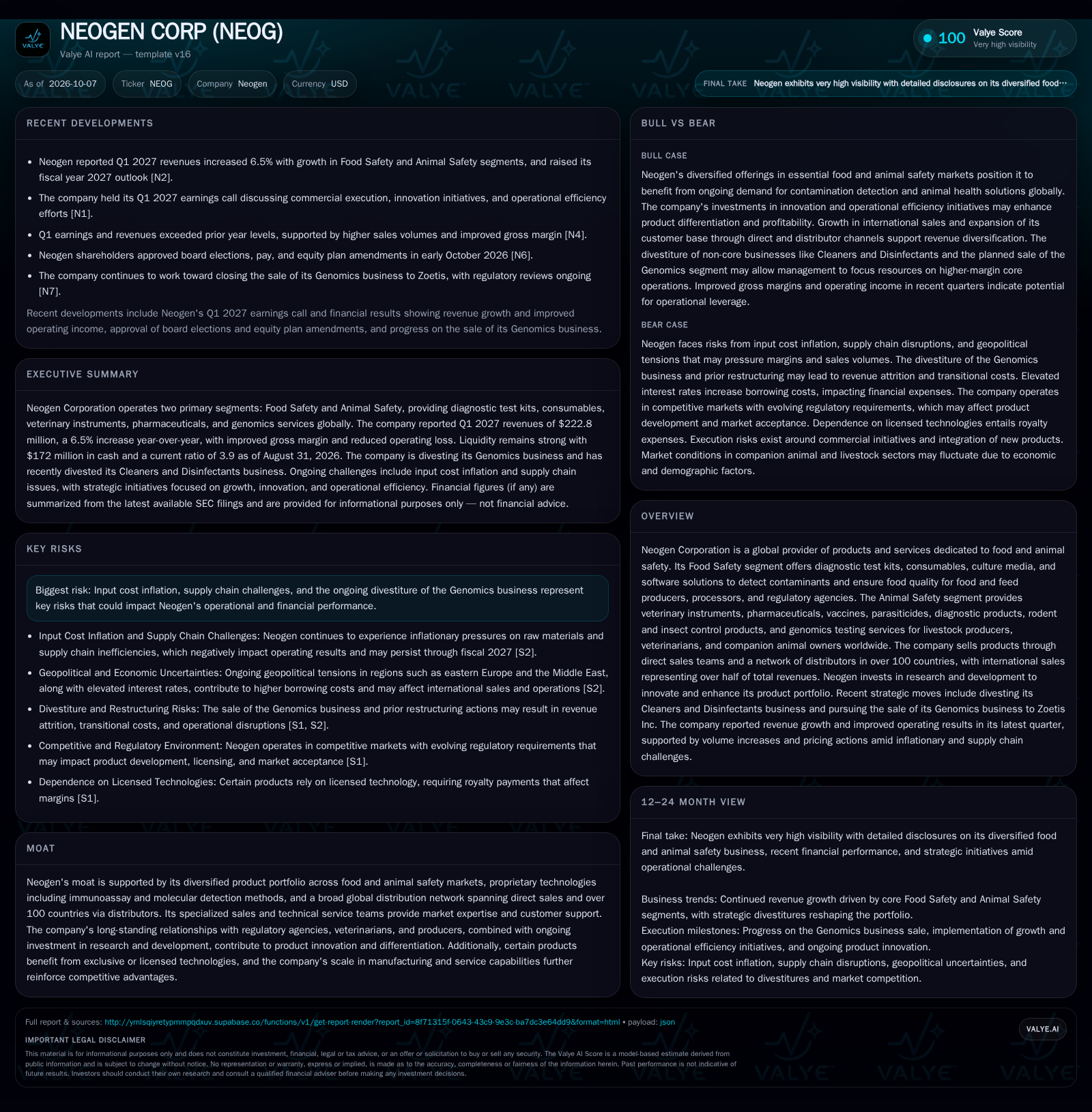
Neogen is exiting non-core businesses, including the Genomics segment (pending sale to Zoetis), and has reported 6.5% revenue growth and gross margin gains in Q1 2027. Operating losses have narrowed, supported by higher segment income, while international sales now exceed half of total revenue. The company faces headwinds from input costs and supply chain pressures, but is prioritizing commercial execution, innovation, and operational efficiency to drive future growth and margin expansion. As of August 31, 2026, Neogen reported $172 million in cash and a current ratio of 3.9, with no near-term debt maturities.
Neogen Corporation is at a pivotal moment, executing a strategic shift away from non-core operations to focus on its foundational Food Safety and Animal Safety segments. Recent financials show encouraging signs: revenue and gross margin have both improved, and operating losses have narrowed despite ongoing cost and supply chain pressures. The pending sale of the Genomics business to Zoetis, following the divestiture of Cleaners and Disinfectants, will further concentrate resources on core competencies. The challenge now is to translate these operational improvements and portfolio moves into sustained profit growth while navigating inflation, regulatory shifts, and global uncertainties.
Strategic Portfolio Realignment and Margin Recovery Define the Present
Neogen’s most recent quarter (Q1 2027) marked a clear improvement in both top-line and margin performance: revenues grew 6.5% to $222.8 million, and gross margin expanded to 47.4% from 45.4% a year earlier. Operating loss narrowed sharply to $1.8 million from $16.1 million, mainly due to higher segment operating income, though corporate expenses still weighed on the bottom line [S2].
The company is actively reshaping its business, having divested its Cleaners and Disinfectants unit in July 2025 and now in the process of selling its Genomics business to Zoetis for $160 million, with regulatory reviews ongoing [S1]. These moves reflect a deliberate focus on the core Food Safety and Animal Safety segments, where recent growth has been strongest.
International markets are now more important than ever, with global sales representing 51.2% of total revenues in fiscal 2026 [S1]. This increases both Neogen’s opportunity set and its exposure to geopolitical and currency risks.
How Neogen’s Core Segments Generate Value—and Where Leverage May Emerge
Neogen’s business model is built on manufacturing and distributing specialized consumables, diagnostic kits, veterinary instruments, and related products for food and animal safety. The economics of these segments typically feature a mix of recurring consumable sales (with steady replenishment cycles) and less frequent capital or instrumentation purchases. Consumables and proprietary test kits tend to command higher gross margins due to their repeat-purchase nature and embedded switching costs.
The company’s gross margin rebound in Q1 2027 was driven by a combination of higher sales volumes, price increases, and favorable currency impacts [S2]. This suggests some pricing power, though it is not clear how much of this is sustainable versus a catch-up to cost inflation. Operating leverage is plausible if revenue growth continues outpacing fixed cost increases, especially as legacy businesses with lower margins are divested.
R&D remains a modest but consistent commitment, at 2% to 5% of revenues, supporting incremental product innovation rather than transformative bets [S1]. The capital intensity of the core business is moderate, and recent loan prepayments have deferred required principal repayments until 2029, reducing near-term financial pressure [S2].
Competitive Landscape: Specialization, Scale, and Regulatory Barriers vs. Intensifying Rivals
Neogen’s competitive position is anchored by its breadth of food and animal safety offerings, specialized sales and support teams, and global distribution network. The company’s ability to serve both regulatory agencies and commercial producers provides some resilience to sectoral swings and regulatory changes.
Barriers to entry include regulatory approvals for diagnostic products, customer trust in test accuracy, and the embedded nature of certain consumables in customer workflows. However, the market is competitive, with rivals ranging from global life-sciences conglomerates to focused diagnostics specialists. Larger competitors may have greater R&D budgets, pricing flexibility, and negotiating leverage with suppliers.
Neogen’s use of licensed technologies introduces some royalty expense drag and potential vulnerability should those licenses not be renewed or if superior technologies emerge. The company’s scale in manufacturing and distribution is an advantage, but ongoing innovation and customer engagement are critical to maintaining relevance.
Operational Focus and Innovation Unlock Margin Expansion and Global Growth
A bullish scenario for Neogen sees the company successfully redeploying capital and management attention from divested businesses into its core Food Safety and Animal Safety franchises. If operational efficiency initiatives and commercial execution drive further gross margin improvement—supported by a continued ability to pass through price increases or launch higher-value products—operating leverage could materialize quickly.
International expansion may accelerate as Neogen leverages its distribution network and regulatory expertise to capture a greater share of emerging-market safety spending. A successful close and integration of the Genomics sale would provide additional potential financial flexibility to invest in product innovation, digital tools, or targeted acquisitions.
Evidence supporting this scenario would include sustained gross margin gains, new product launches gaining rapid adoption, and a visible improvement in operating income and cash flow even as the portfolio narrows.
Balanced Growth with Margin Stabilization as Core Segments Mature
The most plausible trajectory for Neogen is one of moderate revenue growth and gradual margin expansion, as the company focuses on its core segments and digests the impact of recent divestitures. While input cost inflation and supply chain issues are likely to persist, ongoing pricing actions and operational improvements may offset some of these pressures.
The divestiture of the Genomics business could lead to some short-term revenue attrition, but the proceeds and reduced complexity should allow sharper focus on commercial execution and incremental innovation. International markets remain a growth lever but also a source of volatility given geopolitical and currency risks.
This scenario would be confirmed by steady (if unspectacular) revenue and margin trends, stable or improving operating income, and a smooth transition post-Genomics sale with no major disruptions to the remaining business lines.
Cost Pressures and Execution Risks Undermine Profitability Post-Divestiture
A more negative outcome would see persistent input cost inflation, supply chain disruptions, or geopolitical events eroding gross margins faster than Neogen can offset through pricing or efficiencies. In this environment, the loss of scale and diversification from divested businesses could make the core segments more vulnerable to competitive encroachment or regulatory changes.
If the Genomics sale faces unexpected regulatory hurdles or transitional disruptions, Neogen could incur additional costs or experience a sharper-than-expected revenue decline. Execution missteps in commercial or innovation initiatives could further delay margin recovery, while larger rivals might capture share through aggressive pricing or technological advances.
Confirmation of this scenario would come from renewed margin compression, a re-widening of operating losses, or evidence of customer or revenue attrition in key product lines.
Milestones and Metrics Shaping Neogen’s Refocused Strategy
Progress and final regulatory approval of the Genomics business sale to Zoetis, and the redeployment of proceeds.
Quarterly gross margin trends, particularly in the Food Safety and Animal Safety segments, as an indicator of pricing power and cost control.
Revenue growth rates in international markets versus domestic, testing the sustainability of global expansion.
Operating income and net income progression post-divestiture, as a measure of whether margin gains translate into bottom-line profitability.
Execution and adoption of new product launches or enhancements, if disclosed, as a proxy for innovation effectiveness.
Supply chain lead times and input cost inflation trends, which may be discussed qualitatively in earnings calls or filings.
Any changes in royalty expense or license renewals, given the company’s reliance on certain licensed technologies.
Attrition or retention rates in the customer base during the post-divestiture transition, if disclosed, to assess competitive resilience.
Disclaimer: This is research-only, informational analysis and not investment advice. It may include AI-generated interpretation and general industry context. Always verify important details using primary sources.

Comments