
WISeSat.Space: Secure Orbital Infrastructure Ambitions Meet Commercialization and Execution Hurdles
WISeSat.Space Holdings Corp. is attempting to carve out a niche in secure, quantum-resilient satellite infrastructure for sovereign and critical-infrastructure clients. While recent financing and strategic alignment with SEALSQ provide momentum, the absence of revenue and definitive manufacturing contracts underscores an early-stage risk profile where execution, not technology, is the gating factor.
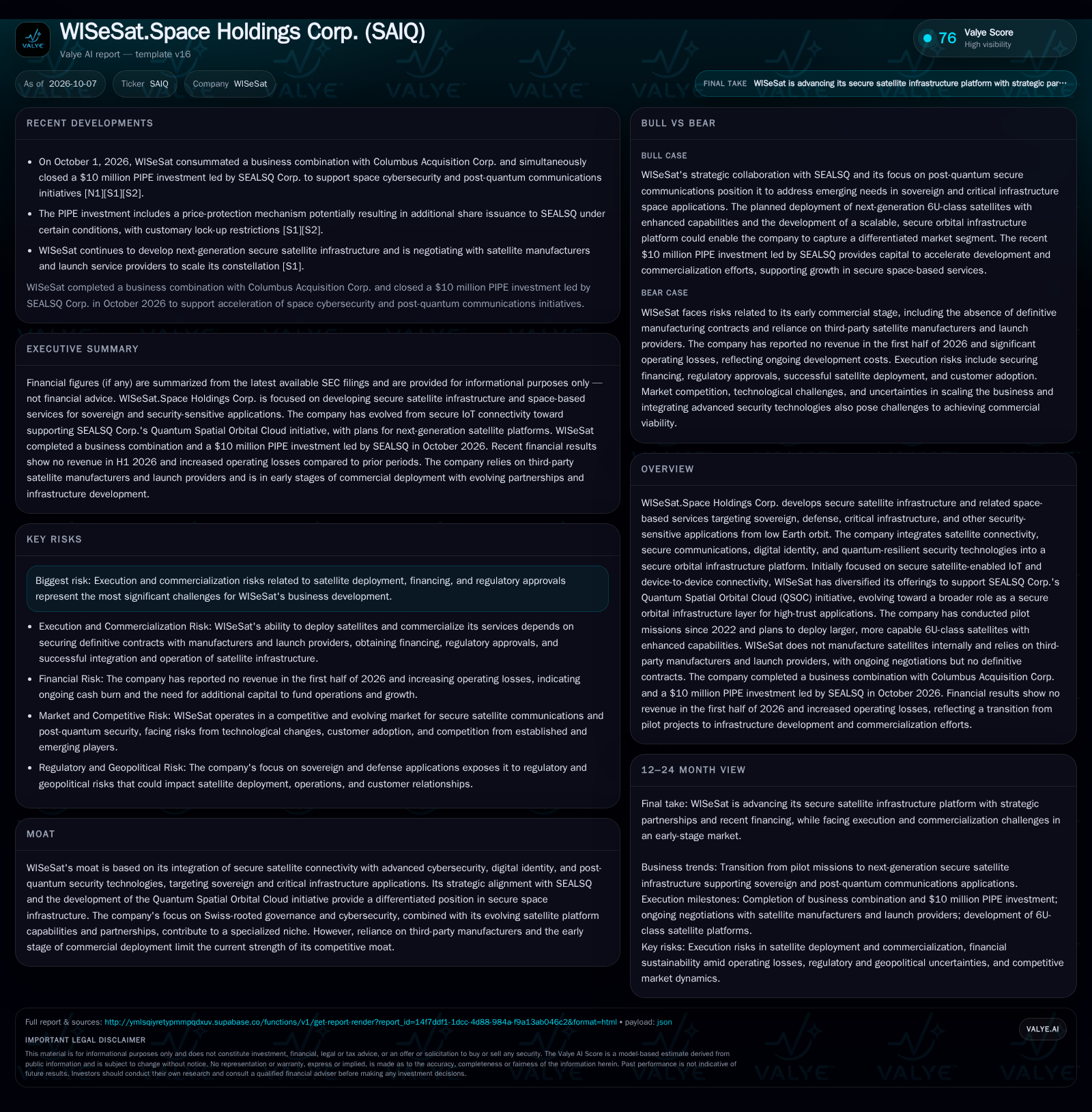
WISeSat.Space Holdings Corp. is transitioning from pilot projects to building a secure orbital infrastructure platform targeting sovereign and post-quantum applications. A $10 million PIPE investment and business combination with Columbus Acquisition Corp. provide fresh capital and strategic support from SEALSQ, but the company reported zero revenue in H1 2026 and faces significant execution risks, including the need to finalize manufacturing contracts and successfully deploy next-generation satellites. Commercial traction, customer adoption, and the ability to manage capital needs will be critical in determining whether WISeSat can establish a differentiated position in the secure space infrastructure market. [S1] [S2] [N1]
WISeSat.Space Holdings Corp. is pursuing an ambitious vision: to become the secure backbone for sovereign and critical-infrastructure communications in low Earth orbit, blending advanced cybersecurity, quantum-resilient technologies, and trusted governance. The company’s transition from pilot missions to a broader infrastructure platform is backed by a recent $10 million PIPE investment and strategic alignment with SEALSQ’s Quantum Spatial Orbital Cloud initiative. However, with no revenue in the first half of 2026, rising losses, and an absence of definitive satellite manufacturing or launch contracts, WISeSat’s future hinges not on its technological roadmap, but on its ability to execute, commercialize, and secure the partnerships needed to build—and monetize—a next-generation secure satellite network. [S1] [S2] [N1]
Recent Financing, Strategic Realignment, and a Revenue Gap Define WISeSat’s 2026 Starting Point
WISeSat completed a business combination with Columbus Acquisition Corp. and simultaneously closed a $10 million PIPE investment led by SEALSQ Corp. in October 2026. The proceeds are earmarked for accelerating space cybersecurity and post-quantum communications initiatives, reflecting a strategic pivot from pilot projects to commercial infrastructure deployment. [S1] [S2] [N1]
Despite this infusion, WISeSat reported zero revenue for the first half of 2026, a drop from $153,725 in the same period the prior year, as earlier funded projects concluded and no new revenue-generating contracts were secured. Meanwhile, operating expenses increased substantially—driven by expanded R&D, sales, and administrative costs—resulting in a net loss of $2.9 million in H1 2026 versus $0.8 million in H1 2025. [S1]
The company remains reliant on third-party satellite manufacturers and launch providers, with ongoing negotiations but no definitive contracts in place. The company reported cash and liquidity metrics for the period; these figures do not by themselves establish operating runway, investment capacity, financial flexibility, or financing capacity.
How WISeSat Could Monetize Secure Satellite Infrastructure—And What Must Go Right
WISeSat’s business model aims to generate revenue by providing secure, resilient satellite capacity and related ground infrastructure to customers with high-security requirements—governments, defense, and critical-infrastructure operators. Under the contemplated QSOC partnership, SEALSQ is expected to have a right of use for capacity in an initial group of twelve satellites, while WISeSat would retain the ability to sell capacity to other customers. [S1]
If this model is realized, WISeSat could potentially blend recurring service revenue (such as capacity leases) with one-off or multi-year infrastructure contracts, depending on customer needs and procurement cycles. However, the specific commercial mechanics—such as contract duration, pricing, or utilization rates—have not been disclosed, and would depend on future agreements.
Operating leverage may emerge if WISeSat can scale its constellation and increase payload utilization—fixed costs (such as ground infrastructure, cybersecurity R&D, and platform operations) could be spread across a larger revenue base. However, the absence of internal manufacturing means margins may be structurally thinner than vertically integrated peers, and the company is exposed to supply-chain pricing and scheduling risks.
The capital requirements for satellite procurement, launch, and regulatory compliance are substantial. While the recent $10 million PIPE investment provides short-term development capacity, additional capital raises may be necessary to fund full constellation deployment, especially if initial customer contracts do not provide upfront payments or long-term commitments.
Specialization in Quantum-Resilient Security—But Facing Incumbents and Emerging Rivals
WISeSat is positioning itself as a secure infrastructure provider at the intersection of satellite communications, cybersecurity, and post-quantum encryption. This specialization targets a niche where trust, sovereignty, and resilience are paramount—attributes increasingly sought by governments and critical-infrastructure operators.
The company’s integration with SEALSQ’s Quantum Spatial Orbital Cloud initiative and its emphasis on Swiss-rooted governance and digital identity could appeal to European and allied customers wary of supply-chain dependencies and data sovereignty risks.
However, WISeSat’s competitive moat is still developing. The market for secure satellite communications is populated by established defense primes, commercial satellite operators, and new entrants exploring quantum-secure links and resilient architectures. Incumbents may have scale, customer relationships, and vertically integrated manufacturing advantages, while emerging players could leapfrog with innovative architectures or commercial models.
WISeSat’s reliance on third-party satellite manufacturing and launch adds another layer of vulnerability: delays, price escalations, or supply-chain disruptions could erode any time-to-market or cost advantage. Ultimately, the company’s ability to secure anchor customers, demonstrate differentiated security capabilities, and deliver operational reliability will determine whether it can carve out a defensible position.
If WISeSat Secures Anchor Contracts and Demonstrates Operational Capability, a Recurring Revenue Platform Could Emerge
The most favorable trajectory for WISeSat is predicated on its ability to close definitive satellite manufacturing and launch agreements, successfully deploy and operate its next-generation 6U-class satellites, and secure anchor customers—especially government or defense agencies—willing to commit to multi-year, high-value contracts.
Early demonstration of robust, quantum-resilient secure communications and seamless integration with SEALSQ’s QSOC could provide strong technical validation and serve as a reference for additional sovereign or critical-infrastructure clients.
If WISeSat achieves high utilization rates and is able to cross-sell capacity to non-SEALSQ customers, operating leverage could accelerate as fixed costs are amortized over a broader revenue base. This would begin to establish a recurring revenue platform, potentially supporting further capital raises or strategic partnerships.
Evidence confirming this scenario would include: announcement of multi-year government or enterprise contracts, successful launch and operation of the first wave of 6U-class satellites, and visible capacity commitments beyond the initial QSOC tranche.
Commercialization Proceeds Slowly as WISeSat Navigates Technical and Procurement Hurdles
The most plausible near-term scenario is that WISeSat continues to invest in R&D and partnership development while working to secure definitive satellite manufacturing and launch contracts. Initial deployments may be delayed or staged, with the company focusing on technical demonstrations and pilot projects for potential anchor customers.
Revenue generation would remain limited or lumpy, as government and critical-infrastructure procurement cycles are often protracted and subject to regulatory review. Operating losses persist as fixed costs remain high and utilization rates are low in the early phases.
Gradual progress may be made as WISeSat builds flight heritage, demonstrates quantum-resilient infrastructure, and leverages its SEALSQ partnership for credibility and initial demand. Over time, successful technical validation could translate into commercial contracts, but the pace of ramp-up is likely to be measured.
This scenario would be confirmed by announcements of successful technical demonstrations, pilot deployments, and incremental contract wins—without yet achieving sustained, recurring revenue or positive operating cash flow.
Failure to Secure Contracts or Sufficient Funding Leaves WISeSat Stalled at the Development Stage
In an adverse scenario, WISeSat fails to secure definitive satellite manufacturing or launch agreements, or is unable to attract anchor customers willing to commit to significant capacity purchases. Without revenue-generating contracts, the company’s operating losses continue to mount as its R&D and administrative expenses outstrip available capital.
Delays in satellite deployment, regulatory approvals, or technical setbacks could further erode confidence among prospective customers and partners. Competitive advances by better-funded incumbents or disruptive new entrants could crowd out WISeSat’s niche before it achieves operational scale.
If additional capital cannot be raised on acceptable terms, the company could be forced to scale back its ambitions, seek strategic alternatives, or wind down operations.
This scenario would be evidenced by further periods of zero or minimal revenue, continued cash burn, no announcements of anchor customer contracts, and disclosures of difficulties in securing manufacturing, launch, or regulatory milestones.
What Will Determine If WISeSat Becomes a Secure Space Infrastructure Contender?
Execution of definitive satellite manufacturing and launch contracts—timing, terms, and delivery schedules would directly affect WISeSat’s ability to deploy operational infrastructure.
Announcement of anchor customer agreements, particularly with sovereign, defense, or critical-infrastructure clients; contract duration, value, and exclusivity terms would help clarify revenue visibility.
Progress on technical demonstrations and pilot deployments—successful validation of quantum-resilient secure communications would provide critical reference points.
Utilization rates and capacity commitments for the initial group of twelve satellites (if disclosed), especially the proportion committed to SEALSQ versus third-party customers.
Cash burn rate and runway—updates on operating expenses and remaining proceeds from the PIPE investment would help assess financial sustainability.
Milestones related to regulatory approvals, spectrum allocation, and compliance with export controls or national security regulations.
Evidence of additional capital raises, strategic partnerships, or supply-chain disruptions that could impact deployment schedules or cost structure.
Disclaimer: This is research-only, informational analysis and not investment advice. It may include AI-generated interpretation and general industry context. Always verify important details using primary sources.

Comments