
Apogee Enterprises: Margin Expansion, Portfolio Moves, and the Realities of Construction Cyclicality
Recent acquisitions and operational initiatives have strengthened Apogee’s architectural portfolio and improved profitability, but exposure to the non-residential construction cycle and integration risks will continue to test its resilience and growth ambitions.
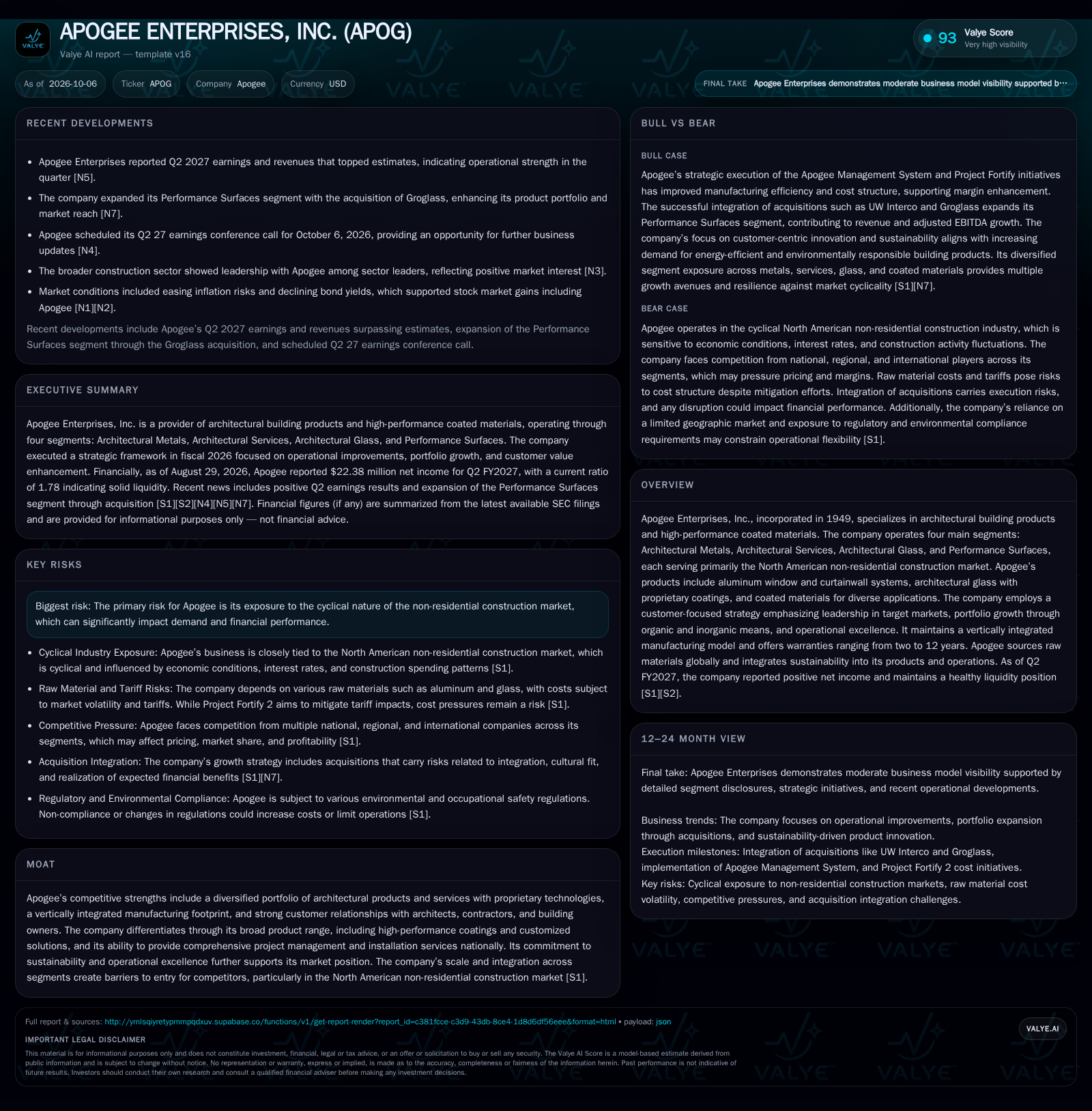
Apogee Enterprises reported $22.38 million in net income for Q2 FY2027 and continues to invest in portfolio expansion, notably through the acquisitions of Kalwall and Groglass. Operational improvements via the Apogee Management System and Project Fortify 2 have contributed to margin gains. However, the company remains highly exposed to North American non-residential construction cycles, faces raw material and integration risks, and must prove that recent inorganic moves can deliver sustainable value [S1] [S2] [N7].
Apogee Enterprises, Inc. stands at a strategic crossroads, having delivered improved profitability and expanded its portfolio through targeted acquisitions such as Kalwall and Groglass. These moves, alongside disciplined cost control and operational excellence programs, have fortified its position as a leading supplier to the North American non-residential construction market. Yet, Apogee’s fortunes remain closely tied to construction cycles, with integration risks and raw material volatility posing persistent challenges. The next phase will test whether Apogee’s operational discipline and strategic investments can consistently outpace industry headwinds and unlock durable value for shareholders.
Recent Acquisitions and Margin Gains Reshape Apogee’s Outlook
Apogee reported net income of $22.38 million for the quarter ended August 29, 2026, with basic EPS of $1.08, marking a period of improved profitability [S2]. The company completed the acquisitions of Kalwall (July 2026) and Groglass (September 2026) for $112.2 million and up to €62.5 million, respectively, expanding its Architectural Glass and Performance Surfaces segments with advanced technologies and broader product offerings [S2] [N7]. Operational initiatives such as the Apogee Management System (AMS) and Project Fortify 2 have contributed to cost reductions and manufacturing efficiency [S1]. As of August 29, 2026, Apogee held $36.5 million in cash, with a current ratio of 1.78 [S2].
How Apogee Monetizes Construction Cycles and Manufacturing Scale
Apogee’s revenue model is anchored in supplying architectural products and services for non-residential construction projects, with a mix of engineered components (Architectural Metals, Glass) and integrated services (Architectural Services) complemented by specialty coated materials (Performance Surfaces) [S1]. Revenue is derived from both short-cycle product sales and long-term contracts, with contract assets and liabilities reflecting multi-period project timing [S2]. Gross margins are sensitive to raw material input costs (aluminum, glass, coatings) and project execution efficiency. The implementation of AMS and Project Fortify 2 is designed to lower fixed manufacturing costs and boost operating leverage, allowing incremental revenues to flow through at higher margins when volumes recover or grow.
Capital intensity varies by segment: metals and glass fabrication require significant investment in equipment and working capital, while services and coatings are more variable-cost driven. Recent acquisitions signal a willingness to deploy capital for portfolio expansion, but integration costs and potential working capital needs may temporarily limit free cash flow. Pricing power is mixed—proprietary coatings and engineered solutions may command premiums, but standard products face commodity-like pressures, especially during industry downturns. The company’s ability to pass through cost increases or capture value from innovation is a central determinant of long-term margin expansion.
Differentiation Through Integration, Technology, and Project Execution
Apogee competes in a fragmented but competitive market alongside national and regional suppliers of architectural metals, glass, and building envelope solutions. Its competitive advantages stem from vertical integration—controlling multiple steps from engineering to installation—and proprietary technologies in coated glass and advanced materials [S1]. The recent additions of Kalwall and Groglass strengthen its ability to offer differentiated façade and anti-reflective solutions, potentially opening new customer segments and enhancing cross-selling opportunities.
However, barriers to entry are highest in complex, high-specification projects where technical expertise and project management are critical, and lower in standard product categories where price competition is intense. Large general contractors and architects often wield significant bargaining power, constraining margins. International players and substitutes (such as alternative building materials or modular construction) are persistent threats, especially if innovation in energy efficiency or sustainability shifts industry standards. Apogee’s focus on sustainability and ability to offer comprehensive project management services may help defend share in premium segments but do not fully insulate it from broader market cyclicality.
If Integration Succeeds and Construction Demand Recovers, Margin Expansion Could Accelerate
A favorable scenario would see Apogee successfully integrating Kalwall and Groglass, realizing targeted synergies in the Architectural Glass and Performance Surfaces segments. If construction activity in North America rebounds—driven by infrastructure spending, green building incentives, or a cyclical recovery in commercial and institutional development—Apogee could benefit from higher volumes flowing through a more efficient cost base, amplifying operating leverage.
Evidence supporting this scenario would include sustained revenue growth in newly acquired segments, above-peer margin improvement, and clear communication of synergy capture in earnings updates. Further, increased adoption of energy-efficient building products, or regulatory shifts favoring advanced coatings and façade systems, would provide a structural tailwind. Confirmation would come from segment-level outperformance relative to competitors, new customer wins in higher-margin categories, and a rising proportion of recurring or multi-year project work.
Most Likely: Steady Execution Amid Cyclical Fluctuations and Integration Headwinds
The most plausible outcome is that Apogee delivers moderate growth and stable margins, with operational improvements offsetting industry cyclicality but integration of recent acquisitions producing only incremental gains. Construction activity in North America may remain uneven, with some segments (institutional, transportation) showing resilience while commercial office and retail lag. Pricing power remains mixed, with proprietary products supporting margins in some areas but competitive intensity capping upside elsewhere.
This scenario would be confirmed by stable or modestly rising revenues, margin performance in line with recent historical averages, and manageable working capital and capital expenditure levels. Signs of friction—such as slower-than-expected synergy realization or cost overruns in acquired businesses—would indicate that integration challenges are limiting near-term upside. Sustained positive net income and cash generation, without significant deterioration in the balance sheet, would support this middle path.
Adverse Outcomes: Construction Slowdown, Cost Shocks, or Failed Integration
A negative scenario could unfold if non-residential construction activity contracts further due to economic slowdown, higher interest rates, or reduced public/institutional spending. In this environment, Apogee would face lower project volumes, increased price competition, and possible under-absorption of fixed costs. If raw material prices spike or tariffs tighten, input cost inflation could compress margins, especially if pass-through mechanisms are weak.
Integration risks loom large: failure to realize planned synergies from Kalwall and Groglass, or operational disruptions during integration, could erode acquired earnings and stretch management bandwidth. Confirmation of this scenario would include declining revenues, margin compression, unexpected restructuring or impairment charges, and negative cash flow. Early warning could come from missed financial targets, customer attrition, or public disclosure of integration setbacks.
What Will Determine Whether Apogee’s Strategy Delivers Durable Value?
Performance of the Architectural Glass and Performance Surfaces segments post-acquisition, especially revenue and margin trends attributable to Kalwall and Groglass.
Realization and disclosure of targeted cost synergies and operational efficiencies from AMS and Project Fortify 2 initiatives.
Trends in non-residential construction starts and backlog, particularly in core North American markets—a useful metric would be segment-level new order intake, if disclosed.
Raw material cost trends (aluminum, glass, coatings) and the effectiveness of Apogee’s pass-through mechanisms to customers.
Integration milestones and any disclosed challenges or delays in combining acquired businesses, especially as reflected in management commentary or restructuring costs.
Sustainability-linked product adoption rates and any regulatory shifts boosting demand for energy-efficient building solutions.
Working capital management and free cash flow generation, particularly as new acquisitions are absorbed and capital needs potentially rise.
Competitive developments, including new product launches or pricing moves by regional and international rivals.
Disclaimer: This is research-only, informational analysis and not investment advice. It may include AI-generated interpretation and general industry context. Always verify important details using primary sources.

Comments