
Lamb Weston: Market Leadership in Frozen Potatoes Faces Margin and Concentration Crosswinds
Lamb Weston’s prominent position in value-added frozen potato products, anchored by deep customer relationships and global reach, delivers scale and resilience. Yet heavy customer concentration, raw material price volatility, and evolving supply chain and consumer dynamics pose persistent challenges to margin stability and growth.
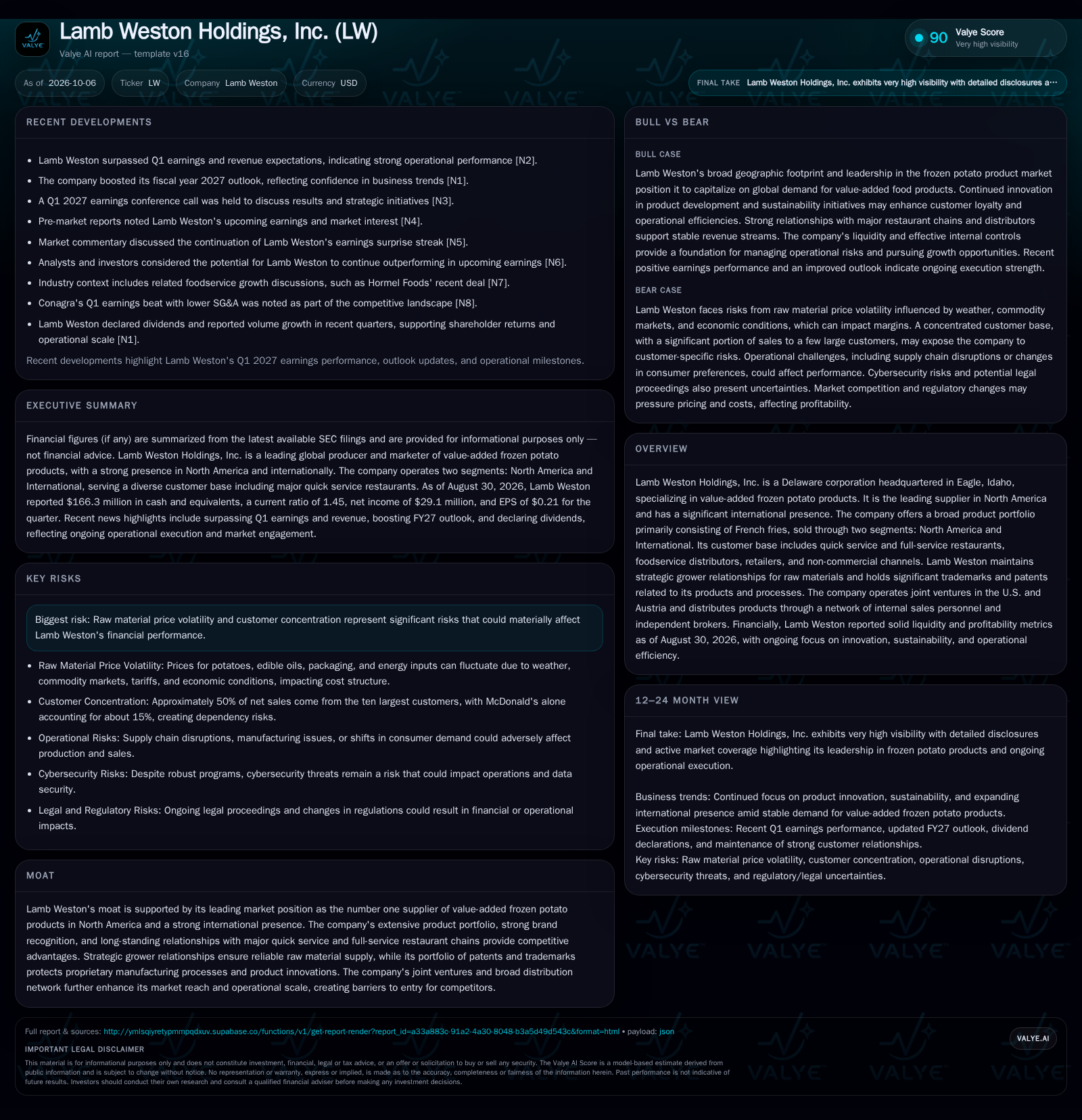
Lamb Weston continues to outperform earnings expectations, driven by its leadership in North American and global frozen potato markets and strong ties to major foodservice customers. However, with roughly half of sales concentrated in its ten largest customers and ongoing exposure to volatile input costs, the company’s future margin and growth profile will depend on its ability to innovate, diversify, and manage supply chain risks. Recent volume growth and dividend declarations underscore operational momentum, but the balance between scale advantages and concentration risks remains central to the thesis. [N1] [N2]
Lamb Weston Holdings, Inc. stands atop the North American frozen potato market, leveraging scale, innovation, and deep-rooted partnerships with major foodservice and retail customers. The company’s recent earnings outperformance and volume growth highlight an ability to execute in a stable but competitive category. Yet, with half of revenues tied to just ten customers and persistent raw material cost swings, the company’s future growth and margin profile will hinge on its ability to diversify risk, optimize procurement, and capture value through product innovation.
Recent Earnings Strength Underscores Operational Execution—But Concentration and Input Risks Loom
Lamb Weston reported net income of $29.1 million and basic and diluted EPS of $0.21 for the quarter ended August 30, 2026. The company’s cash and equivalents stood at $166.3 million, with a current ratio of 1.45, reflecting a balanced near-term liquidity position. The cited source reports dividend-related activity; that disclosure alone does not establish dividend-policy continuity, management confidence, or a material constraint on capital flexibility. However, customer concentration remains pronounced: the ten largest customers represent about 50% of net sales, and McDonald’s alone accounts for roughly 15%. This concentration, combined with persistent exposure to raw material price volatility—particularly for potatoes, edible oils, packaging, and energy—frames both the company’s strengths and its vulnerabilities. [S2] [N1] [N2]
How Lamb Weston Turns Potatoes into Profits: Scale, Mix, and Margin Pressures
Lamb Weston’s business model is built on high-volume, value-added processing of potatoes into frozen products—primarily French fries—distributed through foodservice, retail, and international channels. Gross profit is shaped by a delicate balance of input costs (dominated by raw potatoes, edible oils, and energy), operational scale, and product mix. Fixed costs are significant given the capital intensity of processing plants, but high throughput and automation support operating leverage as volumes rise. Pricing power is nuanced: contracts with major customers (such as global quick service restaurant chains) may limit near-term price flexibility, especially in competitive bidding environments, while premium or differentiated products can command higher margins in less commoditized retail and foodservice segments. The company’s dividend payments and recent volume growth suggest stable cash generation, but operating results remain sensitive to swings in commodity prices and the ability to pass through cost increases. Innovation in processing efficiency, packaging, and sustainability could provide incremental margin tailwinds if successfully commercialized.
Beyond the immediate cost inputs, Lamb Weston's profitability is also influenced by the elasticity of demand within its end markets. In foodservice, where contracts are often negotiated annually or multi-annually, the company faces a delicate balance between maintaining volume commitments and securing price adjustments that reflect cost inflation. This dynamic creates a lag effect where input cost spikes may not be immediately recoverable, compressing margins in the short term. Conversely, in retail channels, consumer price sensitivity can limit the extent of price increases, especially if competing products or private labels offer lower-cost alternatives. Thus, the mix of sales channels and the contractual terms embedded within them critically shape how effectively Lamb Weston can translate cost pressures into pricing actions.
Operational efficiency initiatives, such as automation and yield improvements, serve as critical levers to offset margin pressure from raw material volatility. However, these efficiencies often require upfront capital investment and time to realize benefits, introducing execution risk. Moreover, gains in processing efficiency can be partially offset by rising labor or energy costs, which also factor into the company’s cost structure. Given the capital intensity of frozen food processing, maintaining high utilization rates is essential to diluting fixed costs. Periods of demand softness or supply chain disruptions that reduce throughput can therefore disproportionately impact margins, underscoring the importance of demand stability and supply chain robustness in the company’s economics.
Defending the Top Spot: Brand, Scale, and Supply Chain as Moat—But Substitution and Customer Power Persist
Lamb Weston’s competitive advantages stem from its market leadership in North America, broad product portfolio, and entrenched relationships with major foodservice and retail customers. Its network of strategic grower relationships and investment in proprietary processes (supported by patents and trademarks) help secure raw material supply and protect process know-how. However, the sector is structurally competitive, with other large frozen potato processors, private labels, and regional players vying for share. Customer power is especially pronounced among global quick service restaurant chains, which can negotiate aggressively on price and drive operational requirements. Substitution risk arises from shifting consumer preferences toward alternative carbohydrates or healthier snack options, though the core demand for French fries remains resilient. The ability to differentiate through innovation, sustainability, and reliability of supply will determine whether Lamb Weston can maintain or extend its moat as market dynamics evolve.
Margin Expansion Through Innovation and International Growth Could Outpace Commodity Headwinds
In a favorable scenario, Lamb Weston leverages its R&D investments to introduce new value-added products, packaging innovations, and sustainability initiatives that resonate with both foodservice and retail customers. Successful product launches and process improvements could enhance margins by reducing waste, improving yield, or commanding premium pricing. International expansion—particularly in underpenetrated markets where Western-style fast food is growing—may allow the company to diversify its revenue base and mitigate customer concentration risk. Evidence confirming this upside would include sustained volume growth outpacing industry averages, rising gross margins despite input cost volatility, a decreasing share of sales from the top ten customers, and a growing contribution from international markets. Additional signals would be increased patent filings, new customer wins, or successful launches of differentiated products.
Scale-Driven Stability—But Margins Remain Tethered to Input Volatility and Customer Mix
The most plausible near-term outcome for Lamb Weston is continued moderate volume growth, supported by stable demand for frozen potato products in core North American and developed international markets. Operating leverage from high-capacity plants and a broad distribution network will help offset some input cost swings, but margins are likely to remain range-bound as Lamb Weston manages the push-pull between customer contract terms and commodity price pass-throughs. The company’s entrenched relationships with major QSR and foodservice customers provide revenue stability but limit pricing flexibility. Confirmation of this base case would include steady EPS and dividend payments, a stable or modestly reported liquidity-ratio trends, and gross margins that fluctuate within recent historical ranges in response to commodity cycles. Falsification would come from either a meaningful margin compression (due to inability to pass through costs) or a sharp loss of a major customer.
Margin Compression and Revenue Shocks If Input Costs Spike or Major Customers Defect
The primary risks to Lamb Weston’s outlook are a sustained spike in raw material costs (potatoes, edible oils, packaging, or energy) that cannot be fully passed through to customers, or the loss of a major customer—particularly one of the top ten that collectively account for half of net sales. Such events could compress margins, erode profitability, and strain the company’s ability to invest in innovation or return cash to shareholders. Additional downside triggers include supply chain disruptions (from weather, geopolitical events, or logistics bottlenecks), adverse regulatory changes, or a shift in consumer preferences away from frozen potato products. Evidence confirming a downside scenario would be a sharp decline in gross margin, negative EPS surprises, a reduction or suspension of the dividend, or disclosure of major contract losses. Warnings would also include a spike in short-term debt or working capital pressure as the company manages input cost volatility.
Metrics and Milestones Shaping the Future of Lamb Weston’s Margin and Market Resilience
Gross margin trends quarter-over-quarter and the degree of pass-through of input cost increases to customers.
Volume growth rates in both North American and International segments, especially in underpenetrated or emerging markets.
Customer concentration metrics—specifically, changes in the percentage of net sales attributable to the top ten customers and McDonald’s.
Innovation pipeline: number of new product launches, patent filings, or adoption of sustainability-focused offerings (if disclosed).
Raw material cost indices—tracking potato and edible oil prices relative to historical averages and contract coverage.
Supply chain reliability metrics, including inventory turnover and disruption disclosures, if available.
Disclaimer: This is research-only, informational analysis and not investment advice. It may include AI-generated interpretation and general industry context. Always verify important details using primary sources.

Comments