
Trilogy Metals: Alaska Ambition Hinges on Permitting, Partner Alignment, and Infrastructure Realities
Trilogy Metals' Upper Kobuk Mineral Projects offer significant resource potential, but the company's future depends on navigating permitting obstacles, joint venture complexities, and the economics of remote mining. With no production revenue and a reliance on external financing, Trilogy’s risk profile is defined as much by what could go right as by persistent structural challenges.
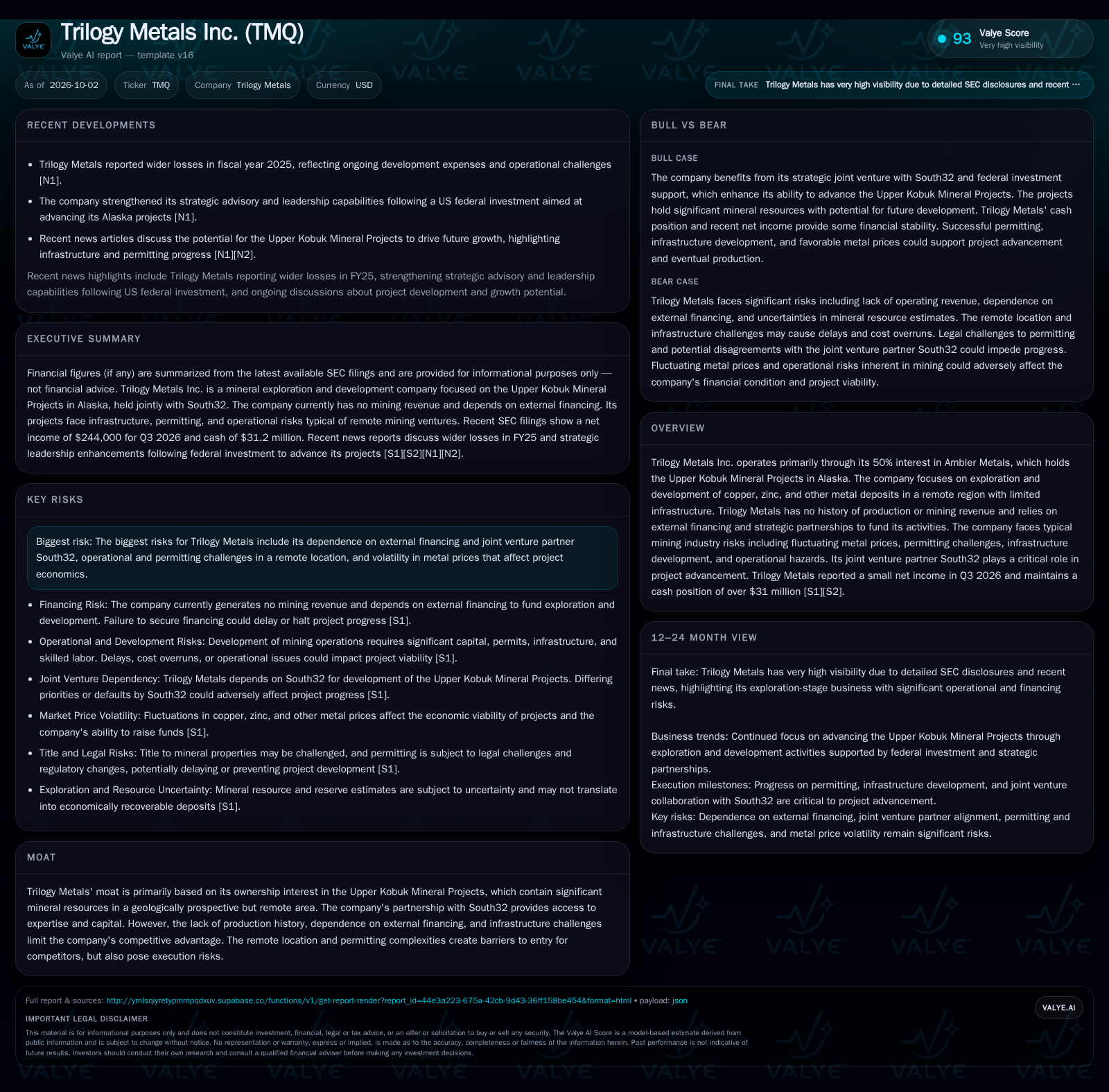
Trilogy Metals has no mining revenue and is focused on advancing the Upper Kobuk Mineral Projects in Alaska via a joint venture with South32. The company’s prospects depend on regulatory approvals, partner collaboration, and future metal prices [S1] [S2].
Trilogy Metals stands at a crossroads familiar to many exploration-stage mining companies: the promise of significant untapped resources versus the realities of remote project development, regulatory headwinds, and capital constraints. With no operating revenue and a balance sheet defined by cash reserves, the company’s fate is closely tied to the progress of its Upper Kobuk Mineral Projects in Alaska—a joint venture with South32. While recent federal support and net income offer incremental positives, the economic and operational path to production remains fraught with uncertainty and complexity.
Recent Financials and Project Status Define the Risk/Reward Equation
Trilogy Metals reported a net income of $244,000 for the quarter ended August 31, 2026, and held $31.2 million in cash and cash equivalents with a current ratio of 1.33 as of that date [S2]. However, the company generates no mining operating revenue and remains entirely pre-production, relying on external financing and partner contributions for all operations [S1] [S2]. Its principal asset is a 50% interest in the Upper Kobuk Mineral Projects (UKMP) in Alaska, held through Ambler Metals, a joint venture with South32. The UKMP projects require substantial permitting, infrastructure development—including road access—and are located in a remote region with a short operating season and significant logistical hurdles. Recent news and filings highlight wider losses in FY25 and ongoing efforts to strengthen strategic leadership in response to federal investment in Alaska projects [S1] [S2]. These facts underscore a business model defined by high uncertainty, capital intensity, and execution risk.
Exploration-Stage Economics: Capital Flows, Fixed Costs, and Deferred Value Realization
Trilogy Metals’ economic model is typical of pre-production miners: it incurs substantial fixed costs for exploration, permitting, and feasibility studies, with no offsetting mining revenue. The company’s cash burn is dictated by the pace of technical work, permitting, and infrastructure planning. Because Trilogy’s projects are in a remote part of Alaska, capital requirements for infrastructure—especially road access and processing facilities—are likely to be high. Variable costs will only become relevant if the project advances to construction and production phases, at which point operating leverage could be significant given the scale of the resource base.
In the current phase, value creation is deferred and highly leveraged to resource conversion milestones, metal price assumptions, and successful permitting. The lack of current revenue means Trilogy is structurally dependent on periodic capital raises, partner contributions (primarily from South32), and occasionally federal or state support. If the project advances, future economics will be highly sensitive to realized copper and zinc prices, operating cost inflation, and the ability to amortize infrastructure investment over a long mine life. Conversely, any delays or cost overruns in permitting or construction could quickly erode potential returns.
Strategic Advantages and Barriers: Resource Base, Joint Venture, and Alaska’s Double-Edged Isolation
Trilogy Metals’ primary advantage is its exposure to a large, geologically attractive resource in a region with few direct competitors. The partnership with South32 provides access to technical expertise, capital, and credibility—key differentiators compared to single-asset juniors. The remoteness of the UKMP projects presents a barrier to entry for other mining companies, as infrastructure development is costly and permitting is complex.
However, these same attributes create substantial execution risk and limit Trilogy’s competitive flexibility. The company is highly dependent on South32 for both funding and project advancement; any misalignment in priorities or a potential partner exit would be disruptive. Substitution risk from other global copper and zinc projects remains high, particularly if more accessible or lower-cost deposits are developed elsewhere. Furthermore, the company faces indirect competition from recycling and alternative materials if metal prices weaken or regulatory pressures shift. Success in this environment will depend on Trilogy’s ability to move from resource delineation to permitted, financed, and constructed assets faster or more efficiently than peer exploration-stage miners.
From Permitting to Production: How Federal Support and Partner Alignment Could Unlock Value
The bull case for Trilogy Metals is predicated on three reinforcing drivers: successful permitting, continued federal and partner support, and a constructive metal price environment. If regulatory approvals accelerate—potentially aided by increased federal investment in Alaska infrastructure—the UKMP projects could move into development, triggering construction and ultimately first production. South32’s ongoing commitment would ensure the capital and operational know-how required for execution.
Confirmation of this scenario would come from rapid progress on road and facility permitting, public announcements of construction start, and new joint venture funding commitments. Additional validation would include updated feasibility studies showing robust project economics at prevailing metal prices, and perhaps early-stage offtake agreements with smelters or end users. If Trilogy can demonstrate a clear pathway to production and positive net present value, equity and debt financing could become less dilutive and more accessible.
Most Likely Trajectory: Incremental Advancement Amid Chronic Delays and Ongoing Capital Needs
The most plausible outcome is that Trilogy Metals continues to advance the UKMP projects incrementally, constrained by permitting delays, infrastructure bottlenecks, and the need for periodic external financing. Progress is likely to be lumpy, with periods of technical or regulatory advancement offset by setbacks due to legal challenges or adverse market conditions. South32 remains engaged, but both partners are forced to manage capital allocation carefully given the scale and risk profile of the projects.
Evidence of this scenario would include modest ongoing expenditures, regular news of permitting submissions or public consultations, and periodic financings to replenish cash reserves. The company would remain pre-revenue for the foreseeable future, with valuation driven by resource updates, permitting milestones, and the external metal price environment. Delays in road construction, challenges in securing long-term offtake, or changes in government policy would confirm the persistence of this middle path.
When Permitting, Partner, or Price Risks Materialize: Erosion of Option Value
The bear case for Trilogy Metals materializes if key risks crystallize: permitting is denied or delayed beyond a feasible timeframe, South32 withdraws or materially reduces its commitment, or copper and zinc prices fall below the thresholds needed to justify development. In this scenario, Trilogy’s cash reserves dwindle without any prospect of near-term revenue, forcing the company into highly dilutive financings or outright project suspension.
Confirmation would come from negative permitting decisions, loss of federal or partner support, or significant impairment charges on project assets. If legal challenges to land access or mineral rights escalate, or if resource estimates are downgraded due to technical or market factors, the equity value could deteriorate rapidly. The company could be left with stranded assets and little recourse but to seek buyers for its project interests at distressed valuations.
Milestones That Will Shape Trilogy Metals' Investment Case
Progress on permitting for road access and mining infrastructure, including regulatory approvals and resolution of legal challenges, will be pivotal.
Updates on South32’s financial and operational commitment to the Ambler Metals joint venture would clarify long-term project viability.
Changes in federal or state-level support for Alaska mining infrastructure, such as new investment programs or policy shifts, could materially alter project timelines.
Disclosure of any new resource or reserve estimates, particularly if accompanied by updated feasibility studies, would help test the economic case.
Announcements regarding construction start dates, contractor selection, or major capital expenditures would signal a shift toward development.
Evidence of preliminary offtake agreements or partnerships with end users would indicate increasing project maturity.
Material adverse developments—such as partner withdrawal, major permitting setbacks, or significant cost inflation—would challenge the bull case.
Disclaimer: This is research-only, informational analysis and not investment advice. It may include AI-generated interpretation and general industry context. Always verify important details using primary sources.

Comments