
McCormick’s Growth Playbook: Expanding Flavor Leadership Amid Margin and Liquidity Pressures
McCormick reported Q3 2026 revenue of $2.02 billion and net income of $97.6 million, with notable sales growth in Mexico and ongoing investments in product innovation and marketing.
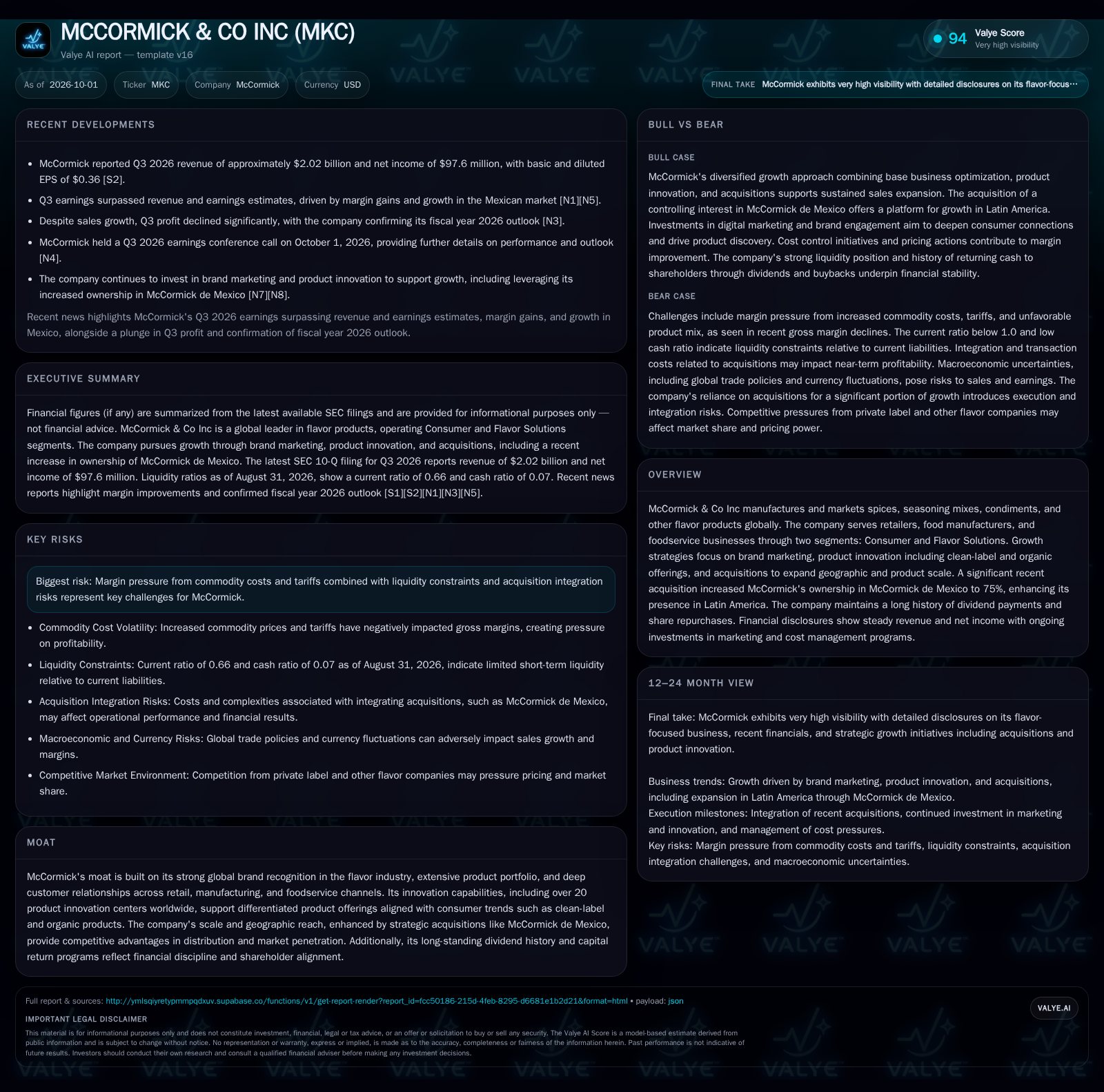
McCormick reported Q3 2026 revenue of $2.02 billion and net income of $97.6 million, with notable sales growth in Mexico and ongoing investments in product innovation and marketing. The company's ability to integrate its expanded Mexican business, manage costs, and sustain innovation investment will shape the balance between growth and risk over the coming year. [S2] [N1] [N3] [N5]
McCormick & Co. stands at a pivotal moment: its aggressive expansion in Latin America, product innovation pipeline, and deepened brand investments point to durable top-line momentum. Yet, recent financials reveal that margin compression and constrained liquidity are intensifying the need for precise execution. The next chapters for McCormick will hinge on its ability to integrate acquisitions, offset input cost pressures, and capture value from emerging consumer trends—all while defending its global flavor leadership in a competitive landscape.
Recent Results Highlight Expansion and Margin Compression
McCormick’s Q3 2026 revenue reached $2.02 billion, with net income of $97.6 million and EPS of $0.36. Growth was supported by robust performance in Mexico following the company’s $750 million acquisition of an additional 25% stake in McCormick de Mexico, bringing its ownership to 75% and deepening its Latin American presence. However, net profit declined year-over-year, and the company’s gross margin narrowed by 60 basis points in 2025 due to commodity inflation, tariffs, and less favorable product mix. [S1] [S2] [N1] [N3] [N5]
How McCormick’s Flavor Engine Converts Growth into Cash—And Where It Can Break Down
McCormick’s business model is built on high-volume production of branded and private-label spices, seasonings, and condiments, sold through Consumer and Flavor Solutions segments. Revenue is generated via a mix of direct retail, foodservice, and B2B channels, with pricing power tied to brand strength and innovation. The economics of the business rely on leveraging scale in manufacturing, distribution, and marketing to drive operating leverage—fixed costs are spread across a broad product portfolio and geographic footprint, while variable costs are heavily exposed to agricultural commodity swings.
The company’s ability to pass through cost increases is a critical lever for margin stability, but evidence from recent quarters suggests that pricing has only partially offset higher raw material, conversion, and tariff costs. The 60 basis point gross margin decline, despite cost savings initiatives, underscores this vulnerability. With SG&A reductions achieved mainly through lower headcount and distribution costs, future efficiency gains may be harder to realize without impacting growth investments. The expanded stake in McCormick de Mexico increases exposure to high-growth markets but also adds capital intensity and integration complexity. [S1] [S2]
The interplay between McCormick’s pricing strategies and raw material cost fluctuations is a critical area where the business model can either reinforce resilience or expose vulnerabilities. If commodity prices remain volatile, the company's ability to implement dynamic pricing without dampening demand will be tested. This requires sophisticated market intelligence and consumer elasticity analysis to avoid volume loss while protecting margins. Furthermore, the capital intensity associated with expanding operations in emerging markets like Mexico introduces additional fixed-cost leverage, which can amplify the impact of any sales volatility. Efficient integration and supply chain optimization in these regions will be essential to prevent margin dilution and maintain cash flow generation.
Sustaining Brand Edge Amid Private Label and Ingredient Cost Volatility
McCormick’s competitive advantages are rooted in global brand recognition, extensive product breadth, and deep relationships across retail and foodservice channels. Its innovation engine, with more than 20 global R&D centers, enables rapid response to shifting consumer preferences—especially for clean-label, organic, and health-driven products. Strategic acquisitions have expanded its reach and category depth, illustrated by the increased stake in Mexico.
However, the company faces persistent threats from private label brands, which are often able to undercut pricing, especially during periods of consumer belt-tightening. Ingredient cost volatility can erode margins faster than branded players can adjust pricing. Emerging flavor startups, direct-to-consumer models, and regional competitors can also chip away at McCormick’s share, especially if the company fails to localize effectively or maintain its innovation pace. The ability to leverage scale for procurement and distribution remains a core defense, but only if margin discipline is maintained.
In the context of rising private label competition, McCormick’s sustained advantage depends heavily on its capacity to innovate not only in product formulation but also in packaging, branding, and consumer engagement. The shift toward clean-label and health-conscious products requires continuous investment in R&D and marketing to preempt smaller, agile competitors who might exploit niche trends more rapidly. Additionally, the company’s scale can be a double-edged sword; while it enables cost advantages in procurement and distribution, it may also slow responsiveness to localized consumer preferences. Balancing global standardization with regional customization will be a key determinant in preserving market share against both multinational and regional players.
Margin Rebound and Latin American Expansion Drive Multi-Year Outperformance
A bullish scenario sees McCormick successfully integrating its expanded Mexican operations, capturing above-market growth in Latin America as disposable incomes rise and consumer preferences shift toward branded, health-oriented seasonings. Innovation in clean-label and global flavors, supported by digital marketing and omnichannel distribution, could accelerate volume and pricing gains, while targeted cost savings and procurement efficiencies restore gross margin to pre-2025 levels.
Confirmation would come from sequential improvement in gross margins, accelerating sales growth outside North America, and evidence of successful new product launches gaining share in both developed and emerging markets.
If McCormick leverages its expanded footprint to achieve procurement synergies and optimize supply chain logistics, it could realize meaningful cost reductions that bolster gross margins beyond mere stabilization. This scenario assumes that the company successfully harmonizes product portfolios across markets, enabling cross-selling opportunities and reducing redundant overhead. Additionally, digital transformation initiatives that enhance consumer data analytics and e-commerce capabilities could unlock new revenue streams and improve marketing ROI. The cumulative effect of these factors would not only support margin recovery but also create a more agile organization capable of sustaining growth amid evolving consumer demands and macroeconomic uncertainties.
Balancing Growth Initiatives with Cost Pressures in a Competitive Market
The most plausible outlook is that McCormick continues to grow sales in the low single digits, with solid contributions from Mexico and product innovation offsetting weakness in mature North American markets. Gross margins remain under pressure but stabilize as pricing actions catch up to input costs and supply chain disruptions ease. The company maintains its dividend and modest share repurchases but refrains from large new acquisitions until liquidity improves.
This scenario would be supported by steady revenue growth, stable or gradually improving gross and operating margins, and no significant deterioration in the current ratio. Challenges in integrating the Mexican business or external commodity shocks could tilt the outcome toward the downside.
Under moderate cost pressure scenarios, McCormick’s ability to maintain a disciplined investment approach will be critical. This includes prioritizing innovation projects with the highest potential return on investment and carefully managing SG&A expenses without undermining brand equity. The company’s capital allocation decisions will need to balance short-term margin protection with long-term growth drivers, particularly in emerging markets where returns may be delayed but significant. Additionally, maintaining a flexible supply chain that can adapt to commodity price swings and tariff changes will help mitigate margin erosion. Monitoring these operational levers closely will provide early signals on whether the company is effectively navigating the cost-growth tradeoff.
Integration Hurdles and Commodity Surges Undermine Earnings and Flexibility
A bearish outcome materializes if McCormick’s integration of its Mexican operations proves more complex or costly than expected, leading to higher-than-planned SG&A or restructuring charges. If commodity prices spike further or tariffs increase, the company may be unable to offset these with pricing or mix, resulting in another leg down in gross margin. Liquidity could tighten to the point where McCormick must curtail innovation investment, delay growth projects, or seek external financing under less favorable terms.
Warning signs would include continued margin erosion, rising special charges, a further decline in liquidity ratios, or negative free cash flow. Market share losses to private label or disruption from new entrants would amplify the risk.
Milestones That Will Define McCormick’s Next Chapter in Global Flavor Leadership
Gross margin progression quarter-over-quarter: Sustained improvement would indicate effective cost management and pricing power; further declines would signal persistent input cost headwinds.
Revenue growth and mix by geography: Acceleration in Latin America, particularly Mexico, would validate the acquisition strategy; stagnation would suggest integration or execution issues.
Liquidity and working capital metrics: A rebound in current and cash ratios, or improved cash conversion cycle, would ease concerns about potential financial flexibility.
SG&A and special charges: Monitoring for unexpected increases related to acquisition integration or restructuring would help gauge the risk of further profit erosion.
Innovation pipeline velocity: Number and performance of new product launches (if disclosed) would indicate whether McCormick is maintaining its edge in consumer trends.
Market share movement in core categories: Shifts toward or away from McCormick brands in retail scanner data (if available) would reflect competitive health.
Commodity and tariff exposure: Tracking major input cost indices and trade policy changes would help anticipate further margin impacts.
Disclaimer: This is research-only, informational analysis and not investment advice. It may include AI-generated interpretation and general industry context. Always verify important details using primary sources.

Comments