
Progress Software: Balancing AI Expansion, Legal Headwinds, and Potential Financial Flexibility in a Shifting Software Landscape
The company’s ability to integrate acquisitions, defend its moat, and manage financial risk will determine whether its expansion strategy delivers durable shareholder value.
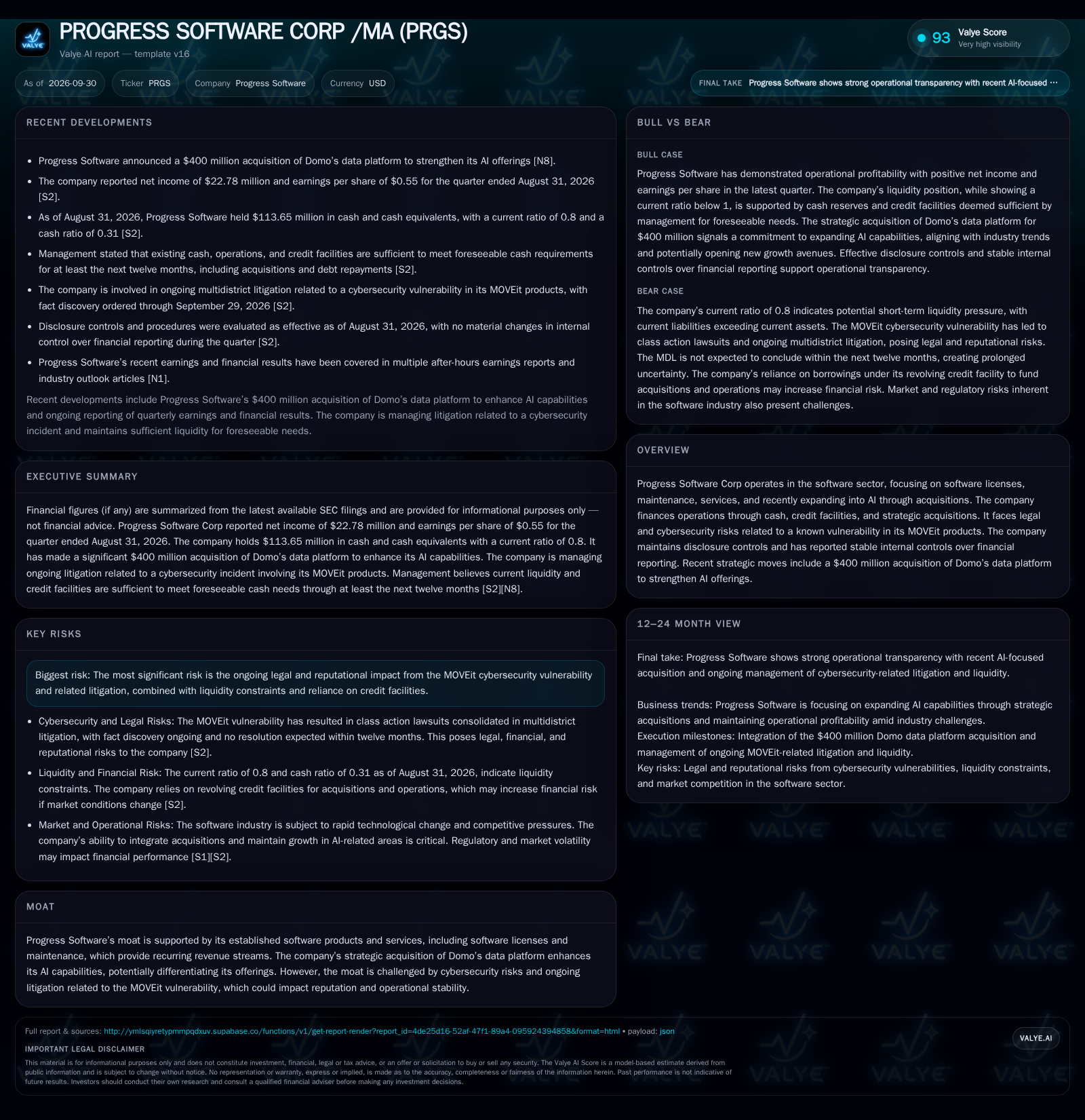
Progress Software is pursuing growth via AI-focused acquisitions, most notably the $400 million Domo deal, but faces continued legal exposure from the MOVEit cybersecurity incident and operates with a current ratio below 1. Management asserts that cash, operations, and credit facilities are sufficient for at least the next twelve months, yet the company’s reliance on revolving credit and exposure to litigation remain central risks. The sustainability of Progress’s expansion and its ability to defend recurring revenue streams will hinge on integration execution and legal outcomes. [S2] [N8]
Progress Software finds itself at a strategic crossroads: while the $400 million Domo acquisition underscores a bold move into the AI and data analytics space, the company continues to grapple with the fallout from the MOVEit cybersecurity breach and a current ratio below 1. How Progress navigates these intertwined challenges will define its competitive standing and ability to generate sustainable, high-quality earnings.
Recent Financial Performance, Legal Exposures, and Strategic Expansion
Progress Software reported net income of $22.78 million and earnings per share of $0.55 for the quarter ended August 31, 2026, indicating continued operational profitability [S2]. [S2]
In July 2026, Progress announced a $400 million acquisition of Domo’s data platform, funded through its revolving credit facility, marking a material expansion of its AI and analytics capabilities [N8] [S2]. At the same time, the company is defending itself in ongoing multidistrict litigation related to a significant cybersecurity vulnerability in its MOVEit Transfer product, with no resolution expected in the near term [S2].
[S2] The convergence of acquisition-driven growth, significant legal liabilities, and constrained liquidity defines the company’s current strategic context.
How Progress Software’s Business Model Converts Platform Expansion into Profitable Growth
Progress Software historically generates revenue from a blend of software licenses, maintenance, and professional services. License and maintenance contracts typically provide recurring revenue streams, while services are often project-based and less predictable. The company’s acquisition of Domo’s data platform suggests a strategic bet on expanding into subscription-based cloud analytics and AI—markets characterized by higher gross margins and more stable, multi-year revenue if customer retention is strong.
The funding of the Domo acquisition via revolving credit introduces additional interest expense and increases leverage. This places a premium on effective integration and rapid realization of cross-selling synergies to offset higher financial costs. If Domo’s platform is successfully embedded into Progress’s product suite, it could shift the company’s revenue mix toward higher-value, stickier offerings and potentially improve operating leverage, as software platforms tend to scale with lower marginal cost.
However, the MOVEit litigation introduces the possibility of material legal settlements or increased cybersecurity investment, which could pressure margins and reduce free cash flow available for future acquisitions or debt service.
Defending the Moat: Recurring Revenue, Integration Challenges, and Cybersecurity Headwinds
Progress Software’s competitive position has historically rested on a portfolio of established software products with recurring maintenance and license revenue—an attractive foundation in the software industry. The Domo acquisition may enable cross-selling into existing enterprise relationships and bolster the company’s data analytics and AI capabilities, areas where demand and pricing power are increasing.
However, the MOVEit cybersecurity incident has the potential to erode customer trust, especially in sensitive verticals such as financial services, healthcare, and government. Competitors in the enterprise software and cloud analytics space—ranging from large platform providers to niche SaaS vendors—could exploit these reputational concerns to win away business or force pricing concessions.
Integration risk is another critical variable: the success of the Domo acquisition depends on Progress’s ability to unify product roadmaps, sales channels, and support operations without disrupting service quality or cultural alignment. Failure to do so could dilute the intended strategic benefits and weaken the company’s ability to defend its recurring revenue streams against well-capitalized rivals.
If AI Integration Drives Expansion and Legal Risks Subside
A favorable outcome would see Progress successfully integrating Domo’s platform into its product suite, capturing incremental share in the high-growth cloud analytics and AI markets. This would likely manifest as accelerating recurring revenue, improved gross margins, and higher customer retention, as clients adopt new analytics capabilities alongside legacy products.
If the MOVEit litigation is resolved on terms that are manageable relative to cash flow, or if Progress demonstrates effective remediation and customer retention in the wake of the incident, the legal drag on valuation could ease. The company’s ability to generate free cash flow sufficient to both service acquisition debt and resume tuck-in acquisitions would further support a virtuous cycle of growth.
Confirmation of this scenario would include sequential growth in ARR (annual recurring revenue), successful Domo cross-sell wins, evidence of customer contract renewals in affected MOVEit segments, and limited net legal settlements relative to operating cash flow. Falsification would occur if integration stalls, customer churn accelerates, or litigation costs spiral.
Most Likely Trajectory: Profitable Operations Amid Lingering Legal and Financial Constraints
The Domo acquisition may contribute incremental growth, but integration costs and interest expense could offset much of the near-term benefit.
Management’s assertion of reported liquidity position for the next twelve months is likely to hold barring a major adverse legal event. Revenue from maintenance and license contracts should provide a degree of baseline stability, though competitive and reputational pressures could limit pricing power or slow new sales. The ongoing MOVEit litigation remains a persistent overhang, with its eventual cost and impact on customer relationships difficult to quantify at this stage.
Evidence supporting this scenario would be stable or modestly growing net income and operating cash flow, manageable legal costs, and no significant deterioration in customer retention or product adoption metrics. A major negative legal development, customer defection, or failed integration would shift the outlook toward the downside.
Legal Liabilities and Integration Missteps Compound Liquidity Pressure
The adverse scenario is characterized by a combination of escalating legal liabilities from the MOVEit litigation, customer attrition tied to reputational damage, and operational disruption from the Domo integration. If legal settlements or judgments exceed expectations, Progress may be forced to increase borrowing or curtail investment, potentially triggering covenant concerns or limiting future growth initiatives.
Integration challenges—such as technology incompatibility, salesforce disruption, or cultural misalignment—could lead to delayed synergies, higher-than-expected costs, and missed revenue targets. In turn, this could erode the company’s recurring revenue base and amplify competitive losses to more agile or trusted vendors.
Concrete evidence for this scenario would include a material increase in litigation reserves, sharp declines in renewal rates or ARR, negative free cash flow, or indications that Progress is unable to refinance or extend its credit facilities on acceptable terms. Early warning signs would also include negative customer sentiment or adverse analyst commentary regarding security and integration.
Milestones and Metrics That Will Determine Progress Software’s Next Phase
Quarterly trends in annual recurring revenue (ARR) and customer renewal rates, especially in segments affected by the MOVEit vulnerability, would help gauge the resilience of the core revenue base—if disclosed.
Updates on the financial magnitude and timeline of the MOVEit litigation, including any settlements, insurance recoveries, or material changes to legal reserves.
Progress on integration milestones for the Domo acquisition: cross-selling wins, combined product launches, and cost synergy realization would provide evidence of value creation.
Interest expense, leverage ratios, and credit facility covenants, as management’s reliance on revolving credit increases financial risk.
Operating cash flow and free cash flow trends, particularly as legal and integration costs are absorbed.
Customer sentiment and net promoter scores in the wake of the cybersecurity incident, to test whether reputational damage is being contained.
New product adoption rates and expansion into AI/data analytics use cases, as evidence that the growth thesis is materializing.
Disclosure of any further cybersecurity incidents or regulatory investigations, as these could amplify legal and reputational risk.
Disclaimer: This is research-only, informational analysis and not investment advice. It may include AI-generated interpretation and general industry context. Always verify important details using primary sources.

Comments