
Hall Chadwick Acquisition Corp: SPAC Execution Window Narrows as REEcycle Deal Progresses
Hall Chadwick Acquisition Corp faces a finite timeline to complete its initial business combination, with a pending agreement to acquire REEcycle Holdings, a rare earth recycling firm. Success now depends on due diligence, deal execution, and the viability of the target’s sector, while the company’s trust account capital serves as both opportunity and constraint.
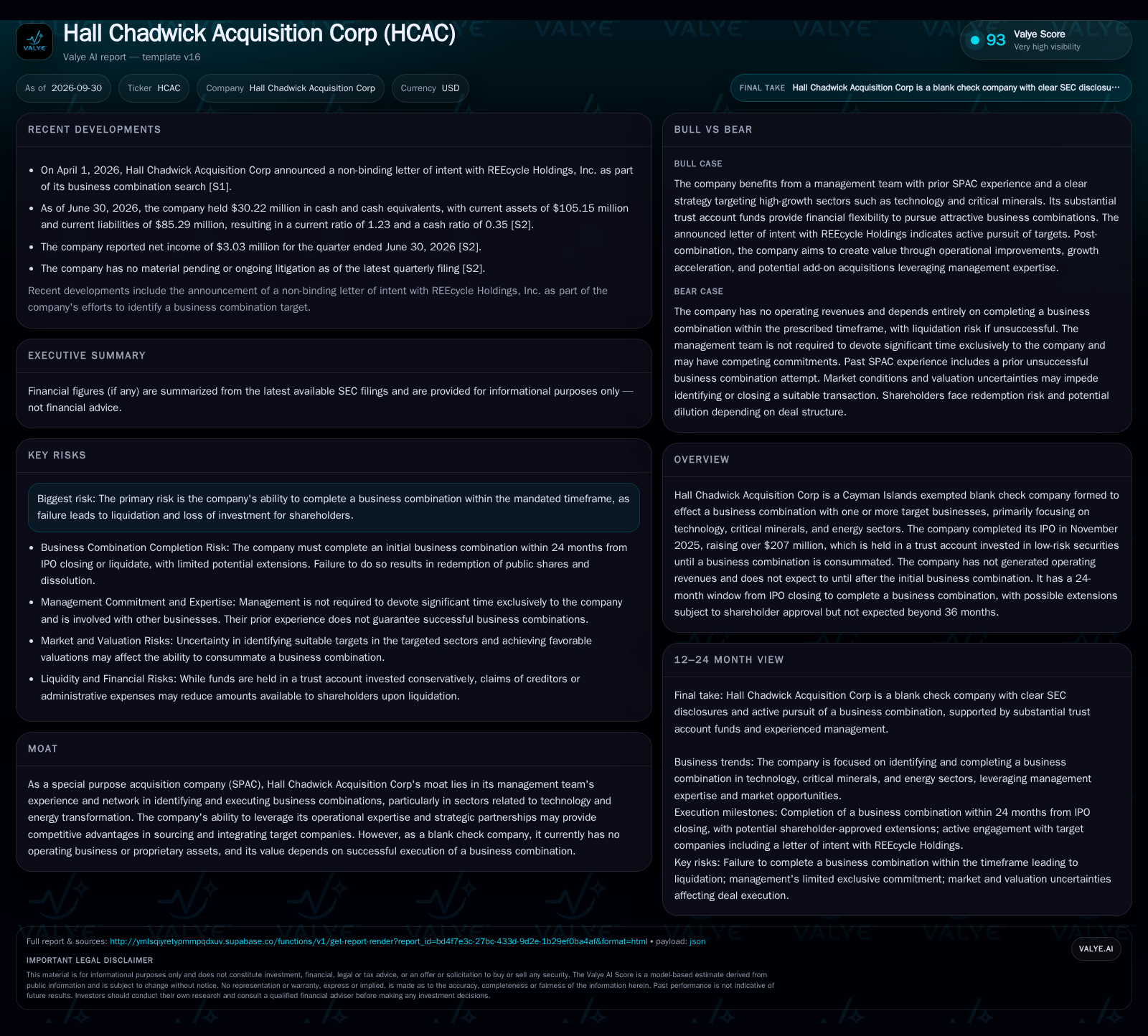
Hall Chadwick Acquisition Corp has entered into a business combination agreement with REEcycle Holdings, aiming to merge with a company focused on rare earth recycling. The SPAC has approximately 14 months remaining on its standard 24-month deal window from IPO, with trust proceeds still held in low-risk assets. The next phase will test both the strategic fit and execution capabilities of management, as well as the commercial prospects of REEcycle’s technology in a competitive and evolving minerals market. Failure to close a deal within the window could lead to liquidation and return of funds to shareholders. [S2]
Hall Chadwick Acquisition Corp, a Cayman Islands-based SPAC, is approaching the critical phase of its lifecycle after signing a business combination agreement with REEcycle Holdings, a company specializing in rare earth element recycling from end-of-life magnets. With a finite window to complete this transaction before its trust account must be liquidated, the focus shifts from capital-raising and target sourcing to the operational and strategic hurdles of closing and integrating a high-potential but unproven business. The outcome will hinge on management’s ability to navigate due diligence, regulatory review, shareholder sentiment, and the technological and market risks inherent in the critical minerals sector. [S2]
Business Combination with REEcycle: A Defining Moment Approaches
Hall Chadwick Acquisition Corp has entered into a business combination agreement with REEcycle Holdings, a Delaware-based company specializing in rare earth element recycling via hydrometallurgical processes. This agreement marks a transition from the SPAC’s capital-raising and target search phase to the execution phase, where success depends on completing due diligence, regulatory approvals, and securing shareholder support. As of June 30, 2026, the company reported $30.22 million in cash and equivalents, with a current ratio of 1.23, and no material litigation, providing a stable but time-limited platform for deal completion. The company must close this transaction by late 2027 or face liquidation, making the pending REEcycle deal the central determinant of near-term value. [S2]
SPAC Economics: Capital Structure, Incentives, and Post-Merger Value Drivers
Hall Chadwick Acquisition Corp’s economics are fundamentally those of a SPAC: it raises capital from public investors, deposits the proceeds in a trust account, and seeks to merge with a private operating company. Until a business combination closes, the SPAC earns only interest income on its trust assets, while incurring operating expenses related to public company compliance and target search. The majority of funds—over $207 million from the IPO and private placement—remain invested in low-risk U.S. government securities or money market funds, limiting both yield and risk.
Upon successful merger, the economics shift dramatically. The merged entity may access the trust capital (net of redemptions and transaction costs) to fund operations, growth, or technology commercialization. However, the SPAC model introduces potential dilution from share redemptions, sponsor shares, and warrants—features that can erode value for public shareholders if not managed carefully. The economics of the post-merger entity will depend on REEcycle’s ability to scale rare earth element recovery, achieve sustainable margins, and demonstrate revenue growth in a capital-intensive industry. The structure may allow for bolt-on acquisitions or further capital raises, but only if initial integration and early commercial milestones are met.
Positioning in the Rare Earth Recovery and SPAC Markets
Hall Chadwick’s competitive position as a SPAC is shaped by its management’s prior experience and its ability to access high-potential targets in sought-after sectors like critical minerals and energy transformation. The choice of REEcycle as a partner targets a segment—rare earth recycling—where supply chain security, ESG mandates, and technological innovation are converging. However, competition is fierce: established recyclers, traditional mining companies, and new entrants are all vying for leadership in rare earth recovery, with varying degrees of technological maturity and regulatory acceptance.
The SPAC’s flexibility to offer capital, public listing, and potential strategic partnerships is a temporary advantage, but one that evaporates if a deal is not closed within the mandated window. Post-merger, competitive advantage will depend on REEcycle’s intellectual property, cost position, ability to achieve offtake agreements, and scale manufacturing. Until then, Hall Chadwick’s differentiator is its ability to bring a vetted, high-potential target to public markets quickly—a value proposition that is strongest in periods of capital scarcity or sectoral tailwinds.
If REEcycle Delivers Commercial Proof, Value Creation Could Be Substantial
The most favorable outcome is that Hall Chadwick successfully closes the REEcycle transaction and the combined company achieves commercial proof of its rare earth recycling technology. If REEcycle demonstrates scalable recovery yields, cost competitiveness, and secures long-term supply or offtake agreements with magnet manufacturers or OEMs, the merged entity could capture a premium valuation as a critical minerals enabler. Potential confirmation of this scenario would include public announcements of commercial contracts, rapid ramp in production volumes, and early-stage revenue growth post-combination. Analyst coverage, institutional investor interest, and sector re-rating could follow if REEcycle’s process is validated at scale, especially in the context of ongoing supply chain concerns for rare earth elements.
Execution Risks and Mixed Outcomes Characterize the Most Likely Path
The most plausible scenario is one of mixed success: Hall Chadwick closes the REEcycle merger after moderate redemptions, but the post-merger company faces a protracted period of pilot-scale operations, technology de-risking, and commercial negotiations. Initial revenue may be limited or lumpy, with cost overruns and delays typical of early-stage industrial scale-up. The merged entity may need to raise additional capital to fund expansion, leading to further dilution if equity markets are weak. Confirmation would come from a completed merger with modest initial revenues, ongoing capital raises, and cautious management guidance. Falsification would include failure to close the deal, or early evidence of technical or commercial setbacks that force a strategic pivot.
Deal Failure or Technology Setback Could Force Liquidation or Value Destruction
The adverse scenario is that due diligence uncovers material issues with REEcycle—technical, regulatory, financial, or strategic—that prevent deal closure. Alternatively, macro conditions, shareholder redemptions, or loss of regulatory approval could derail the transaction. In this case, Hall Chadwick may fail to find and close a new deal within its remaining SPAC window, resulting in liquidation and return of trust funds to public shareholders, with sponsors forfeiting their investment. Even if the deal closes, lack of commercial traction or negative data on REEcycle’s process could lead to rapid value erosion, delisting risk, or the need for a distressed recapitalization. Confirmation would include public deal termination, liquidation filings, or technical disclosures indicating unviability of the recycling process.
Milestones That Will Determine Hall Chadwick’s Outcome in the Coming Year
Progress toward definitive merger agreement and regulatory filings: Announcements or SEC filings confirming the advancement from letter of intent to a binding merger agreement and S-4 registration would be critical.
Shareholder redemption rates: High redemption rates at the merger vote would materially affect available capital and public float.
Due diligence and audit outcomes: Disclosures of technical, financial, or legal due diligence findings—if negative—could jeopardize the deal.
Commercial milestones at REEcycle: Evidence of pilot plant commissioning, customer samples, or offtake agreements would support commercial viability.
Post-merger capitalization and dilution: The structure of the combined company’s capitalization, including PIPE financing, sponsor shares, and warrant exercises, will affect public shareholder value.
Board and management composition post-merger: Confirmation of the operating and governance structure for the combined company.
Sector regulatory or macro events: Changes in rare earth trade policy, recycling subsidies, or supply chain disruptions could shift the risk/reward calculus.
If disclosed, early revenue or margin performance from REEcycle’s operations would test the scalability thesis.
Disclaimer: This is research-only, informational analysis and not investment advice. It may include AI-generated interpretation and general industry context. Always verify important details using primary sources.

Comments