
IperionX: Technology-Driven Titanium Scale-Up Meets Funding and Execution Crossroads
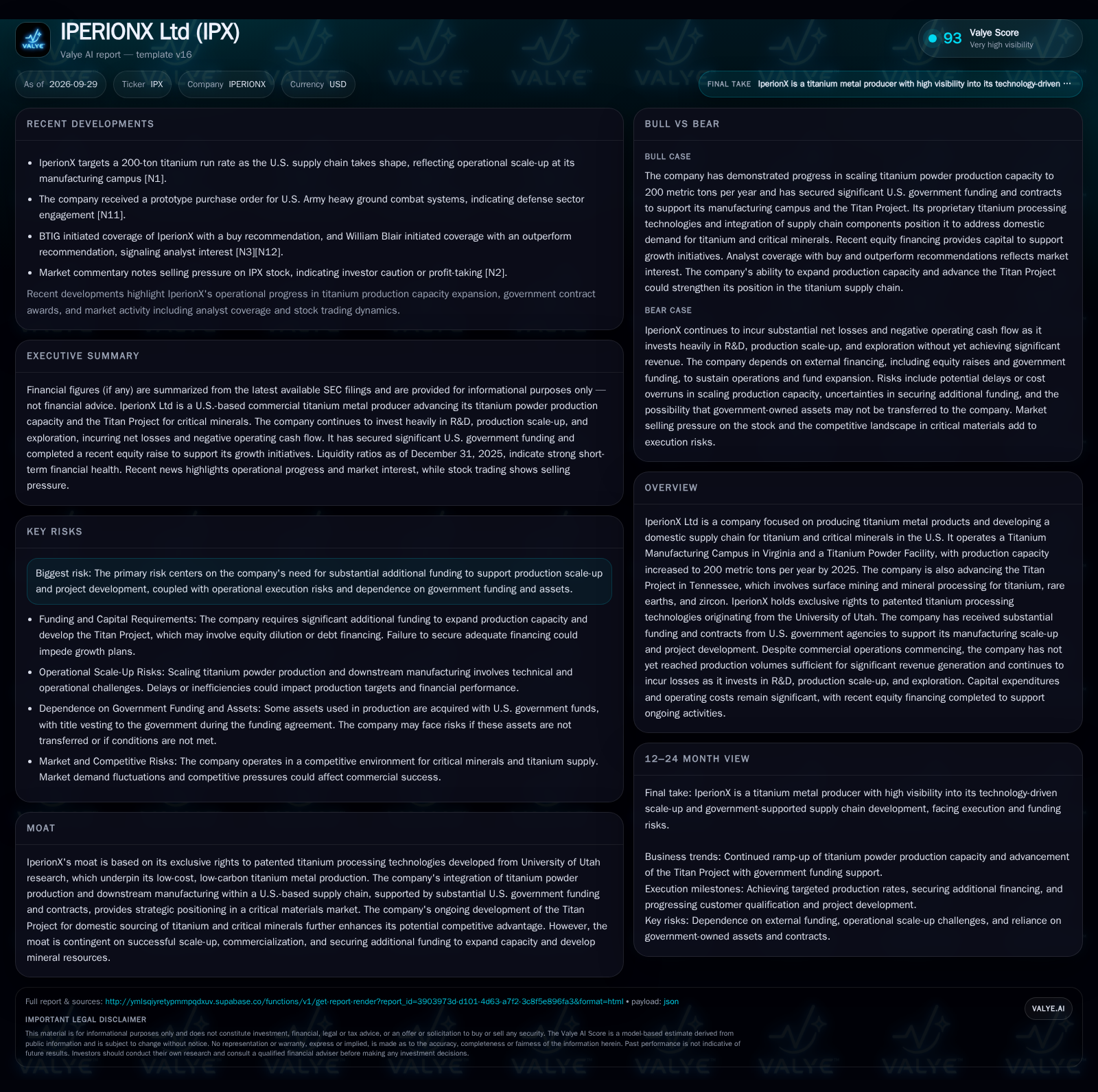
IperionX has advanced to commercial titanium powder production in the U.S., leveraging patented processing technology and government support to expand capacity and develop a domestic supply chain. Yet, persistent losses, reliance on external funding, and the need to prove cost and market advantages make the next phase of execution pivotal.
IperionX has scaled its U.S. titanium powder production to 200 tpa and secured significant government backing, but remains pre-revenue and reliant on further external capital. The company’s success now depends on demonstrating economic advantage, achieving commercial offtake, and securing funding for the ambitious Titan Project.
IperionX has reached a crucial inflection point as a U.S.-based titanium producer, transitioning from demonstration to commercial operations with proprietary processing technology and growing government support. A 60% increase in powder production capacity and the launch of the Titan Project represent strategic milestones, but the company remains pre-revenue and highly dependent on external financing. The path forward will test whether IperionX can convert technical and policy advantages into sustainable economics as it seeks to anchor a domestic critical minerals supply chain.
Where IperionX Stands: Capacity Gains, Losses, and the Funding Equation
IperionX has increased its titanium powder production nameplate capacity from 125 to 200 metric tons per year by 2025, achieving this 60% gain through operational and process improvements without additional capital outlay [S1]. This demonstrates the company’s ability to leverage its proprietary technology for efficient scaling. At the same time, net losses widened to $66.8 million in fiscal 2026, with heavy R&D ($25.2 million), exploration ($5.4 million), and administrative ($25.9 million) expenses reflecting both ongoing commercialization and the capital intensity of the Titan Project [S1].
[S1] Liquidity ratios at the prior calendar year-end were strong, but the company has not yet achieved sufficient production volumes for significant revenue or positive operating cash flow [S1]. The Titan Project in Tennessee and the optional expansion of powder production to 1,400 tpa both require further substantial funding, likely involving a mix of debt, equity, or partnerships [S1].
The Mechanics of Titanium Production: Cost, Scale, and Value Chain Leverage
The core of IperionX’s business model is to produce titanium metal products—initially powders—using patented, potentially lower-cost and lower-carbon processes licensed from the University of Utah. Titanium powder economics are typically characterized by high value per unit weight, but require significant capital investment and tight process control to achieve cost competitiveness and quality for demanding end-markets such as aerospace and defense.
IperionX aims to capture margin by integrating upstream (Titan Project mining) and downstream (powder and component manufacturing) operations, reducing reliance on imported feedstock and offering a domestic, potentially more secure supply chain. Achieving positive operating leverage will depend on ramping production to levels that absorb fixed costs, securing offtake agreements, and translating government-supported scale-up into commercial sales. The company’s ability to expand powder capacity to 1,400 tpa in the future is conditional on access to further capital, and the economics of the Titan Project will depend on successful mining, processing, and market demand for both titanium and critical minerals such as rare earths and zircon.
Until commercial sales volumes are realized, IperionX remains in an investment-heavy phase, with negative cash flow and a high dependency on external funding. The commercial structure of powder sales—whether via long-term contracts, spot sales, or direct supply to government or private sector customers—will determine revenue visibility and working capital needs.
Assessing Moat Potential in a Crowded Titanium and Critical Minerals Arena
IperionX’s potential moat rests on its exclusive rights to patented titanium processing technology, which, if proven at scale, could deliver structural cost or sustainability advantages over legacy Kroll-process producers and international competitors [S1]. The company’s U.S. base and government support position it well as supply chain security becomes a policy priority, particularly for defense, aerospace, and advanced manufacturing segments.
However, titanium and critical minerals markets are highly competitive, with incumbent producers (including global miners, integrated metal producers, and specialty powder firms) already established. Substitution risk exists from alternative materials or international supply chains if IperionX’s costs or quality do not meet market needs. The company’s strategy to integrate mining, processing, and manufacturing could increase switching costs or supply chain stickiness for domestic customers, but only if it can demonstrate reliability and scale.
A further complication is that key production assets at the Titanium Powder Facility are government-funded, with title vested in the U.S. government during the funding agreement term [S1]. This could limit asset flexibility or create operational constraints if funding terms change or are not renewed.
Unlocking Value: When Technology and Policy Tailwinds Convert to Revenue
The most favorable scenario for IperionX would see its proprietary titanium powder process validated at commercial scale, leading to cost and carbon advantages that attract large defense, aerospace, or industrial customers. Successful customer qualification and the signing of multi-year offtake agreements would establish recurring revenue and support further capacity expansion.
If the Titan Project advances on schedule and delivers domestic titanium, rare earths, and zircon, IperionX could become a critical supplier in the U.S. supply chain, benefiting from policy-driven demand and potential premium pricing. Additional government contracts or grants might further de-risk scale-up costs, while successful expansion to 1,400 tpa powder capacity would create operating leverage as fixed costs are spread over higher output.
Evidence that would confirm this scenario includes: public disclosure of material offtake contracts, consistent quarter-over-quarter volume ramp, gross margin improvement, and new government or Tier 1 industrial partnerships.
Commercialization Proceeds, but Break-Even Remains Distant
The most plausible near-term path is that IperionX continues to ramp titanium powder production and advances the Titan Project, but remains in a pre-revenue or low-revenue phase as it moves through customer qualification cycles.
Government support provides a partial buffer for scale-up risk, but the company must repeatedly prove technology reliability and economic viability to both commercial and policy stakeholders. The timeline to break-even is extended, with ongoing exposure to capital market conditions, cost inflation, and execution risk.
This scenario would be confirmed by further equity raises, incremental capacity upgrades, and initial but modest commercial shipments, with limited gross margin visibility in the next 12-24 months.
When Funding Gaps and Execution Risks Derail the Scale-Up
The adverse scenario sees IperionX unable to secure adequate follow-on funding for either the Titan Project or powder capacity expansion, leading to stalled progress or forced downscaling of operations. Technical challenges or delays in ramping production could erode customer confidence, while failure to secure commercial offtake agreements would prolong negative operating cash flow.
Rising costs, regulatory setbacks, or loss of government asset access could exacerbate financial stress. In this scenario, dilution risk increases for existing shareholders, and the company could ultimately be forced into asset sales, strategic partnership on unfavorable terms, or even restructuring.
Evidence of this scenario would include: missed production milestones, a sharp increase in fundraising activity on distressed terms, reports of customer qualification failures, or withdrawal of government support.
Milestones That Will Define IperionX’s Commercial Trajectory
Quarterly titanium powder production volumes and plant utilization rates—if disclosed—will show whether the company is approaching commercial scale.
Disclosure of binding offtake agreements, especially with defense, aerospace, or major industrial customers, would validate demand and pricing.
Gross margin trends and cost-per-ton metrics will be critical in assessing whether the technology delivers a structural advantage.
Progress milestones and capital deployment at the Titan Project, including permitting, project funding, and first ore production.
Updates on the status and terms of government-funded assets at the Titanium Powder Facility—especially any changes in asset ownership or funding conditions.
Frequency, size, and terms of future equity or debt raises, indicating capital market access and dilution risk.
Advancement of downstream integration—such as component manufacturing or additive manufacturing partnerships—that could enhance value capture.
Any shifts in U.S. government policy or procurement that impact domestic titanium supply chain priorities.
Disclaimer: This is research-only, informational analysis and not investment advice. It may include AI-generated interpretation and general industry context. Always verify important details using primary sources.

Comments