
Copart’s $1.9B Digital Expansion: Integration, Platform Economics, and Competitive Stakes in Auto Auctions
Copart’s acquisition of ACV Auctions for $1.9 billion signals a strategic bet on digital scale and technology leverage in vehicle auctions.
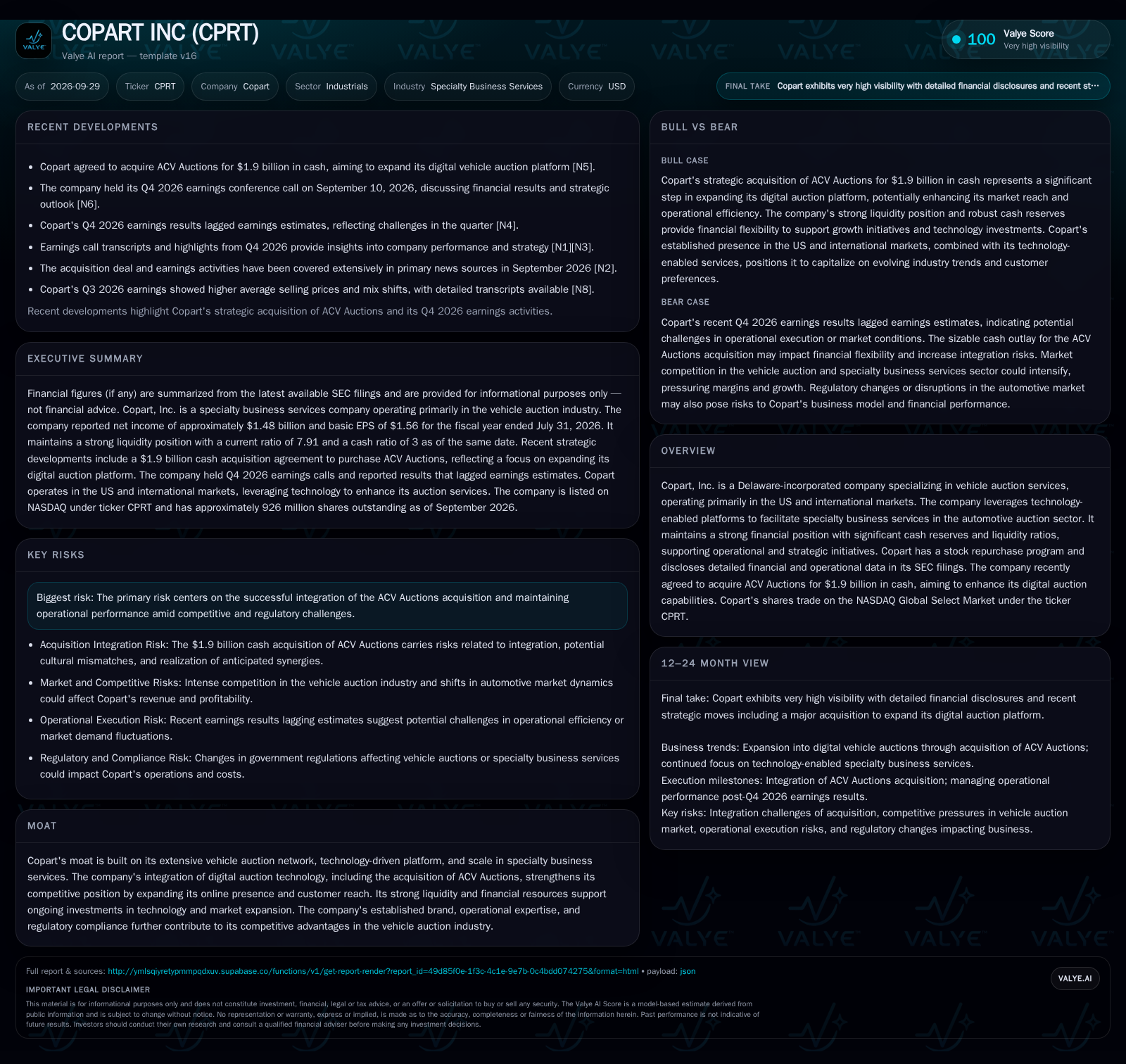
Copart is acquiring ACV Auctions for $1.9 billion in cash, aiming to expand its digital auction capabilities amid reported liquidity position and a reported balance sheet position. The move is designed to strengthen Copart’s technology platform and market reach, but introduces integration and execution risks as the company adapts to intensifying competition and shifting automotive market trends. Recent earnings fell short of expectations, highlighting the need for operational discipline during this transition phase. [N4] [N5]
Copart’s $1.9 billion cash acquisition of ACV Auctions marks a pivotal moment for the company as it accelerates its transition into a fully digital auto auction powerhouse. Buoyed by a reported liquidity position, Copart is betting that increased digital scale and technology integration will extend its leadership in the increasingly competitive vehicle remarketing sector. However, the sizable capital commitment, integration challenges, and recent earnings underperformance underscore the need for careful execution as Copart moves into this next phase of growth and transformation. [N4] [N5] [S1]
Strategic Acquisition and Financial Position Define Copart’s New Phase
Copart has entered into a $1.9 billion cash agreement to acquire ACV Auctions, a move intended to significantly expand its digital vehicle auction platform and reinforce its position in the specialty business services sector [N5]. The company reported cash and liquidity metrics for the period; these figures do not by themselves establish operating runway, investment capacity, financial flexibility, or financing capacity. [S1] While this financial strength provides Copart with the capacity to execute large-scale strategic initiatives, the company’s Q4 2026 earnings lagged market expectations, signaling operational or market challenges as it embarks on this ambitious integration [N4]. These developments collectively set the stage for a period marked by both opportunity and heightened execution risk.
Beyond the headline liquidity metrics, a deeper analysis of Copart’s financial position should consider the interplay between capital allocation priorities and the timing of integration-related expenditures. Large-scale acquisitions typically entail upfront integration costs, potential restructuring charges, and investments in harmonizing technology platforms, all of which can temporarily constrain free cash flow. Moreover, the balance sheet strength must be evaluated in the context of macroeconomic uncertainties affecting the automotive remarketing sector, such as shifts in used vehicle demand, credit availability for buyers, and regulatory changes impacting salvage vehicle flows. This nuanced financial context underscores the importance of maintaining operational flexibility during the integration phase to mitigate downside risks while pursuing strategic growth.
Auction Platform Economics: Scale, Margins, and Digital Leverage
Copart’s business model is centered on facilitating vehicle auctions—primarily salvage and wholesale vehicles—through technology-enabled platforms that connect sellers (insurers, dealerships, fleet operators) with a global network of buyers. Revenue is primarily generated from auction fees, buyer premiums, and ancillary services such as vehicle storage and transportation. The economics of this model benefit from high operating leverage: once the digital and physical infrastructure is established, incremental auction volume drives margin expansion, as fixed costs are spread over a larger transaction base.
The integration of ACV Auctions could enhance Copart’s digital capabilities, potentially enabling more seamless online auctions, richer data analytics, and improved customer experiences. If successfully executed, this may allow Copart to capture a greater share of higher-value vehicles and expand its service offering to new customer segments. However, the $1.9 billion cash outlay increases capital intensity, and the payback period will depend on the speed and effectiveness of integration, as well as the realization of cross-platform synergies.
The auction platform’s unit economics are also sensitive to network effects and liquidity dynamics. As more buyers and sellers engage on the platform, the value proposition strengthens, potentially accelerating auction velocity and reducing time-to-sale. However, if integration delays or user experience issues arise, network liquidity could suffer, eroding competitive advantage. Additionally, the monetization of ancillary services—such as transportation logistics, vehicle reconditioning, or financing facilitation—depends on successful cross-selling and data-driven customer segmentation. Therefore, the realization of margin expansion hinges not only on scale but also on the platform’s ability to deepen customer engagement and diversify revenue streams beyond core auction fees.
Digital Transformation and Competitive Pressures in Vehicle Remarketing
Copart’s historical moat has been built on its expansive auction yard network, proprietary digital platforms, and strong relationships with insurers and fleet operators. However, the competitive landscape is evolving rapidly. Digital-native entrants—such as the acquired ACV Auctions—have begun to disrupt traditional auction models with fully online auctions, real-time bidding, and integrated inspection services. Meanwhile, established peers in the vehicle remarketing and auction sector are also investing heavily in digital transformation, logistics, and value-added services.
Success in this environment will likely hinge on the ability to deliver a superior digital experience, efficient transaction processing, and robust data transparency for both buyers and sellers. Copart’s acquisition of ACV Auctions is a direct response to these pressures, aiming to preempt disintermediation by digital-first competitors and to extend Copart’s reach into new market segments. However, integration risk and the potential for culture or technology mismatch remain real challenges. The question is whether Copart can leverage the combined platform to defend its market share and sustain above-average margins as the industry digitizes.
The competitive dynamics in vehicle remarketing are further complicated by evolving buyer preferences and technological innovation cycles. For instance, the rise of mobile bidding, AI-powered vehicle condition assessments, and blockchain-based transaction verification could redefine industry standards for transparency and trust. Copart’s ability to integrate ACV Auctions’ technology stack presents an opportunity to accelerate adoption of such innovations, but also requires agility to continuously iterate and upgrade capabilities amid rapid technological change. Furthermore, competitive responses may include price competition, expanded service offerings, or strategic partnerships, all of which could pressure margins and necessitate ongoing investment in platform differentiation.
Synergy Realization and Digital Scale Drive Outperformance
In a favorable scenario, Copart successfully integrates ACV Auctions, extracting both cost and revenue synergies. The combined digital platform attracts new buyer and seller cohorts, increases auction velocity, and enables expansion into adjacent segments such as retail or fleet remarketing. Enhanced data analytics and transaction automation could reduce operational costs and improve pricing transparency, driving higher take rates and customer retention.
Confirmation of this scenario would be evident in accelerating revenue growth above historical trends, margin expansion as digital volumes scale, and improved customer acquisition or retention metrics (if disclosed). Additional signals would include successful cross-selling of services across the combined customer base, and positive commentary from management regarding integration milestones and realized synergies.
Incremental Growth Amid Integration and Market Normalization
The most plausible outcome is that Copart achieves incremental growth through the ACV Auctions integration, but faces a transition period marked by elevated costs and operational complexity. Revenue may grow modestly as the digital platform expands, but integration challenges—such as aligning technology systems, salesforces, and organizational cultures—dampen near-term margin gains. The broader vehicle auction market normalizes post-pandemic, with volumes stabilizing and average selling prices moderating after prior mix shifts.
This scenario would be confirmed by moderate revenue growth in line with peers, steady but not expanding margins, and management commentary highlighting integration progress but also acknowledging ongoing challenges. Earnings may remain under pressure in the near term—consistent with recent underperformance—before potential benefits from the acquisition begin to accrue over several quarters.
Integration Stumbles and Heightened Competition Erode Value
In a negative scenario, Copart struggles to integrate ACV Auctions, resulting in higher-than-expected costs, cultural friction, and customer attrition. Technology integration issues could disrupt service quality or delay platform enhancements, while digital-native competitors accelerate market share gains among key customer segments. Margin compression occurs as Copart is forced to invest more aggressively in technology and customer incentives to stem losses, and the anticipated synergies from the acquisition fail to materialize.
Evidence supporting this scenario would include persistent earnings underperformance, negative operating leverage, rising integration expenses, and declining customer engagement or transaction volumes (if disclosed). Additional warning signs would be adverse management commentary about integration setbacks or higher-than-anticipated churn among acquired ACV Auctions customers.
Milestones That Will Shape Copart’s Digital Auction Thesis
Progress on integration of ACV Auctions, including updates on platform unification, technology migration, and organizational alignment.
Revenue growth rate relative to pre-acquisition trends and to digital-native competitors in the auction sector.
Gross and operating margin evolution over the next several quarters, as a test of synergy realization versus integration drag.
Customer retention, cross-sell, and new account acquisition rates across both legacy Copart and acquired ACV Auctions platforms, if disclosed.
Management commentary and quantitative disclosures regarding realized cost savings or incremental revenue from the acquisition.
Average auction selling price and mix shifts, as indicators of market demand and platform effectiveness.
Trends in capital expenditures and technology investment, to assess the sustainability of Copart’s digital transformation.
External regulatory or market developments that could impact the economics of vehicle auctions or specialty business services.
Disclaimer: This is research-only, informational analysis and not investment advice. It may include AI-generated interpretation and general industry context. Always verify important details using primary sources.

Comments