
Brightline Interactive: Physical AI Infrastructure Ambitions Meet Defense Sector Realities
Brightline Interactive, formerly Glimpse Group, is betting on its SpatialCore platform and deep government ties to power the next wave of interoperable AI in physical environments. But financial losses, long sales cycles, and a fragmented competitive landscape mean execution risks remain high as the company seeks to expand beyond defense into broader markets.
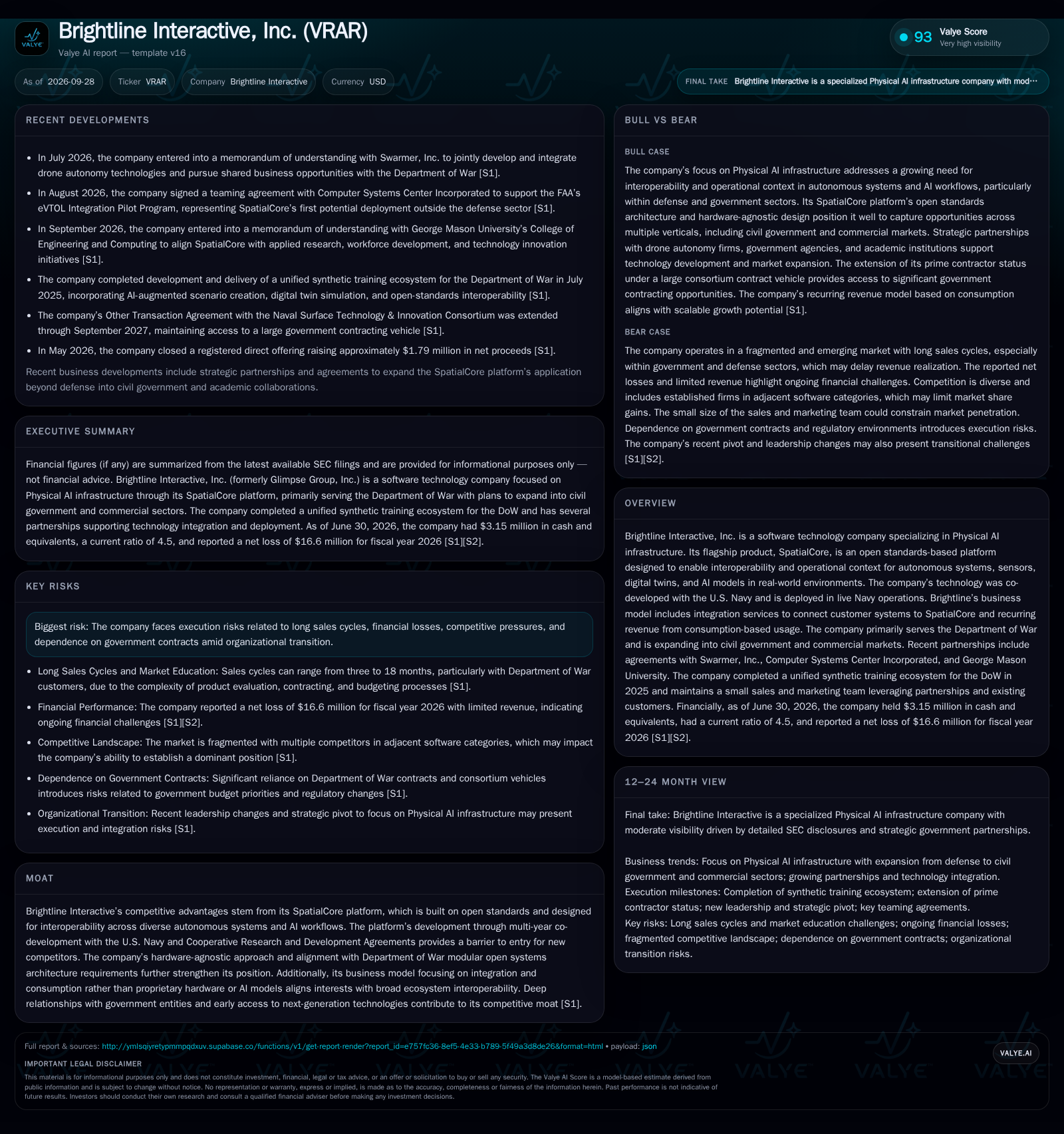
Brightline Interactive’s SpatialCore platform targets interoperability and operational context for autonomous systems, primarily within the U.S. defense sector. Recent partnerships and government contracting vehicles provide market access, but ongoing net losses and slow revenue ramp highlight the challenge of scaling in fragmented, high-friction markets. Success will hinge on converting defense credibility into broader adoption and recurring revenue, while managing capital and execution risk in a crowded field. [S1] [S2]
Brightline Interactive’s transformation from Glimpse Group to a defense-focused Physical AI infrastructure provider marks a strategic bet on the future of interoperable, real-world AI systems. With its SpatialCore platform already deployed in live Navy operations and a suite of new partnerships spanning drones, eVTOL, and academic research, the company is positioning itself as a middleware enabler for autonomous and AI-driven missions. However, persistent net losses, a small sales team, and the inherent slow pace of government contracting keep financial and execution risks front and center. The question is whether recent milestones and deepening ecosystem ties can translate into scalable, recurring revenue before capital constraints bite. [S1] [S2]
Recent Developments Shape Brightline’s Strategic Trajectory
Brightline Interactive’s most material current facts revolve around its expanded partnerships, government contracting access, and financial posture. The company signed a memorandum of understanding with Swarmer, Inc. for drone autonomy integration, and a teaming agreement with Computer Systems Center Incorporated to support the FAA’s eVTOL Integration Pilot Program—its first foray beyond defense into civil aviation. Additionally, its Other Transaction Agreement with the Naval Surface Technology & Innovation Consortium was extended through September 2027, preserving access to a significant government contracting vehicle. Financially, Brightline ended June 2026 with $3.15 million in cash, $510,000 in Q3 revenue, and a net loss of $16.6 million for fiscal 2026. Leadership changes, including a new CEO and board members with deep defense backgrounds, further signal a renewed strategic focus. These developments matter because they reflect both the company’s ongoing dependence on government opportunities and its attempt to diversify, all while contending with a high cash burn and the need for operational proof points. [S1] [S2]
Interoperability as a Platform: Revenue Model and Cost Structure
Brightline’s business model is predicated on two primary revenue streams: integration services, which generate upfront project-based fees for connecting customer systems to SpatialCore, and recurring consumption-based revenue tied to actual usage of the platform in missions, simulations, and AI workflows. This model aligns with industry trends toward software-as-a-service and usage-based pricing, especially in mission-critical government and enterprise environments. However, the economics are shaped by a high-fixed-cost structure—driven by R&D, compliance, and a need for technical sales—contrasted with variable costs that scale with customer adoption and platform usage.
Operating leverage is theoretically attractive: once a customer is integrated onto SpatialCore, incremental usage should yield high-margin recurring revenue. In practice, ramping customer adoption is slow, as evidenced by modest reported revenue versus significant net losses. The capital intensity is moderate compared to hardware-centric peers, but the need to fund long sales cycles, ongoing platform development, and market education creates a persistent funding gap. The company’s recent direct offering underscores reliance on external financing to bridge operating losses until adoption inflects. [S1] [S2]
Fragmented Market, Open Standards, and the Battle for Ecosystem Relevance
Brightline operates within a fragmented competitive landscape, with rivals spanning simulation (e.g., Bohemia Interactive Simulations), AI middleware (e.g., Duality AI), autonomy orchestration (e.g., Viam, Applied Intuition), and defense-specialized integrators. The company’s core differentiators—hardware agnosticism, open-standards architecture, and deep co-development with the U.S. Navy—help mitigate lock-in concerns and appeal to customers wary of vendor dependency.
However, these same factors lower switching costs, making it easier for customers to evaluate alternatives or multi-source solutions. Larger competitors may have deeper sales benches, broader product portfolios, and the ability to subsidize long sales cycles. For Brightline, the challenge is to convert technical credibility and defense relationships into sticky, high-value contracts before adjacent software vendors or platform providers encroach on its territory. Partnerships and government contracting vehicles extend reach, but commercial success will ultimately depend on proof of operational value, customer retention, and the ability to scale beyond bespoke projects. [S1]
Defense Validation Spurs Broader Adoption and Recurring Revenue Ramp
The bull case rests on Brightline’s ability to leverage its Navy-proven SpatialCore platform and government contracting vehicles to win additional defense and civil government projects, while parlaying this credibility into commercial verticals such as logistics and critical infrastructure. If the company can demonstrate that integration with SpatialCore materially accelerates deployment and operational effectiveness for autonomous systems, it could achieve higher platform adoption and usage-based revenue. Expansion into the FAA’s eVTOL pilot program and partnerships with academic institutions may serve as catalysts for ecosystem expansion and workforce development.
Evidence that would confirm this scenario includes: a material increase in recurring platform revenue, multi-year usage commitments from government or commercial customers, successful deployment in civil aviation or logistics, and growing integration partnerships. Announcements of significant new contracts, especially those with recurring minimums or expansion clauses, would further validate the transition from project-based to scalable platform economics. [S1]
Gradual Defense Uptake with Incremental Expansion into Adjacent Markets
The most plausible scenario is a slow but steady ramp in defense-sector adoption, with Brightline securing additional projects under its existing government contracting vehicles, while making incremental progress in civil government and commercial pilots. Revenue growth may remain episodic and lumpy, tied to the timing of contract wins and customer onboarding. The company’s small sales and marketing footprint suggests that organic expansion will be measured, with partnerships and prime contractor status providing access but not guaranteeing conversion.
Financially, continued net losses are likely until recurring platform usage reaches a critical mass. Occasional equity raises or non-dilutive funding may be needed to sustain operations. Confirmation of this scenario would include modest but consistent revenue growth from defense and pilot programs, continued extension or renewal of government contracting vehicles, and gradual broadening of the customer base—without evidence of a sharp inflection in usage or commercial market traction. [S1] [S2]
Persistent Losses and Slow Adoption Force Strategic Retrenchment
The bear case is that Brightline’s long sales cycles, project-based revenue, and competitive headwinds prevent it from achieving scale before capital constraints intensify. If government customers delay procurement, or if competing platforms capture key contracts, the company could face ongoing financial losses without a clear path to self-sufficiency. The small sales team may be unable to capitalize on partnership opportunities or adequately pursue new verticals, while the need for continuous R&D and compliance spending erodes the cash runway.
Evidence supporting this scenario would include stagnant or declining revenue, further net losses, lack of new recurring contracts, or the need for repeated dilutive financings. Loss of prime contractor status, termination of key partnerships, or negative shifts in government funding priorities would further exacerbate the risk of retrenchment or strategic alternatives. [S1] [S2]
Milestones and Metrics That Will Clarify Brightline’s Platform Trajectory
Growth in recurring platform revenue and a breakdown of usage-based versus integration services revenue, if disclosed, would help test the scalability of the SpatialCore business model.
Disclosure of multi-year or minimum-commitment contracts—particularly in civil government or commercial sectors—would indicate expansion beyond bespoke defense projects.
Customer adoption rates and the number of active mission-critical deployments would provide evidence of real-world traction and operational relevance.
Updates on government contract backlog, pipeline, or awarded task orders through the NSTIC or other vehicles would clarify near-term revenue visibility.
Sales cycle duration trends and customer acquisition costs, if available, would illuminate barriers to faster adoption and the effectiveness of the sales strategy.
Evidence of retention, renewal, or expansion among existing customers—such as follow-on contracts or increased usage—would help gauge platform stickiness.
Announcements of new strategic partnerships or ecosystem integrations, especially those that drive usage across multiple sectors, would signal progress toward network effects.
Disclaimer: This is research-only, informational analysis and not investment advice. It may include AI-generated interpretation and general industry context. Always verify important details using primary sources.

Comments