
MillerKnoll: Margin Gains, Brand Strength, and the Volatility of Contract Furniture Demand
Despite mixed top-line trends, MillerKnoll’s improved margins and diversified design portfolio highlight both the company’s resilience and the persistent challenges of cost inflation and shifting demand cycles across its core segments.
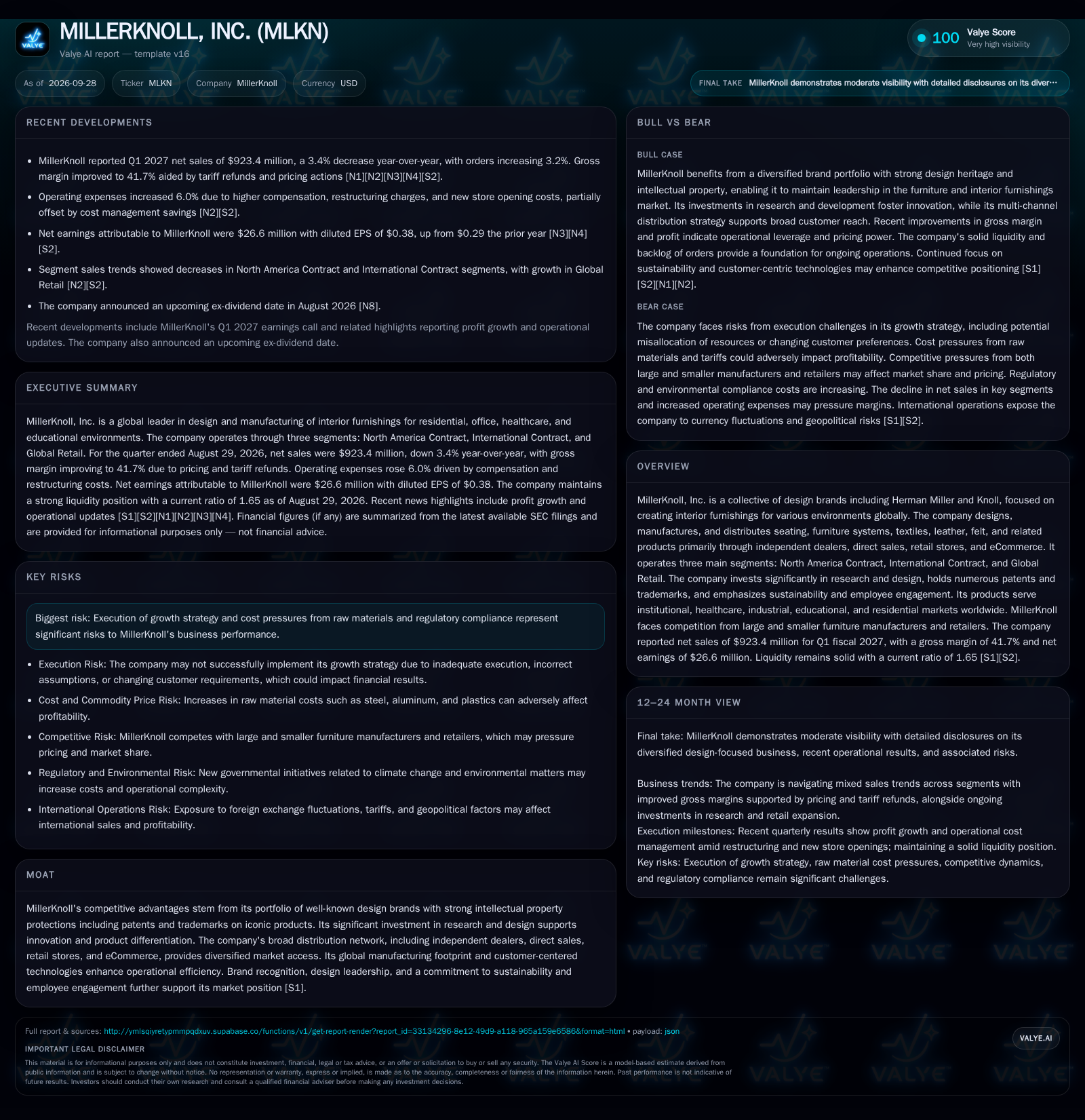
MillerKnoll reported a 3.4% year-over-year decline in net sales for Q1 fiscal 2027, driven by weakness in contract segments, but gross margin rose to 41.7% thanks to pricing actions and tariff refunds. Orders increased 3.2%, hinting at possible future stabilization. Operating expenses rose due to compensation and restructuring, while Global Retail sales grew modestly. [S2] [N1] [N2] [N3] [N4]
MillerKnoll, a global design leader with iconic brands like Herman Miller and Knoll, is navigating a complex environment marked by declining contract segment sales but improving profitability. The latest quarter saw a notable gross margin expansion, reflecting pricing discipline and tariff relief, even as top-line pressures persisted. With a strong backlog, increasing order activity, and a well-diversified channel and product mix, the company is positioned to weather near-term volatility. Yet, rising operating expenses and intensifying competition underscore the importance of execution and cost management for sustaining margin gains and long-term relevance. [S2] [N1] [N2] [N3] [N4]
Recent Margin Expansion Amid Mixed Demand Signals
MillerKnoll’s most recent quarter illustrates a nuanced operating landscape: net sales decreased 3.4% year-over-year to $923.4 million, with declines in both North America Contract (-5.3%) and International Contract (-6.4%), offset by a 2.6% increase in Global Retail sales [S2]. Despite the sales contraction, orders rose 3.2%—a potential leading indicator of improved demand or project pipeline stabilization [S2]. Notably, gross margin climbed to 41.7% from 38.5% the prior year, attributed to both pricing actions and tariff refunds [S2]. Operating expenses increased 6%, reflecting higher compensation, restructuring, and store opening costs [S2]. The backlog stood at $669.2 million, slightly below the prior year but still substantial [S2]. reported liquidity position, with a current ratio of 1.65 as of August 29, 2026 [S2].
How MillerKnoll Converts Design Leadership into Profits
MillerKnoll’s revenue model is built on a multi-segment, multi-channel approach: contract furniture for offices and institutions, and a growing retail presence for residential and small business customers. The bulk of sales (over 53%) flow through independent dealers [S1], with the remainder split between direct sales, owned retail, and eCommerce. This structure diversifies exposure but also subjects the company to cyclical swings in business and institutional demand, while retail provides some counter-cyclical ballast.
Gross margin improvements suggest that MillerKnoll can exercise pricing power—likely a function of brand strength, design differentiation, and selective cost pass-throughs. The recent boost from tariff refunds is non-recurring, but the underlying margin trajectory reflects ongoing efforts in cost management, product mix optimization, and potentially favorable raw material contracts. Operating leverage, however, is not fully realized: operating expenses have outpaced revenue growth, driven by labor, restructuring, and retail expansion. The capital intensity of manufacturing, global logistics, and R&D (with $66.7 million spent in fiscal 2026 [S1]) requires careful balancing of investment and cost discipline. The company reported cash and liquidity metrics for the period; these figures do not by themselves establish operating runway, investment capacity, financial flexibility, or financing capacity.
Brand Portfolio, Patents, and the Battle for Design Relevance
MillerKnoll commands a valuable portfolio of design-driven brands, anchored by iconic names such as Herman Miller and Knoll, supported by a suite of patents and trademarks [S1]. This intellectual property base confers some pricing and margin advantages, but the global furniture and interiors market is intensely competitive and fragmented. Large peers, regional players, and direct-to-consumer upstarts continuously challenge incumbents on price, speed, and customization. MillerKnoll’s distribution through independent dealers and direct channels helps reach diverse customer segments, though this also exposes it to potential channel conflict and dealer consolidation.
Product innovation and sustainability are core to MillerKnoll’s competitive narrative, but maintaining relevance requires constant investment and rapid response to evolving workplace and lifestyle trends. While the company’s international manufacturing footprint aids scale and flexibility, it also introduces currency, tariff, and geopolitical risks. The ability to leverage brand equity and design leadership into premium pricing and customer loyalty is a core differentiator, but the threat of commoditization remains—especially as new entrants exploit eCommerce and lower fixed costs.
If Demand Normalizes and Margin Discipline Holds, Profits Could Inflect
The most favorable scenario for MillerKnoll involves a sustained rebound in contract demand (offices, healthcare, education), coupled with continued retail growth and stable cost inputs. If the recent 3.2% uptick in orders signals a broader cyclical recovery, pending backlog could convert into stronger revenue in subsequent quarters [S2]. Gross margins could remain elevated if the company maintains pricing discipline, continues to optimize product mix, and locks in favorable procurement contracts.
Confirmation would come from sequential sales growth in contract segments, further expansion in retail, and stable or improving operating margin despite higher SG&A. Additional evidence would include reduced restructuring charges, positive working capital trends, and sustained cash generation. Falsification would occur if order growth stalls, margins erode as tariff benefits fade, or retail momentum is insufficient to offset contract volatility.
Mixed Segment Performance and Cost Inflation Remain Persistent Themes
The most plausible near-term outcome is continued volatility in contract demand, with modest retail growth partially offsetting segment declines. Gross margin may normalize as one-time tariff refunds roll off, but pricing actions and cost management could prevent a full reversion to prior levels. Operating expenses are likely to remain elevated as the company invests in store expansion and restructuring initiatives.
Sales may stabilize or recover modestly if business and institutional customers resume deferred projects, but persistent cost inflation (labor, materials) and competitive pricing pressures will cap margin upside. Confirmation of this scenario would include stable backlog, flat-to-slightly positive order trends, and operating margins that hold above pre-pandemic averages. Falsification would be visible in renewed sales declines across all segments, sharp increases in expenses, or evidence of channel or customer attrition.
Cost Pressures and Demand Weakness Could Trigger Margin Compression
A bearish scenario would see contract demand deteriorate further, with retail unable to compensate for lost volume. If raw material and labor costs escalate faster than MillerKnoll can adjust pricing or reduce expenses, gross margins could compress, particularly as tariff-related tailwinds dissipate. Operating leverage would work against the company, with fixed costs and expansion initiatives amplifying profit declines.
Confirmation would be evident in sequential backlog erosion, order contraction, and negative operating leverage (expenses rising faster than sales). Falsification would require clear evidence of cost containment, stabilization or recovery in contract sales, and resilience in retail demand even as macro conditions worsen.
Practical Benchmarks for Tracking MillerKnoll’s Strategic Execution
Quarterly order growth by segment—particularly in North America Contract and International Contract—would clarify whether recent upticks are sustainable or transitory.
Gross margin progression, excluding one-time tariff or refund effects, will be critical to assessing the durability of recent profitability gains.
Operating expense trends, especially related to restructuring, compensation, and new store openings, will signal the effectiveness of cost discipline.
Backlog changes: Movement in the $669 million backlog versus prior quarters will indicate the health of the project pipeline and near-term revenue visibility.
Retail segment growth rates and same-store sales (if disclosed) would help test whether the consumer-facing business is gaining traction.
Any updates on raw material pricing, tariff exposure, or supply chain disruptions would help gauge future margin risk.
Competitive activity—such as new product launches or major channel shifts by peers—could alter the pricing environment or market share trajectory.
Disclaimer: This is research-only, informational analysis and not investment advice. It may include AI-generated interpretation and general industry context. Always verify important details using primary sources.

Comments