
Artisan Consumer Goods: Financing Frictions, Manufacturing Gaps, and the Challenge of Reigniting a Granola Brand
With operations stalled by manufacturing lapses and acute liquidity shortfalls, Artisan Consumer Goods sits at a crossroads: securing financing and a production partner is make-or-break for the survival—and potential reboot—of its Within / Without Granola business.
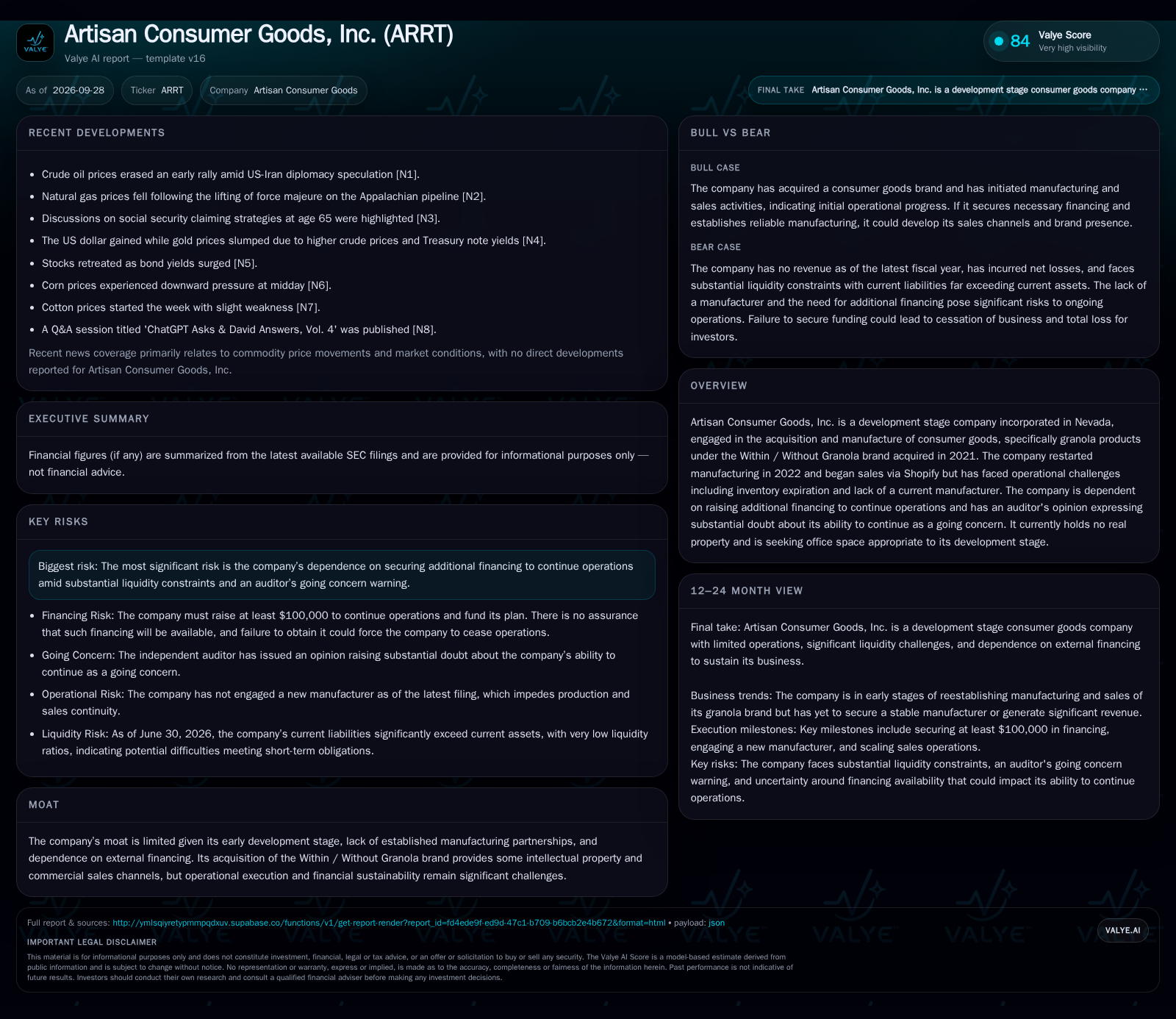
Artisan Consumer Goods, Inc. remains a pre-revenue, development-stage company with its granola operations halted due to expired inventory and no current manufacturer. The path forward depends on reestablishing production, funding operations, and overcoming execution and capital hurdles [S1].
Artisan Consumer Goods, Inc. faces an existential test as it struggles to restart its granola business following expired inventory and the absence of a manufacturing partner. With no revenue, a severe working capital deficit, and an urgent need for at least $100,000 in fresh financing, the company’s future hinges on its ability to secure both capital and operational partners. In a crowded and competitive natural foods market, the question is whether Artisan can overcome these foundational hurdles to reestablish its Within / Without Granola brand—or if the operational and financial frictions will prove terminal [S1].
Acute Liquidity Crisis and Operational Stagnation Define the Present
As of June 30, 2026, Artisan Consumer Goods reports zero revenue and a net loss of $36,862, with current assets of just $8,603 against current liabilities of $371,705. The company’s current and cash ratios stand at an extremely low 0.02, highlighting its inability to meet near-term obligations. Notably, its granola operations are at a complete standstill: the last production run’s inventory expired and was written off in early 2023, and no new manufacturer has been engaged since. The company must raise at least $100,000 to fund ongoing expenses and restart operations, but there is no assurance that such financing will be available. The auditor’s going concern warning further underscores the precariousness of the situation, putting the entire business’s survival in doubt [S1].
Business Model Economics: High Fixed Costs, Unproven Margins, and the Capital Barrier
Artisan Consumer Goods’ underlying business model—producing and selling branded granola—typically depends on achieving sufficient scale to offset fixed manufacturing, packaging, compliance, and distribution costs. Early-stage consumer packaged goods (CPG) companies often face negative margins and cash burn until they reach viable sales volume and secure efficient production contracts. In Artisan’s case, the lack of a manufacturing partner halts all revenue and prevents any cost absorption. Even if production resumes, small batch sizes may carry high per-unit costs, limiting gross margin and leaving little room to fund marketing or distribution expansion.
The capital requirement is especially acute: the company must raise at least $100,000 just to restart operations, likely covering initial production, packaging, compliance, and working capital for inventory and fulfillment. In the absence of revenue, all fixed and variable costs become a direct drain on limited resources. If financing is secured, the company may still face cash flow constraints unless it can quickly ramp sales and negotiate favorable payment terms with suppliers and distributors. Without evidence of recurring contracts, strong sales channels, or differentiated pricing power, path-to-profitability remains speculative.
Brand Asset vs. Market Realities: Navigating a Crowded Granola Landscape
Artisan’s acquisition of the Within / Without Granola brand provides a foundation of intellectual property and some prior market presence, but the company lacks evidence of scale, exclusive distribution, or proprietary formulation that could confer a durable competitive advantage. The natural and specialty foods market is intensely competitive, with numerous established and emerging brands vying for shelf space, online visibility, and consumer loyalty. Large incumbents benefit from scale, established supply chains, and significant marketing budgets, while niche brands often rely on unique formulations, local sourcing, or lifestyle positioning.
Artisan’s current absence from the market, lack of active manufacturing, and minimal financial resources leave it highly vulnerable to competitive displacement. If the company is unable to establish unique brand positioning or secure cost-effective production and distribution, it risks being crowded out by better-capitalized or more agile competitors. The lack of recurring customer relationships, subscription models, or proprietary distribution channels further limits its ability to build switching costs or defend share.
If Financing Arrives: Rebooting Operations and Testing Product-Market Fit
The most optimistic scenario hinges on Artisan securing at least $100,000 in external financing, enabling it to engage a new manufacturer, restart production, and relaunch the Within / Without Granola brand. With capital in hand, the company could reestablish Shopify and other e-commerce sales, pursue local retail partnerships, and invest in digital marketing to rebuild consumer awareness.
Early traction—evidenced by consistent monthly sales, positive customer reviews, and repeat orders—would suggest product-market fit and could support a case for follow-on financing or distribution expansion. If the company achieves cost-effective manufacturing and builds a loyal customer base, it may begin to scale revenue and improve gross margin, setting the stage for incremental operating leverage.
Confirmation would come from disclosed sales growth, new manufacturing contracts, and evidence of expanding distribution. Falsification would be signaled by inability to raise capital, continued production delays, or negligible sales post-relaunch.
Operational Paralysis Persists Unless Both Capital and Execution Hurdles Are Cleared
The most plausible near-term outcome is continued operational paralysis. Without a new manufacturing partner and in the absence of fresh capital, Artisan is unlikely to generate revenue or meaningfully progress its business plan. The company may remain in a holding pattern—seeking financing, negotiating with potential manufacturers, and attempting to secure office space—while incurring ongoing administrative and compliance costs.
Incremental progress could occur if the company secures a small bridge financing or a contract manufacturing agreement, but unless both funding and operational execution align, material revenue generation and business momentum are unlikely. Confirmation of this scenario would come from repeated disclosures of zero revenue, lack of manufacturing updates, and ongoing working capital deficits. Falsification would require a concrete financing announcement and evidence of renewed product shipments or sales.
Terminal Risk: Failure to Fund or Restart Production Forces Business Cessation
The adverse scenario is stark: if Artisan fails to raise the necessary $100,000 and cannot secure a manufacturing partner, it may be forced to cease operations entirely. The auditor’s going concern warning signals that, absent a turnaround, insolvency or dissolution is a real possibility.
Indicators of this downside include further auditor warnings, delisting or deregistration, management resignations, or a formal wind-down announcement. If the company is unable to make progress on either the financing or operational front, equity holders may face a total loss.
Milestones and Metrics That Will Determine Artisan’s Survival and Trajectory
Disclosure of a successful financing event (amount, terms, and investor type) to test whether the company can clear its capital hurdle.
Announcement or details of a new manufacturing partnership, including production timeline and minimum order commitments, if disclosed.
Evidence of resumed sales activity—such as Shopify store relaunch, initial order volumes, and customer feedback.
Updated financials showing revenue generation, gross margin, and cash burn rate following any operational restart.
Progress in securing office space and establishing basic administrative infrastructure, which may signal operational momentum.
Changes in management structure or board composition, particularly if new expertise or capital partners join.
Auditor updates or SEC filings indicating a shift in going concern status or risk disclosures.
Any legal, regulatory, or contractual developments that could impact the company’s ability to operate or access capital.
Disclaimer: This is research-only, informational analysis and not investment advice. It may include AI-generated interpretation and general industry context. Always verify important details using primary sources.

Comments