
Foxx Development Holdings: Build-to-Order Ambitions Collide with Margin Pressures and Financial Strain
The company’s build-to-order model aims to minimize inventory risk while targeting US carriers and e-commerce channels.
The company’s build-to-order model aims to minimize inventory risk while targeting US carriers and e-commerce channels. However, margin pressure, heavy reliance on third-party distributors, and uncertain product traction in wearables and IoT devices present major hurdles to sustainable growth and profitability. Execution risks and limited financial runway make Foxx’s path forward highly contingent on rapid operational improvement or external funding [S1].
Foxx Development Holdings Inc. is attempting to carve out a sustainable niche in the US communications device market through a build-to-order, asset-light approach that prioritizes inventory risk management and channel flexibility. Despite a diversified product lineup and expansion into both carrier and e-commerce sales, the company’s FY2026 financials show a precarious position: $52.6 million in revenue is offset by a nearly equivalent net loss, and liquidity metrics are at critical lows. This analysis explores the economic logic behind Foxx’s model, the competitive realities of the sector, and the operational and financial hurdles it must overcome to avoid existential risk.
Recent Performance: Revenue Growth Overshadowed by Deep Losses and Acute Liquidity Stress
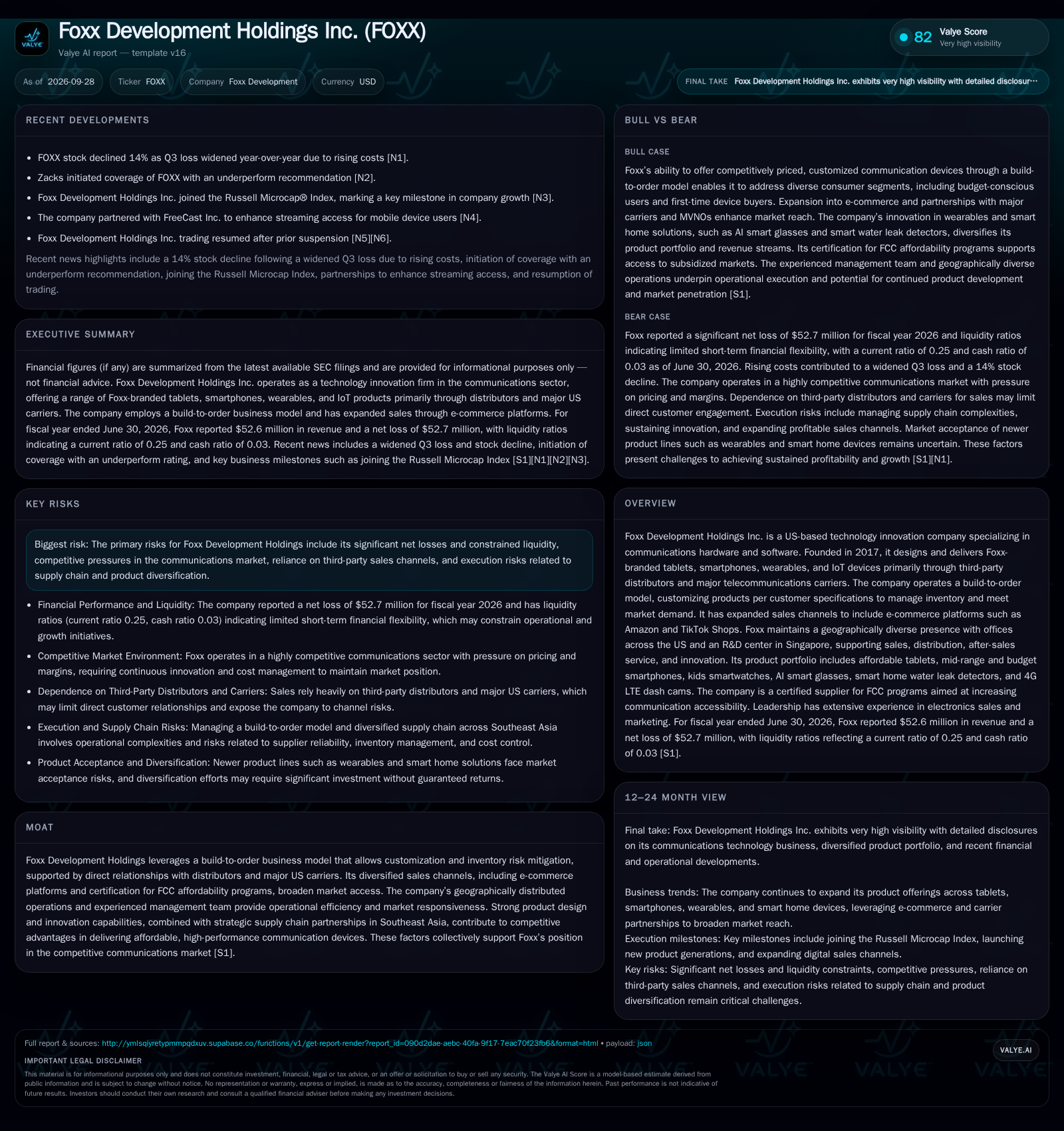
For the fiscal year ended June 30, 2026, Foxx Development Holdings reported $52.6 million in revenue, selling over 1.6 million smartphones and more than 15,000 tablets, alongside wearables and IoT products [S1]. However, the company posted a net loss of $52.7 million, resulting in a basic and diluted EPS of -$7.61 [S1]. [S1] The company’s stock declined 14% following a widened Q3 loss on rising costs, and coverage was initiated with an underperform recommendation [N1] [N2]. These facts underscore a business under significant financial strain, with operational improvement or external financing likely required for near-term survival.
Build-to-Order Economics: Inventory Risk Mitigation Versus Margin Compression
Foxx’s build-to-order model enables the company to sidestep the capital intensity and working capital drag of holding large inventories. Bulk purchase orders from distributors—primarily major US carriers and, increasingly, e-commerce partners—allow Foxx to customize production volumes, theoretically aligning costs with demand and reducing obsolescence risk [S1]. However, this model comes with trade-offs. The company’s reliance on third-party distributors and carrier partners means it has limited pricing power and little direct engagement with end-users, which can suppress margins and constrain brand equity development.
The communications hardware market is characterized by high fixed costs (R&D, certification, tooling) and intense price competition, especially in the value and mid-range segments. While Foxx’s asset-light structure may offer some operating leverage if volumes rise, its current scale appears insufficient to absorb overhead and deliver profitability. Product innovation—such as wearables and smart home devices—requires upfront investment, but the pace of adoption and return on these investments remains uncertain.
The build-to-order approach also introduces complexity in supply chain coordination and forecasting accuracy. While it reduces inventory holding costs, it places significant pressure on demand forecasting and supplier responsiveness. Any misalignment between production schedules and actual end-customer demand can lead to delays, increased expedited shipping costs, or missed sales opportunities. Moreover, the reliance on third-party distributors to place bulk orders means Foxx has limited visibility into real-time consumer preferences, which can hinder agile product adjustments and inventory replenishment strategies. This dynamic underscores a tension between inventory risk mitigation and operational flexibility that must be carefully managed to avoid margin erosion.
Channel Reliance and Product Breadth: Seeking Relevance in a Crowded Communications Landscape
Foxx operates in one of the most brutally competitive sectors: consumer communications hardware. Its primary go-to-market strategy involves partnerships with major US telecom carriers (T-Mobile, AT&T, Verizon) and MVNOs, complemented by a recent push into leading e-commerce platforms [S1]. These channels provide access to large pools of potential customers but also expose Foxx to the negotiating leverage and product selection priorities of its partners.
Against established OEMs, Foxx’s potential advantages are its build-to-order flexibility, ability to serve FCC-subsidized market segments, and lower price points. However, these are easily eroded if competitors match on price or carriers shift promotional focus. The company’s efforts to diversify into wearables and IoT products—such as AI smart glasses and smart water leak detectors—may open new niches, but market traction is unproven. In such a context, Foxx’s brand recognition, customer loyalty, and direct consumer data remain limited, making sustained differentiation challenging.
Foxx’s channel dependence also implies vulnerability to shifts in partner strategies and market dynamics. For instance, carriers and e-commerce platforms may prioritize exclusive deals with larger OEMs or proprietary brands, limiting shelf space and promotional support for Foxx’s products. Additionally, the fragmented nature of the US communications market—with multiple carriers, MVNOs, and online marketplaces—requires tailored sales and marketing efforts to optimize channel performance. Without sufficient scale or direct consumer engagement, Foxx may struggle to influence these channel partners’ prioritization, further constraining growth potential and pricing leverage. This environment demands continuous channel management and strategic alignment to maintain relevance.
Product breadth, while potentially a diversification strength, can also dilute focus and resources. Expanding into wearables and IoT devices introduces new technological and market risks, including longer development cycles, certification hurdles, and uncertain consumer adoption curves. These product categories often require differentiated marketing approaches and post-sale support capabilities, which may stretch Foxx’s operational bandwidth. If investments in these adjacent segments do not yield meaningful revenue contributions or margin improvements, they could exacerbate financial strain. Therefore, disciplined portfolio management and rigorous go-to-market validation are critical to ensure that product expansion complements rather than undermines core business economics.
What Would a Turnaround Look Like? Paths to Margin Expansion and Channel Leverage
A plausible upside scenario for Foxx would require a combination of operational execution and favorable market dynamics. If the company can leverage its build-to-order model to win larger, higher-margin deals with carriers or achieve a breakout hit in wearables or IoT devices, operating leverage could quickly improve. Success in e-commerce channels—demonstrated by significant volume growth or higher average selling prices—would indicate that Foxx is reaching new customer segments and building brand equity.
Evidence supporting this scenario would include a reversal of net losses, improvement in gross and operating margins, consecutive quarters of positive operating cash flow, and a material increase in e-commerce sales mix. Announcements of new, multi-year carrier agreements, or sustained growth in subsidized device programs, would further validate the upside. Conversely, continued net losses, stagnant e-commerce traction, or channel partner churn would falsify the turnaround thesis.
Incremental Progress Amid Margin Headwinds and Ongoing Funding Needs
The most probable near-term outcome is that Foxx continues to grow revenue modestly through carrier and e-commerce channels but remains stuck with negative margins due to competitive pricing, high fixed costs, and limited scale benefits. The company may manage to reduce the rate of net losses via incremental operational improvements, cost management, and selective product rationalization.
If Foxx is able to secure bridge financing or vendor credit to extend runway, it may have time to execute on new product launches or channel initiatives. However, any material deterioration in distributor relationships, worsening liquidity, or failed new product launches would tilt the risk toward downside.
Financial Distress and Channel Attrition: The Risk of a Liquidity Crisis
The adverse scenario for Foxx is a tightening liquidity crunch leading to operational disruptions, loss of key channel partners, or inability to fulfill purchase orders. With a current ratio of 0.25 and cash ratio of 0.03, the company’s margin for error is extremely thin [S1]. Any setback—such as a spike in component costs, a major order cancellation, or delayed carrier payments—could force Foxx into restructuring, asset sales, or even insolvency.
Confirmation of this scenario would be visible through missed payables, layoffs, a sudden drop in reported shipments, or regulatory filings indicating going-concern risk. Failure to secure new external funding, further stock declines, or termination of key carrier or e-commerce relationships would also signal a move toward financial distress. Conversely, evidence of immediate cash infusions, new credit lines, or improved working capital management would challenge this downside thesis.
Developments That Will Determine Foxx’s Survival and Strategic Direction
Quarterly net income/loss and gross margin trends—does the company show sequential improvement or continued deterioration?
Cash and equivalents on hand, along with changes in current and cash ratios—do these indicate improving liquidity or rising default risk?
Volume and revenue mix by channel (carriers vs. e-commerce)—is e-commerce gaining traction, and what’s the margin differential if disclosed?
Updates on carrier and MVNO relationships—are there new agreements, renewals, or evidence of lost shelf space?
Adoption rates and revenue contribution from new products such as wearables and IoT devices—a useful metric would be attach rates or repeat order frequency, if disclosed.
Announcements regarding external financing, credit facility expansions, or equity raises—does Foxx secure the funds needed to operate and invest?
Evidence of cost structure optimization—such as supplier negotiations, SG&A reduction, or R&D reprioritization—are fixed costs trending down as a percent of sales?
Disclaimer: This is research-only, informational analysis and not investment advice. It may include AI-generated interpretation and general industry context. Always verify important details using primary sources.

Comments