
Ocean Capital Acquisition Corp: SPAC Structure, Execution Window, and the Economics of Dealmaking Uncertainty
With $115 million in trust and a one-year deadline to complete its initial business combination, Ocean Capital Acquisition Corp faces the classic SPAC challenge: convert capital and management credibility into a viable merger before time and competitive pressure erode optionality.
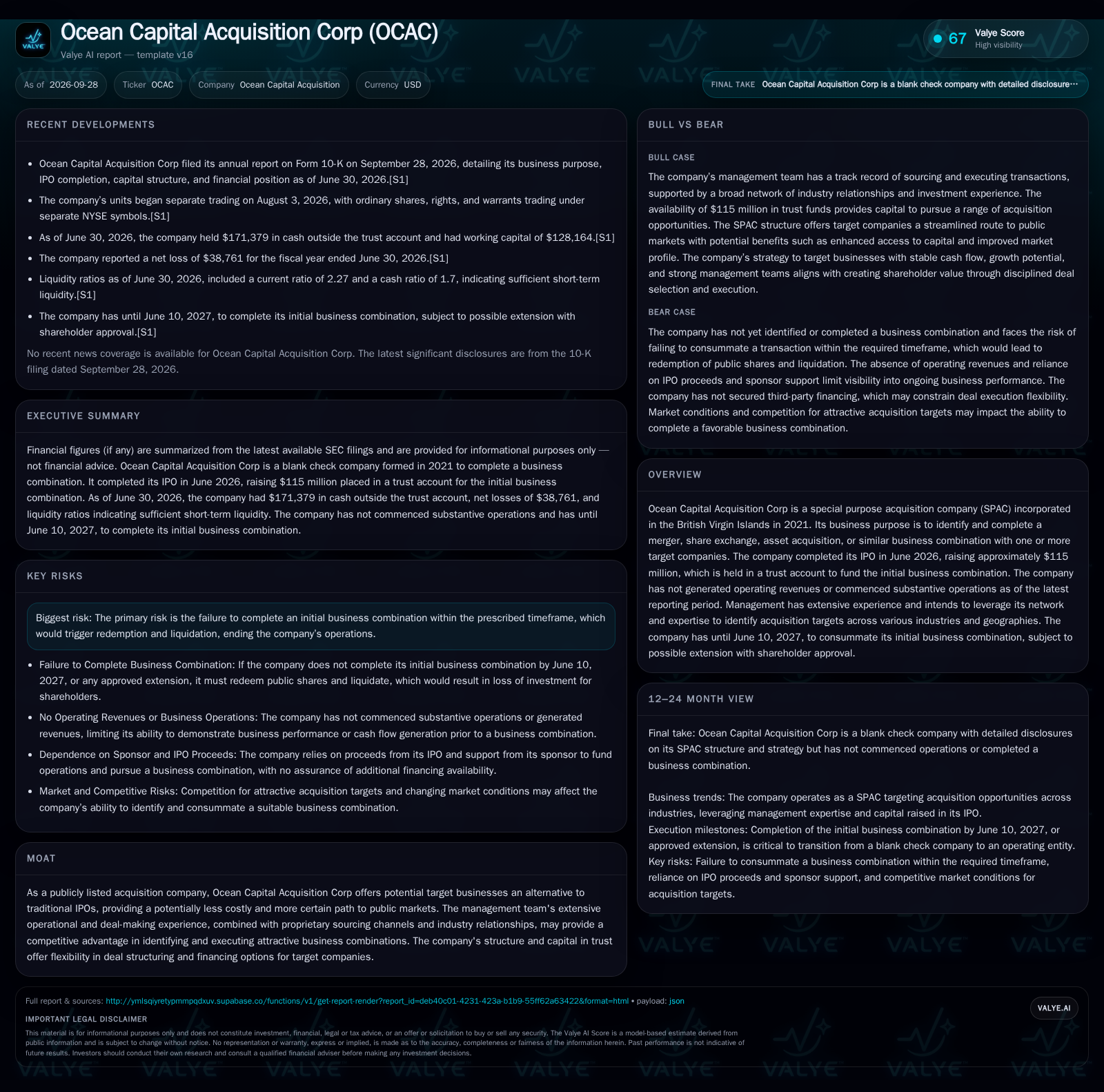
Ocean Capital Acquisition Corp is a newly listed SPAC with $115 million in trust and no operating business as of June 2026. Its management team aims to leverage broad deal experience and industry networks to source a business combination by June 2027. The company’s economics, risk profile, and valuation hinge on the identification and completion of a suitable merger within its prescribed timeframe—a process shaped by market competition, target quality, and the evolving SPAC landscape.[S1]
Ocean Capital Acquisition Corp exemplifies the modern SPAC: a blank check company with $115 million in trust, a one-year window to execute a business combination, and a management team touting operational and dealmaking expertise. With no operating business or revenue as of June 2026, Ocean Capital’s value proposition is entirely forward-looking—the successful identification, negotiation, and closure of a merger with a promising private company. This places the SPAC at the intersection of market opportunity, execution risk, and the evolving dynamics of public market access for acquisition targets. The next twelve months are decisive: failure to close a deal means liquidation and return of capital, while a well-chosen target could transform the entity and unlock value for shareholders.[S1]
IPO Proceeds in Trust and the Countdown to a Deal
As of June 30, 2026, Ocean Capital Acquisition Corp had $115 million from its IPO and concurrent private placement held in a U.S.-based trust account, with $171,379 in cash outside the trust and working capital of $128,164.[S1] The company has not commenced any substantive operations or generated operating revenues, and reported a net loss of $38,761 for the fiscal year ended June 30, 2026.[S1] Its units began separate trading on the NYSE in August 2026. Critically, the SPAC has until June 10, 2027, to complete its initial business combination, subject to extension with shareholder approval; otherwise, it must redeem public shares and liquidate.[S1] The absence of a disclosed target and reliance on IPO proceeds exposes investors to the binary risk of either a timely transaction or forced dissolution.
How SPAC Economics Create High-Stakes Optionality
Ocean Capital’s business model is fundamentally transactional: it earns no revenue until a merger is consummated. The company reported cash and liquidity metrics for the period; these figures do not by themselves establish operating runway, investment capacity, financial flexibility, or financing capacity. [S1] The economics shift dramatically after a successful merger: the acquired company becomes the operating business, and the legacy SPAC’s value depends on the target’s growth, cash flow, and capital structure.
SPACs typically structure deals using a mix of cash (from the trust), equity (new shares), and occasionally seller rollover or PIPE (private investment in public equity) financing. Ocean Capital’s flexibility in deal structuring could appeal to some targets, but the absence of third-party financing to date means the initial trust balance is the primary resource.[S1] The economics for public shareholders are shaped by redemption rates, deal terms, post-merger dilution (from warrants/rights), and the operating performance of the acquired business. Fixed costs are modest pre-merger, but post-combination, scale and margin expansion depend entirely on the acquired entity.
SPAC Competition and the Search for Attractive Targets
Ocean Capital enters a crowded and competitive field of SPACs seeking to merge with private companies eager for public listings and liquidity. The management team’s experience and network may provide access to proprietary deal flow, but the broader market is characterized by intense competition for high-quality targets, especially those with recurring revenue and strong free cash flow—attributes explicitly sought by Ocean Capital.[S1]
Private equity firms, direct listings, and traditional IPOs all serve as alternative exit routes for promising private companies. SPACs must often offer compelling terms—speed, certainty, valuation flexibility, and sometimes additional capital or operational support—to win mandates. The company’s ability to differentiate depends on management relationships, credibility, and the perceived value-add of a public listing via SPAC rather than other channels. The market’s recent focus on quality over quantity in de-SPAC transactions raises the bar for both sourcing and execution.
A Well-Executed Merger Unlocks SPAC Value
If Ocean Capital leverages its management expertise and network to identify a compelling target—ideally a business with stable cash flow, recurring revenue, and strong growth prospects—the SPAC could close a deal that generates significant value for public shareholders.[S1] A successful de-SPAC transaction could yield a publicly traded operating company with enhanced access to capital, improved market profile, and potential for multiple expansion.
Evidence supporting the upside would include the announcement of a definitive merger agreement with a credible, high-quality target, favorable transaction terms (low redemptions, manageable dilution), and positive market reception upon deal announcement. Additional confirming signs could be PIPE participation by reputable investors, strong post-merger financial guidance, and retention of key management from the target company.
Execution Window Drives Uncertainty and Optionality
The most plausible scenario is that Ocean Capital spends the next several months evaluating targets, with a deal announcement possible before the June 2027 deadline. Given the competitive market and the SPAC’s finite resources, the eventual target may be solid but not exceptional, reflecting the realities of supply and demand in the current SPAC landscape. Shareholder redemptions at the time of the vote could be significant, reducing cash available for the merger and increasing dilution from warrants and rights.
Confirmation of this scenario would come from a merger announcement with a mid-tier or niche company, moderate redemption rates, and a post-deal trading range near trust value. Falsification would be the absence of any deal progress, repeated deadline extensions, or failure to secure PIPE financing if required by the transaction structure.
Deadline Pressure and the Risk of Forced Liquidation
The most adverse outcome is that Ocean Capital fails to identify or close a suitable business combination before the June 2027 deadline, leading to forced liquidation and return of funds to public shareholders.[S1] This scenario could be driven by intense competition for quality targets, unfavorable market conditions, or inability to structure an attractive deal without third-party financing.
Evidence of this downside would include a lack of merger announcements as the deadline approaches, public disclosure of failed negotiations, or an extraordinary general meeting to approve liquidation and redemption. High sponsor expenses without progress and increasing public redemptions further support the risk case.
Thesis-Testing Markers for Ocean Capital’s SPAC Journey
Announcement of a definitive agreement with a credible merger target, including sector, scale, and financial profile.
Level of shareholder redemptions at the time of the merger vote—if disclosed, this will determine effective cash available for the deal and post-merger capitalization.
PIPE (private investment in public equity) participation or other third-party financing commitments, if any, to supplement the trust account.
Transaction terms including valuation, dilution from warrants/rights, and sponsor promote structure—would help test alignment and risk/reward for public shareholders.
Deadline extensions sought and approved (if any), which would signal execution delays or challenges in closing a transaction.
Retention of key management from the target company post-merger, as this is often critical to continuity and post-deal performance.
Market reaction to deal announcement and proxy filings, as reflected in share price relative to trust value and trading volume.
Any disclosure of failed negotiations or withdrawn merger proposals, which would indicate execution risk or market headwinds.
Disclaimer: This is research-only, informational analysis and not investment advice. It may include AI-generated interpretation and general industry context. Always verify important details using primary sources.

Comments