
Nordicus Partners Corp: Portfolio-Building Ambitions Confront Early-Stage Realities and Funding Constraints
The company’s multi-asset strategy aims to unlock value through clinical milestones and exits, yet its ability to sustain progress hinges on near-term funding and successful navigation of the regulatory and scientific gauntlet.
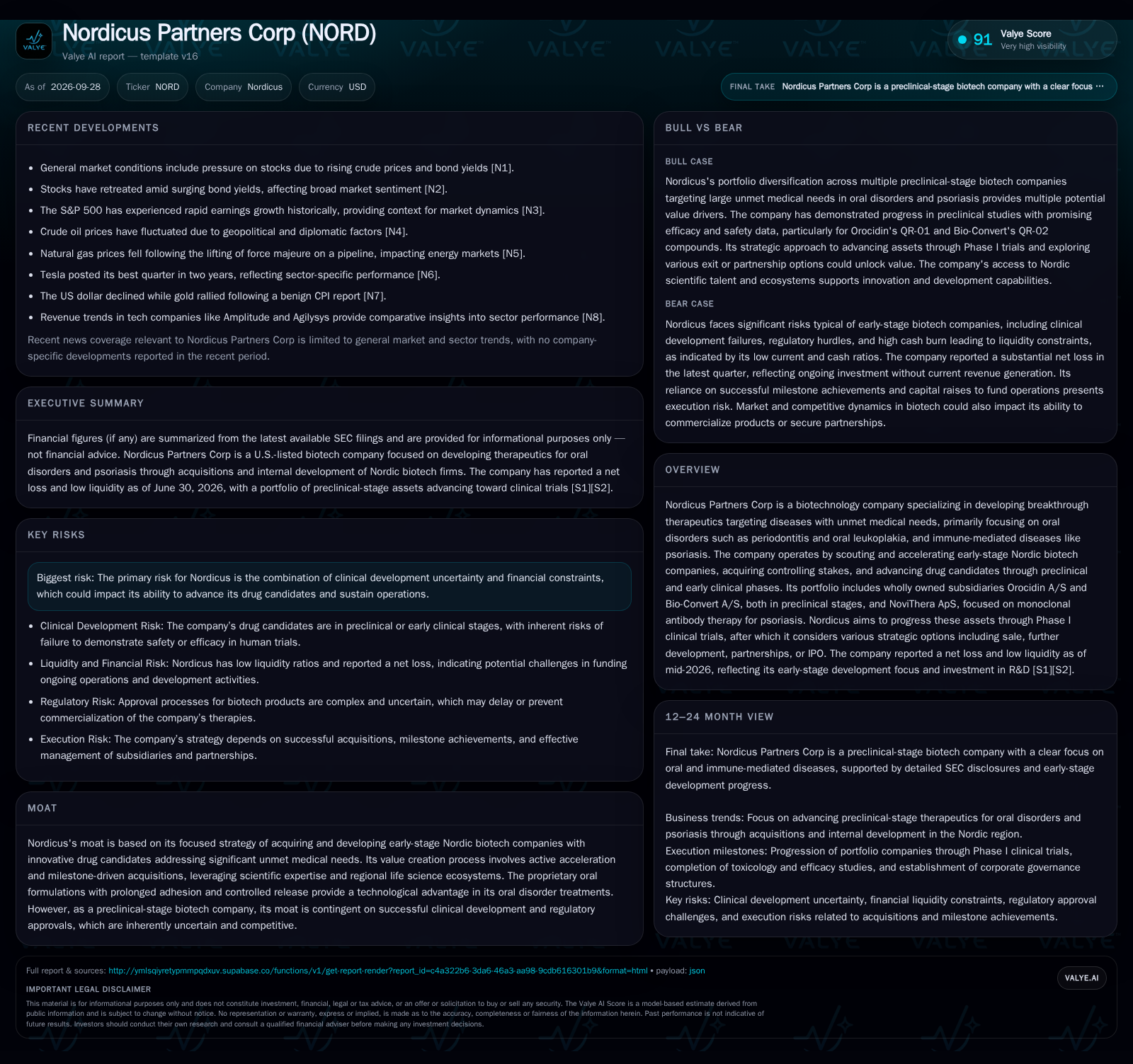
Nordicus Partners Corp is a U.S.-listed biotech incubator advancing preclinical therapies for oral and immune-mediated diseases via controlling stakes in Nordic startups. Its current portfolio—Orocidin (periodontitis), Bio-Convert (oral leukoplakia), and NoviThera (psoriasis)—remains preclinical, with lead assets showing animal proof-of-concept. However, the company’s financials reveal low liquidity and a recent quarterly net loss, underscoring the need for additional capital to reach pivotal human trials or strategic exits. Nordicus’s differentiated model offers multiple shots on goal, but funding risk and clinical uncertainty dominate the near-term outlook. [S1] [S2]
Nordicus Partners Corp is building a trans-Atlantic bridge between Nordic scientific innovation and U.S. capital markets, betting on a portfolio of early-stage biotech ventures targeting high-unmet-need diseases in oral health and immunology. While the company’s diversified approach—acquiring and accelerating multiple preclinical assets—offers several potential value inflection points, its financials highlight a precarious funding position. [S2]
Recent Portfolio Moves and Financial Pressures Define the Present
Nordicus Partners Corp has recently cemented its identity as a U.S.-listed biotechnology incubator with a focus on early-stage Nordic assets. The company now holds 100% ownership of two Danish preclinical-stage companies—Orocidin A/S (periodontitis therapies) and Bio-Convert A/S (oral leukoplakia)—and majority control (50.1%) of NoviThera ApS, launched in late 2025 to develop monoclonal antibody therapies for psoriasis. Lead programs across these subsidiaries have shown promising animal data, but none have yet advanced to human trials. [S1] [S2]
Financially, Nordicus ended June 2026 with just $38,788 in cash, a current ratio of 0.18, and a quarterly net loss of $2.28 million. [S2]
The company’s business model centers on progressing these assets through Phase I clinical trials, after which it targets exit opportunities, further development, or strategic partnerships. However, the ability to reach these milestones is highly contingent on resolving near-term funding constraints. [S1] [S2]
Economics of a Multi-Asset, Preclinical Biotech Incubator
Nordicus’s operating model is asset-centric: it scouts, acquires, and accelerates early-stage Nordic biotech ventures, aiming to capture value by advancing programs to key clinical milestones and then pursuing exit or partnership options. The economics are highly binary and milestone-driven—success hinges on moving assets from preclinical through early clinical proof-of-concept. Value realization typically comes from out-licensing, asset sales, or strategic alliances, rather than internal commercialization, especially given the company’s limited scale and resources.
The portfolio approach offers theoretical risk mitigation—if one program fails, others might succeed—but also multiplies capital requirements. Each asset must be funded through expensive preclinical and early clinical work, with fixed costs (R&D, regulatory, management) dominating until major inflection points are reached. Operating leverage is limited at this stage; there are no revenues to offset R&D spend, and each additional program increases cash burn.
Given the company’s current cash position and negative operating cash flow, frequent equity or convertible financings are likely necessary. Cost control is important, but the path to value creation is fundamentally gated by the ability to fund and execute multiple clinical programs in parallel.
Positioning Within the Biotech Venture Ecosystem and Barriers to Imitation
Nordicus carves its niche by focusing on under-explored disease areas (oral disorders like periodontitis and oral leukoplakia) and leveraging Nordic scientific talent. In contrast to single-asset biotechs, its portfolio model is designed to provide multiple shots on goal—attracting investors seeking diversified exposure to early-stage biotech.
Potential advantages include first-mover status in indications with few or no approved therapies (such as oral leukoplakia) and proprietary oral drug delivery technologies with prolonged adhesion and controlled release. Access to regional life science ecosystems could yield pipeline opportunities and technical expertise.
Counterforces are formidable: the company competes for capital, talent, and potential exit partners with both global pharma and a crowded field of biotech incubators. Larger, better-funded competitors may have more resources to advance similar assets. There are also substitutes in the form of single-asset biotech firms, academic spin-outs, and in-licensing by major pharma. Barriers to imitation are moderate; while Nordicus’s geographic and scientific focus is differentiating, success ultimately depends on execution, scientific outcomes, and the ability to repeatedly access capital.
Unlocking Value Through Clinical Milestones and Strategic Transactions
The most favorable scenario for Nordicus involves successfully advancing at least one lead program (e.g., Orocidin’s QR-01 for periodontitis or Bio-Convert’s QR-02 for oral leukoplakia) through preclinical and Phase I safety trials, demonstrating both safety and early signs of efficacy in humans. This could trigger interest from larger pharmaceutical companies or specialty biotech acquirers, leading to out-licensing, asset sales, or partnership deals at substantial premiums to invested capital.
Such an outcome would require robust preclinical data, successful IND filings, and clear differentiation from existing or pipeline therapies. Evidence confirming this scenario would include timely entry into human trials, positive clinical readouts, non-dilutive funding (e.g., grants or milestone payments), and disclosure of partnership or M&A negotiations.
Falsification would come from clinical failures, inability to advance programs due to funding shortfalls, or lack of external interest despite technical progress.
Pursuing Parallel Asset Development Amid Ongoing Financing Needs
The most plausible near-term path is that Nordicus continues to advance its preclinical assets—progressing QR-01 and QR-02 toward IND-enabling studies and GMP manufacturing, and seeking to initiate Phase I trials within the next 12-24 months. The company will likely need to secure additional capital (through equity, convertible debt, or grants) to sustain operations and fund these milestones.
Progress may be uneven: delays in manufacturing, regulatory submissions, or trial enrollment are common at this stage. One or more programs could stall, but the diversified portfolio increases the probability that at least one asset reaches human proof-of-concept. If successful, Nordicus may attract partnership interest, but the timing and terms would depend on the strength of early clinical data and the competitive landscape.
Evidence supporting this scenario would include announcements of successful IND submissions, additional funding rounds, and initiation of clinical trials. Conversely, persistent liquidity stress, inability to raise capital, or preclinical setbacks would undermine it.
Funding Gaps and Clinical Uncertainty Threaten Portfolio Continuity
A negative outcome for Nordicus could unfold if acute liquidity constraints force the company to halt or dramatically slow development, leading to layoffs, asset sales at distressed valuations, or even insolvency before any program reaches clinical proof-of-concept. This risk is amplified by the company’s current cash position and high fixed costs relative to its funding base.
Scientific or regulatory failures—such as adverse preclinical findings, failed toxicity studies, or regulatory refusals to proceed to human trials—could further erode investor confidence and limit access to fresh capital. In such a scenario, the company’s diversification strategy may provide limited protection, as funding shortages or negative news in one asset could spill over to others.
Confirmation of this scenario would include missed payroll or vendor payments, public disclosure of going-concern warnings, failed financing attempts, or asset sales under duress. Falsification would require clear evidence of successful fundraising and clinical advancement.
Milestones That Will Determine the Realizable Value of Nordicus’s Portfolio
Disclosure of successful IND submissions and acceptance for QR-01 (periodontitis) and QR-02 (oral leukoplakia), which would signal readiness for human trials.
Announcements of new funding—equity raises, non-dilutive grants, or strategic investments—sufficient to fund at least 12 months of operations.
Progress updates on GMP manufacturing and regulatory interactions for Bio-Convert’s QR-02, as delays here could push back clinical timelines.
Evidence of partnership discussions, out-licensing negotiations, or inbound interest from pharma for any portfolio asset.
Cash burn trends and updated liquidity disclosures, as ongoing negative operating cash flow with no new capital could force asset sales or restructuring.
Preclinical or clinical data readouts for QR-04 (psoriasis monoclonal antibody) in animal or, if disclosed, early human studies.
Any indications of board or management turnover, which could signal internal stress or strategic shifts.
A useful metric would be detailed R&D spend by program, to assess capital allocation discipline and prioritization across the portfolio.
Disclaimer: This is research-only, informational analysis and not investment advice. It may include AI-generated interpretation and general industry context. Always verify important details using primary sources.

Comments