
Xeriant, Inc.: Advanced Materials Ambitions Confront Liquidity and Execution Hurdles
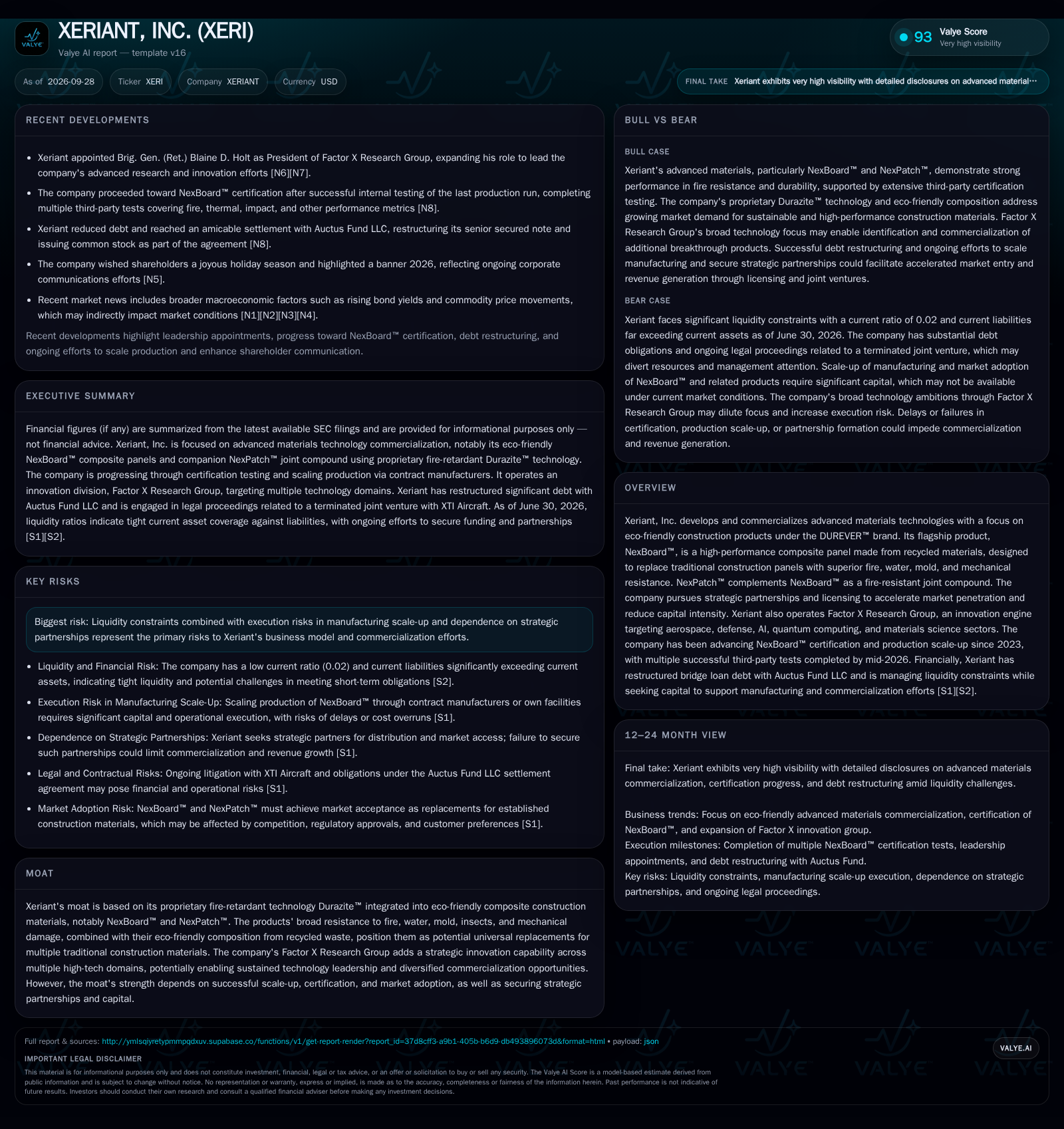
Xeriant is advancing its DUREVER™-branded NexBoard™ and NexPatch™ fire-resistant construction materials, supported by proprietary Durazite™ technology and recent successful certification tests.
Xeriant is advancing its DUREVER™-branded NexBoard™ and NexPatch™ fire-resistant construction materials, supported by proprietary Durazite™ technology and recent successful certification tests. Execution now depends on forming partnerships to accelerate market entry and securing capital to scale manufacturing and fulfill anticipated licensing agreements, with risks amplified by a broad innovation agenda and legacy legal obligations [S1] [S2] [N8].
Xeriant, Inc. is at a pivotal inflection point, leveraging its proprietary Durazite™ fire-retardant technology to launch eco-friendly construction panels and joint compounds aimed at replacing legacy building materials. With recent certification milestones and anticipated licensing deals, Xeriant appears poised for commercialization—yet its acute liquidity shortfall and large current liabilities impose a tight timeline for securing partnerships and scaling production. The company’s broad innovation ambitions, while a source of potential upside, also introduce execution and capital allocation complexity that could both accelerate and imperil its transformation.
Recent Certification Milestones and Financial Strain Define Xeriant’s Position
Xeriant has completed 16 third-party certification tests for its NexBoard™ composite construction panels, covering fire, thermal, impact, mechanical, and environmental resistance. These results pave the way for both interior and exterior wallboard applications, signaling technical readiness for broader market entry [S1] [N8].
The company reported a current ratio of 0.02 for the period. [S2]
The company has restructured its senior secured note with Auctus Fund LLC but remains bound by scheduled settlement payments, while also pursuing licensing agreements anticipated in late 2026 [S1].
Leadership changes—most notably the appointment of Brig. Gen. (Ret.) Blaine D. Holt to head Factor X Research Group—expand the company’s innovation footprint into multiple technology domains [N6] [N7].
How Xeriant’s Advanced Materials Model Could Unlock Value—or Expose Risk
Xeriant’s business model is predicated on leveraging proprietary, eco-friendly advanced materials to replace traditional construction panels. NexBoard™ aims to capture share from drywall, plywood, OSB, MDF, MgO board, and cement board, potentially offering superior fire and environmental performance. The intended economics combine direct product sales with licensing, joint ventures, or combinations to accelerate market access and reduce capital intensity [S1].
If licensing deals materialize, Xeriant may benefit from high-margin royalty streams, lowering its own capital outlay for manufacturing and distribution. However, the current reliance on contract manufacturing for NexBoard™ means gross margins will depend on the ability to scale efficiently, negotiate favorable production terms, and avoid quality or supply disruptions.
The company reported cash and liquidity metrics for the period; these figures do not by themselves establish operating runway, investment capacity, financial flexibility, or financing capacity. The company’s capital needs are magnified by ongoing settlement payments, legal obligations, and the broad scope of Factor X Research Group, which, while potentially valuable, could dilute focus and escalate burn if not tightly managed.
Will Durazite™ Technology and Eco-Friendly Features Differentiate in a Crowded Market?
Xeriant’s competitive proposition rests on the proprietary Durazite™ fire-retardant integrated into recycled composite panels, offering a combination of fire, water, mold, insect, and mechanical resistance. This potentially positions NexBoard™ and NexPatch™ as universal substitutes for multiple traditional building materials [S1].
The construction materials market is highly competitive, with entrenched incumbents and established supply chains. Success for Xeriant will likely hinge on demonstrating clear, quantifiable performance and cost advantages—such as lower installation costs, longer life, or compliance with emerging fire and sustainability codes. Without established channel relationships, the company’s need for strategic partners or licensing deals is acute.
Substitution threats are real: competing products may rapidly incorporate similar eco-friendly or fire-resistant features, compressing any early-mover advantage. The broad ambitions of Factor X Research Group—spanning aerospace, AI, and quantum—offer potential for differentiated technology, but also risk diluting focus in the near-term construction materials commercialization effort.
Switching costs for construction materials can be modest unless mandated by code or insurance, so customer adoption will likely depend on third-party validation, certifications, and pilot project success. The absence of disclosed recurring revenue or multi-year contracts suggests that Xeriant’s initial go-to-market will be transactional, with recurring or renewal economics dependent on long-term adoption.
Accelerated Licensing and Market Pull Could Transform Xeriant’s Economics
A favorable scenario emerges if Xeriant quickly finalizes licensing agreements with major manufacturers, enabling broad market distribution without incurring the full capital costs of direct manufacturing scale-up. This would allow the company to monetize its intellectual property rapidly and generate royalty or milestone income streams, improving margins and liquidity.
Successful field adoption of NexBoard™—backed by certification test results—and validation from early channel partners could catalyze demand, attract additional partners, and could support premium pricing relative to legacy materials. If Factor X Research Group identifies further breakthrough applications or cross-industry collaborations, the innovation pipeline could create additional licensing or JV opportunities, enhancing Xeriant’s valuation as a technology platform.
Evidence that would confirm this scenario includes: public announcement of signed licensing deals with credible industry players; disclosure of royalty or milestone payment terms; successful completion of large pilot projects or initial commercial sales; and improvement in cash flow or reduction in short-term liabilities following these commercial wins.
Certification Success, But Commercial Traction Proves Slow and Capital Intensive
The most plausible outcome is that Xeriant achieves technical validation through certification but encounters a prolonged commercialization ramp. Licensing negotiations and partnership discussions may extend into 2027, requiring bridge financing or dilutive capital raises to cover ongoing operations and settlement obligations.
Initial market adoption could be limited to niche or pilot projects—such as green building initiatives or fire-resilient retrofits—while broader uptake awaits further validation, code approvals, or cost reductions. Contract manufacturing may be sufficient for early volumes, but margin expansion will depend on scaling and negotiating better terms.
Factor X Research Group may yield additional intellectual property, but near-term revenues are likely to be dominated by NexBoard™ and NexPatch™ commercialization. The company’s acute liquidity situation means any delay in cash inflow could trigger further restructuring or asset sales.
This scenario would be confirmed if Xeriant discloses slow or piecemeal licensing progress, continued working-capital deficits, and the need for short-term financing while maintaining technical momentum and ongoing partner engagement.
Liquidity Crunch and Execution Delays Could Force Restructuring or Asset Sales
The most adverse outcome would see Xeriant unable to convert certification and technical readiness into meaningful commercial deals within its limited cash runway. Continued operating losses, settlement payments, and legal expenses could quickly outpace available liquidity.
Failure to secure material licensing or partnership agreements would force the company to seek emergency financing—potentially at punitive terms—or liquidate assets, including its intellectual property portfolio. Legal and operational distractions from legacy XTI litigation and the breadth of Factor X ambitions could further drain management bandwidth and resources.
Evidence supporting this downside would include: disclosure of going-concern warnings; inability to meet scheduled settlement payments; failure to announce licensing or JV agreements; or significant dilution and asset sales to raise cash.
Milestones That Will Define Xeriant’s Viability and Value Creation Path
Announcement of signed licensing agreements or joint ventures with recognized building materials manufacturers—ideally with disclosed economic terms.
Disclosure of initial commercial sales volume, pricing, and customer feedback for NexBoard™ and NexPatch™ (if disclosed).
Updates on cash flow from operations, including any non-dilutive capital inflows tied to licensing or milestone payments.
Evidence of working capital improvement—such as a reported liquidity-ratio trends or reduction in short-term liabilities—following commercial deals.
Progress reports on Factor X Research Group’s pipeline, including patent filings, external collaborations, or technology validation milestones (if disclosed).
Resolution or material developments in legal proceedings and settlement obligations, particularly any impact on cash requirements.
Updates on manufacturing scale-up efficiency, quality control, and ability to meet third-party demand at commercial scale.
Management commentary or external validation regarding customer adoption, retention, and repeat purchase behavior for NexBoard™ and NexPatch™ (would help test the thesis).
Disclaimer: This is research-only, informational analysis and not investment advice. It may include AI-generated interpretation and general industry context. Always verify important details using primary sources.

Comments