
NanoViricides: Platform Ambitions, Capital Realities, and the Road to Antiviral Differentiation
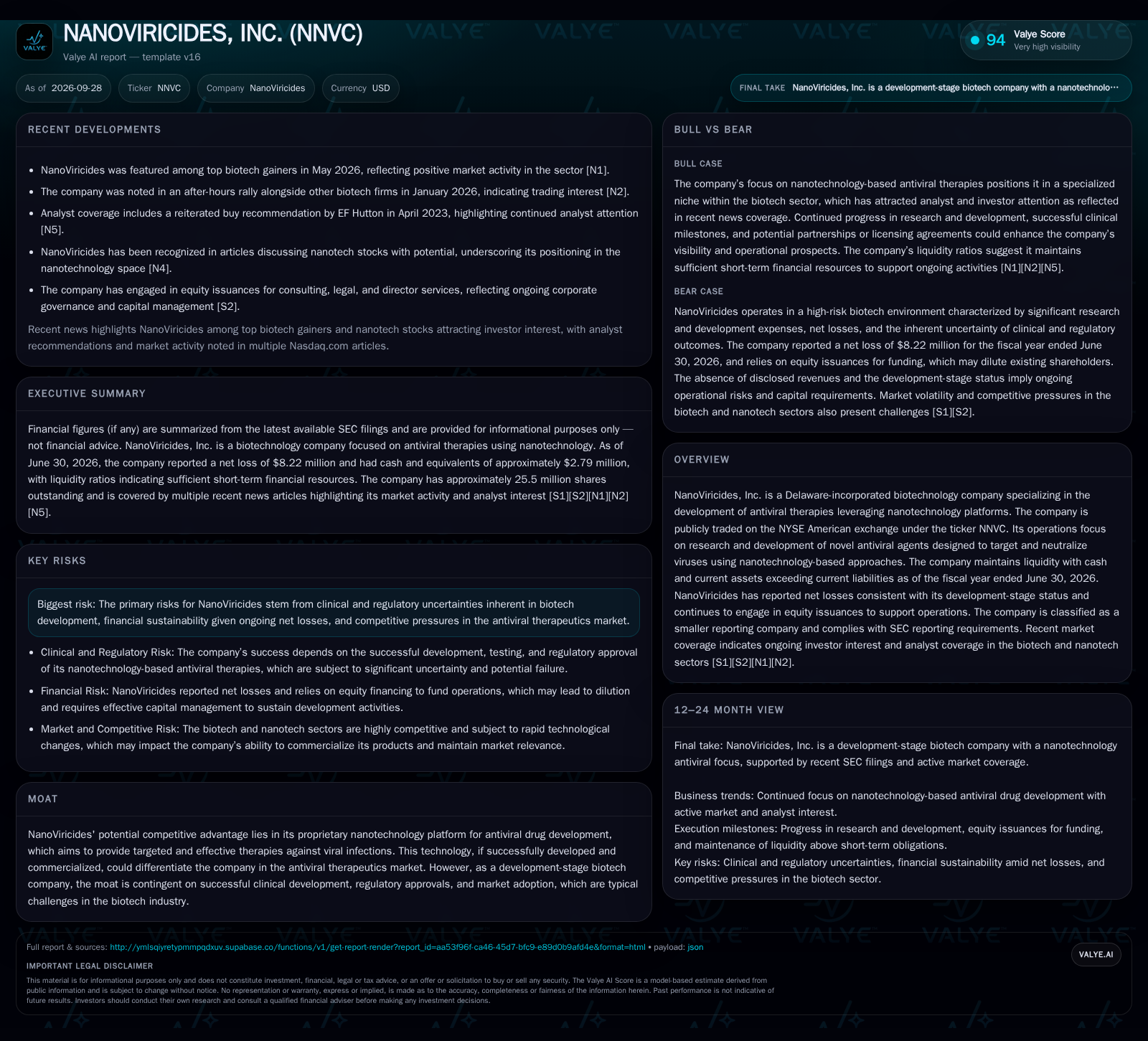
NanoViricides stands at the crossroads of nanotechnology and antiviral drug development, maintaining operational liquidity but facing persistent net losses and the hurdles endemic to early-stage biotech. While recent news coverage and analyst attention underscore sector visibility, the company’s ability to convert its proprietary platform into commercial or clinical milestones remains the central question.
Recent news and analyst coverage highlight ongoing market interest, yet the company remains pre-commercial and exposed to clinical, regulatory, and financing risks [S1] [N2] [N5].
NanoViricides, Inc. operates at the intersection of nanotechnology and biotechnology, pursuing antiviral therapies through proprietary nanoscale platforms. Despite maintaining a cash balance and current assets that exceed short-term liabilities, the company remains deeply in the development stage, with ongoing net losses and no disclosed revenue streams. Equity issuances for operational funding and recent market activity reflect both the opportunities and risks typical of pre-commercial biotech firms. The core challenge for NanoViricides is to translate its technological promise into tangible clinical progress and, ultimately, commercial viability in a highly competitive and capital-intensive sector [S1] [S2] [N2] [N5].
Liquidity Position and Development-Stage Profile Define Current State
As of June 30, 2026, NanoViricides reported cash and equivalents of $2.79 million, with current assets totaling $3.16 million and current liabilities at $1.19 million. The company reported a current ratio of 2.66 for the period. [S1] However, the company posted a net loss of $8.22 million for the fiscal year and has not disclosed any commercial revenues, underscoring its status as a pre-commercial, development-stage biotech. To sustain operations, NanoViricides has relied on equity issuances for consulting, legal, and director services [S2]. These facts highlight a business that, while not immediately threatened by liquidity shortfalls, is fundamentally reliant on external financing and faces the typical financial pressures of early-stage drug development.
Translating Platform Science into Sustainable Economics
NanoViricides’ business model centers on the research and development of antiviral agents using proprietary nanotechnology platforms. In theory, successful development and regulatory approval would enable monetization through direct sales, licensing agreements, or partnerships with larger pharmaceutical firms. However, the absence of disclosed revenues suggests that the company is not yet generating product sales or milestone payments.
The economics of early-stage biotech are defined by high fixed R&D costs, low variable costs until commercialization, and significant capital needs to fund multi-year development cycles. Operating leverage may emerge if a lead candidate progresses to late-stage trials or commercialization, but the company currently absorbs ongoing losses without offsetting revenue. Funding requirements are typically met through equity issuances, as evidenced by NanoViricides’ recent share-based compensation for services [S2]. This approach can sustain operations but dilutes existing shareholders and may become increasingly costly if market sentiment weakens. Ultimately, the transition from preclinical or early-stage clinical work to a commercially viable product is the economic fulcrum for the business.
The pathway from proprietary nanotechnology research to a sustainable commercial model involves critical inflection points where scientific validation must translate into economic value. For NanoViricides, this transition depends not only on technical success but also on strategic decisions regarding intellectual property management, partnership structures, and market positioning. Licensing agreements, if pursued, could provide upfront payments and royalties, mitigating the capital intensity of late-stage development. However, such deals often require demonstrable clinical proof of concept and a clear competitive advantage. Additionally, the scalability of manufacturing nanotechnology-based therapeutics and the associated cost structures will influence gross margins and pricing strategies, which are essential for long-term financial viability. The company’s ability to balance R&D investment with prudent capital allocation will be key in navigating the high fixed-cost environment characteristic of biotech innovation.
Differentiation in a Crowded Antiviral and Nanotech Landscape
NanoViricides operates in the highly competitive antiviral therapeutics sector, where incumbents range from major pharmaceutical companies to specialized biotech firms pursuing both traditional and novel modalities. Its core proposition—a nanotechnology-based platform that targets and neutralizes viruses—could offer advantages in selectivity or efficacy, but these benefits remain unproven at the commercial or clinical level.
The competitive landscape is characterized by rapid technological advances, frequent new entrants, and a race for intellectual property. Larger biopharma players may possess greater resources for clinical development and commercialization, while peer-stage biotech firms often compete for limited investor and partner attention. Substitution risk is inherent, as other modalities (e.g., monoclonal antibodies, nucleic acid therapies, small molecules) vie for similar indications. NanoViricides’ potential moat derives from proprietary nanotechnology, but this advantage is contingent on successful differentiation through clinical outcomes and regulatory progress.
In the antiviral therapeutics landscape, technological differentiation must be complemented by strategic market access considerations. NanoViricides’ nanotechnology platform, while potentially offering unique mechanisms of viral neutralization, faces challenges in demonstrating clear clinical superiority over established modalities. The regulatory pathway for novel nanomedicines can be more complex, requiring extensive safety and efficacy data to address concerns about biodistribution, immunogenicity, and long-term effects. Furthermore, payer acceptance and reimbursement strategies will hinge on comparative effectiveness and cost-benefit analyses relative to existing treatments. The company’s competitive moat will thus depend not only on scientific innovation but also on its capacity to navigate regulatory hurdles, secure intellectual property rights that withstand challenges, and engage with key stakeholders across the healthcare ecosystem to facilitate adoption.
Breakthrough Clinical Progress Catalyzes Funding and Strategic Interest
A favorable scenario for NanoViricides would hinge on clear evidence of clinical efficacy and safety for its lead antiviral candidates, demonstrated through successful early-stage trial results or compelling preclinical data. Such milestones could serve as catalysts for further funding, either through nondilutive grants, partnerships, or premium-priced equity offerings. The company’s visibility in nanotech and biotech news, as well as analyst coverage, suggests a receptive audience for positive scientific developments [N2] [N5].
Confirmation of this scenario would come from formal announcements of clinical trial initiations, positive readouts, or the signing of licensing or co-development agreements with established pharmaceutical partners. Conversely, delays in trial enrollment, inconclusive data, or lack of industry interest would undermine the upside case.
Sustained R&D Efforts with Incremental Progress and Dilutive Financing
The most plausible trajectory for NanoViricides is continued incremental advancement of its R&D pipeline, punctuated by periodic capital raises to fund operations.
In this scenario, NanoViricides may report scientific progress, new preclinical findings, or small-scale partnerships, but would remain pre-commercial for the foreseeable future. Evidence supporting this outcome would include continued net losses, additional equity-based compensation or financing rounds, and the absence of late-stage clinical or commercial milestones. Unexpected acceleration in clinical development or a major partnership could shift the company out of this base case.
Capital Constraints and Clinical Setbacks Threaten Continuity
The adverse scenario would see NanoViricides unable to achieve meaningful clinical progress or attract new funding on acceptable terms. Clinical or preclinical setbacks, negative trial results, or regulatory obstacles could erode investor and partner confidence, making equity issuance more dilutive or even inaccessible if market sentiment turns negative.
In this case, the company could face shrinking cash balances, increasing payables, or even going-concern warnings. Confirmation would be evident in delayed or canceled R&D programs, failure to file timely SEC reports, or sharp declines in market capitalization. A useful signal would be the announcement of cost-cutting measures or strategic reviews aimed at preserving cash rather than advancing development.
Milestones That Could Shift the NanoViricides Investment Thesis
Disclosure of clinical trial initiations, progress, or positive readouts for lead antiviral candidates would be a critical inflection point.
Updates on licensing, co-development, or partnership agreements with larger pharmaceutical or biotech companies, if announced, would materially alter the commercial outlook.
Announcements regarding regulatory filings, such as Investigational New Drug (IND) applications or regulatory feedback, would provide clarity on development timelines.
Evidence of nondilutive funding sources (e.g., grants, government contracts) would reduce reliance on equity issuance and improve financial sustainability.
Market reactions to scientific publications, conference presentations, or new intellectual property filings could signal shifts in perceived technical differentiation.
A useful metric would be any disclosed pipeline prioritization or explicit articulation of lead indications, which would help investors assess strategic focus.
If disclosed, information on burn rate trends or forward guidance on funding needs would help test assumptions about capital sufficiency.
Disclaimer: This is research-only, informational analysis and not investment advice. It may include AI-generated interpretation and general industry context. Always verify important details using primary sources.

Comments