
Biomerica, Inc.: Diagnostic Innovation Meets Capital and Execution Crossroads
Biomerica’s push into personalized diagnostics and European markets is counterbalanced by persistent losses, reported liquidity position, and the uncertainties of a strategic review. The company’s ability to translate development activity into sustainable revenue and margin improvement will determine whether it can break out of microcap volatility and realize the promise of its differentiated test portfolio.
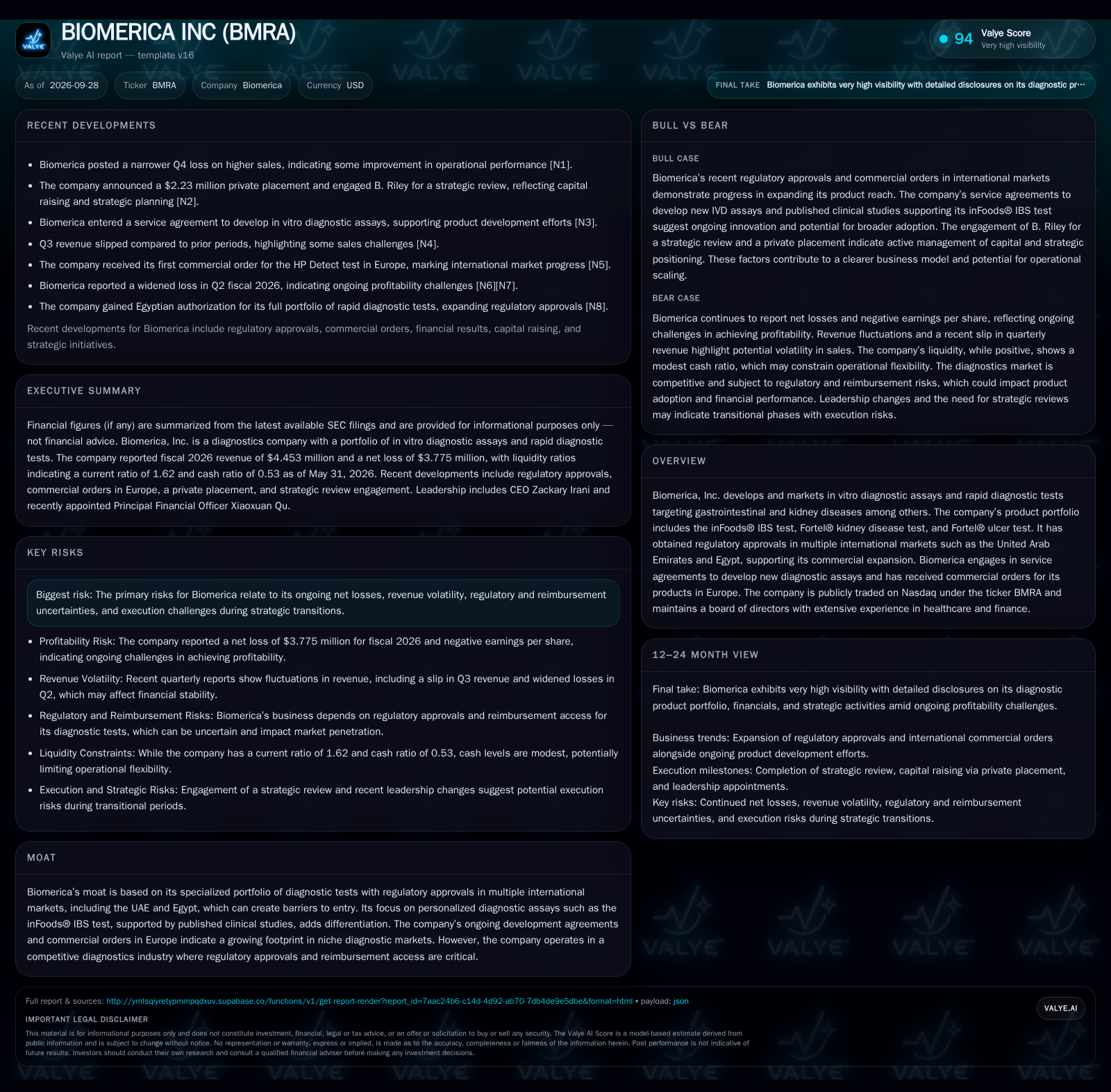
Biomerica reported $4.453 million in fiscal 2026 revenue with a net loss of $3.775 million, reflecting ongoing profitability challenges. Recent developments—including a $2.23 million private placement, a strategic review led by B. Riley, and a first commercial order for HP Detect in Europe—signal both active repositioning and execution risk. The company’s future hinges on its capacity to convert innovation and development partnerships into recurring, higher-margin sales, while managing capital constraints and navigating competitive, regulatory, and reimbursement headwinds. [S1] [N2] [N5]
Biomerica, Inc. stands at a critical juncture defined by ongoing innovation in diagnostic assays, expanding international reach, and persistent financial losses. Recent moves—a private placement, strategic review, and new commercial orders—signal both opportunity and uncertainty. As the company attempts to leverage its differentiated test portfolio and new partnerships, its ability to convert development activity into durable top-line growth and margin expansion will be tested against capital constraints, competitive intensity, and the unforgiving economics of diagnostics.
Recent Capital Moves and Operational Milestones Reshape the Risk Profile
Biomerica reported $4.453 million in revenue and a net loss of $3.775 million for fiscal 2026, underscoring a pattern of ongoing losses despite some sales improvement in the latest quarter. In August 2026, Biomerica announced a $2.23 million private placement and engaged B. Riley for a strategic review, highlighting both capital needs and a willingness to consider broader strategic options. Operationally, Biomerica received its first commercial order for the HP Detect test in Europe and entered a service agreement to develop new IVD assays, marking incremental progress in product adoption and pipeline expansion. [S1] [N2] [N3] [N5]
Diagnostics Revenue Model: High Fixed Costs, Variable Margins, and the Scaling Conundrum
Biomerica’s core business revolves around the development and sale of in vitro diagnostic (IVD) assays and rapid tests, primarily targeting gastrointestinal and kidney disease. The fundamental economics of diagnostics are defined by high up-front R&D and regulatory costs, moderate-to-high gross margins once scale is reached, and acute sensitivity to volume and reimbursement trends. For microcap diagnostics companies, the transition from pilot sales and development agreements to meaningful, recurring product revenue is often prolonged and capital-intensive.
With $4.453 million in revenue versus a $3.775 million net loss in fiscal 2026, Biomerica has yet to demonstrate operating leverage or scalable profitability. While service agreements to develop new assays provide some near-term revenue and signal external validation, the economic impact may be limited unless these agreements scale or convert into recurring product sales.
Pricing power in diagnostics is typically constrained by payer reimbursement rates and competitive pressure, especially when tests compete with established alternatives or commoditized panels. Volume growth—especially from international markets or new clinical indications—would be the primary driver of gross margin expansion. However, without clear disclosure of contract structures, customer concentration, or pricing tiers, the path to sustained positive cash flow remains speculative.
Personalization and Niche Focus Versus Scale Players and Regulatory Hurdles
Biomerica’s differentiation lies in its focus on personalized diagnostic assays, such as the inFoods® IBS test, and its willingness to target under-served or niche indications in gastrointestinal disease. This approach can carve out defensible market segments less attractive to large diagnostics incumbents, but it also limits the potential addressable market and may slow adoption if clinical evidence or reimbursement support lags.
In the broader landscape, Biomerica competes against diversified diagnostics manufacturers, specialty assay developers, and emerging digital health platforms. The company’s ability to secure service agreements and early international orders suggests some traction, but its small scale and modest financial resources leave it vulnerable to competitive displacement, slower time-to-market, and regulatory or payer pushback. The recent European order for HP Detect demonstrates initial channel access, but meaningful competitive advantage would require repeat orders, clinical adoption, and favorable reimbursement decisions—none of which are yet established as recurring or durable.
Switching costs in diagnostics can be significant when clinical workflow integration, regulatory approval, and reimbursement coding are required, but they are not automatic. The long-term moat for Biomerica will depend on published clinical outcomes, integration into clinical guidelines, and the ability to defend intellectual property while scaling manufacturing and distribution efficiently.
Pipeline Commercialization and International Expansion Unlock Margin Leverage
In a favorable scenario, Biomerica accelerates the conversion of its development pipeline and service agreements into commercialized products, resulting in recurring, higher-margin sales. International traction, as evidenced by the first European order for HP Detect, could be expanded through additional regulatory clearances, distributor partnerships, and successful real-world use cases. If the inFoods® IBS test or other novel assays gain clinical guideline inclusion or payer reimbursement, the company could see step-changes in volume and pricing power.
Confirmation would come from sequential growth in product revenue (distinct from service/development agreements), improved gross margins, and announcements of multi-year sales contracts or repeat international orders. Evidence of positive operating cash flow, reduced reliance on external capital, and favorable reimbursement decisions would further support the upside case. Conversely, continued reliance on one-off service agreements, lack of volume growth, or failure to secure international repeat business would undermine this scenario.
Incremental Progress Amid Funding Constraints and Market Volatility
The most plausible near-term outcome is continued incremental progress: sporadic product sales growth, additional development agreements, and ongoing but volatile revenue. Biomerica may secure further international regulatory clearances or small-scale commercial orders, but the pace of adoption is likely to remain measured given its modest resources and the timeframes required for clinical validation, regulatory approval, and payer coverage.
The company will likely need to balance R&D investment with careful cost management and periodic capital raises, as evidenced by the recent private placement and strategic review. Confirming evidence for this scenario would include continued but uneven revenue growth, persistent net losses, and periodic liquidity events. Falsification would occur if Biomerica either breaks out with sustained product revenue growth and margin improvement (moving toward the upside) or faces acute cash constraints, regulatory setbacks, or loss of key partnerships (moving toward the downside).
Execution Missteps, Funding Gaps, and Competitive Displacement Drive Deterioration
The adverse chain begins with Biomerica failing to convert its pipeline or service agreements into recurring, high-margin product sales. Regulatory or reimbursement setbacks, delayed product launches, or lack of clinical adoption could further slow revenue, while ongoing net losses rapidly erode the company’s reported cash balance. In this scenario, the company’s reliance on dilutive capital raises or unfavorable financing terms increases, compounding shareholder pressure and limiting operational flexibility.
Competitive threats—from larger diagnostics players or novel digital health entrants—could further squeeze market share or accelerate pricing pressure, especially if Biomerica’s differentiated assays fail to achieve clinical or payer endorsement. Confirmation of this scenario would come from declining core product revenue, a shrinking cash balance with higher short-term liabilities, and a lack of new development or commercial agreements. Announcements of restructuring, asset sales, or a distressed strategic outcome would further cement the downside path.
Milestones That Will Determine Whether Biomerica Can Escape Microcap Volatility
Sustained sequential growth in core product revenue—particularly from inFoods® IBS, Fortel® tests, and HP Detect—would indicate successful commercialization and adoption. [S1] [N5]
Gross margin trends, if disclosed, would clarify whether incremental sales are translating into improved operating leverage or being offset by cost pressures.
Conversion of service agreements into recurring product revenue and/or long-term commercial contracts would provide evidence of pipeline monetization. [N3]
Evidence of successful international regulatory clearances, additional commercial orders, or distributor partnerships—especially in Europe or new geographies—would support the case for market expansion. [N5]
Payer reimbursement decisions or clinical guideline endorsements for flagship assays would increase adoption potential and pricing power.
Operating cash flow trends and the frequency/terms of capital raises would illuminate underlying business sustainability and execution risk.
Retention of strategic partnerships or entry into new collaborations following the B. Riley-led review could signal either positive momentum or distress-driven outcomes. [N2]
Leadership stability and execution on stated R&D timelines—especially after recent management changes—would help test whether Biomerica can maintain operational focus. [S1]
Disclaimer: This is research-only, informational analysis and not investment advice. It may include AI-generated interpretation and general industry context. Always verify important details using primary sources.

Comments