
Palatin Technologies: Specialized Melanocortin Drug Development, Partnership Leverage, and the Economics of Rarity
Palatin’s focus on melanocortin receptor agonists for rare obesity and inflammatory disorders, combined with a partnership-driven model and recent licensing milestones, positions it as a targeted innovator with substantial upside—yet exposes it to the capital, execution, and competitive risks typical for early-stage biopharma.
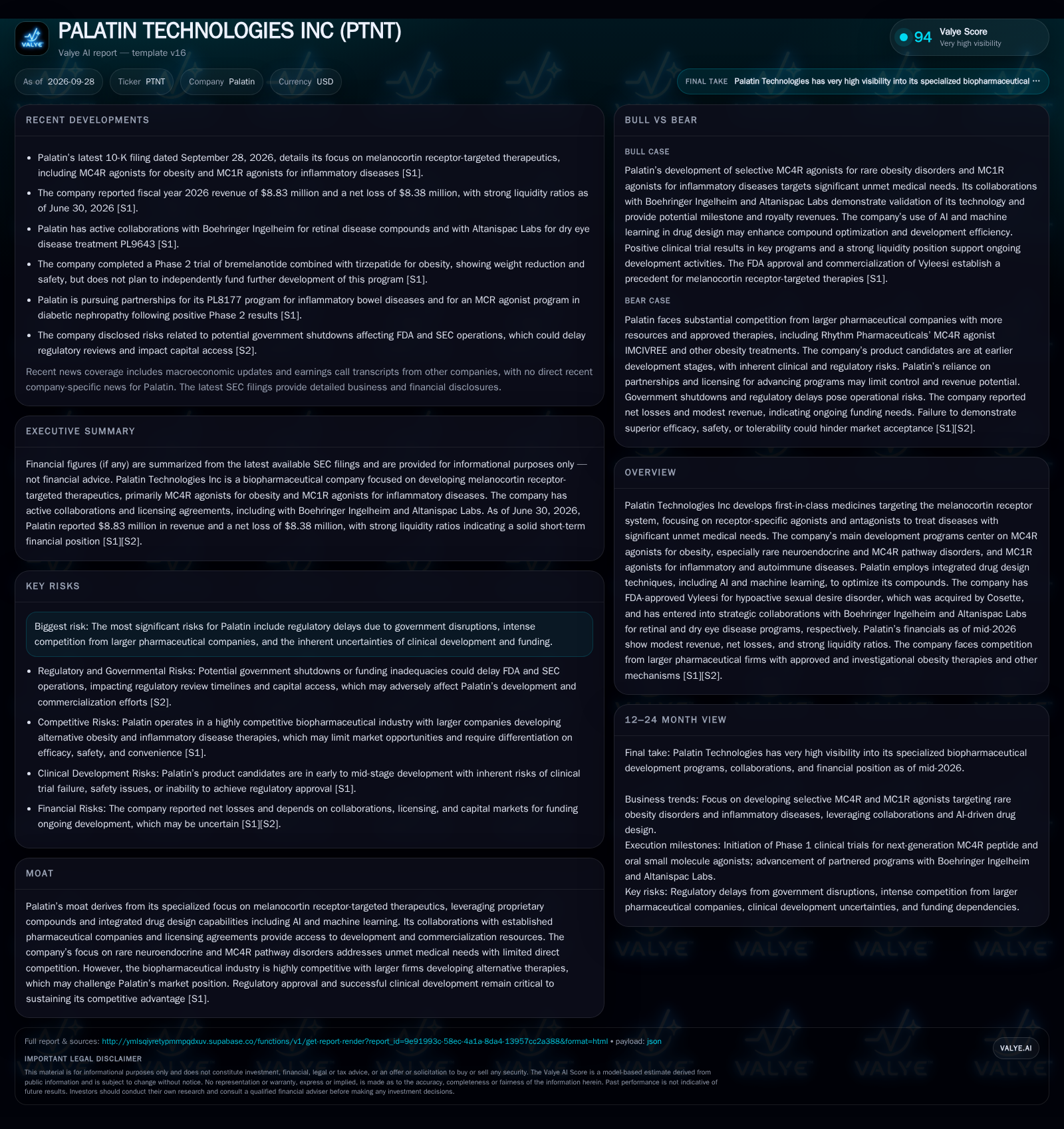
Palatin Technologies’ 2026 snapshot reveals a company advancing melanocortin receptor-targeted drugs—especially for rare obesity and inflammatory diseases—while securing collaborations and licensing deals for non-core programs. [S1]
Palatin Technologies stands at a critical juncture as a specialist in melanocortin receptor-targeted therapeutics, aiming to carve out leadership in rare obesity disorders and inflammatory diseases with high unmet needs. The company's 2026 position reflects both validation—via licensing and collaboration deals—and the stark realities of early-stage biopharma: persistent net losses, dependency on external partners, and the challenge of competing against larger, well-capitalized drug developers. Its ability to translate promising clinical data and partnership momentum into sustainable value will define the next phase of its journey.
Recent Licensing, Clinical Milestones, and Financial Position Shape Palatin’s Near-Term Outlook
Palatin’s most material developments as of September 2026 are: the licensing of PL9643 (a dry eye disease candidate) to Altanispac Labs after completing a Phase 3 trial, generating upfront and potential milestone payments; the completion of positive Phase 2 studies for both PL8177 (in inflammatory bowel diseases) and an MCR agonist in diabetic nephropathy, for which partnerships are being actively sought; and continued revenue recognition from these deals, driving fiscal 2026 revenue to $8.83 million despite a net loss of $8.38 million. The company reported cash and liquidity metrics for the period; these figures do not by themselves establish operating runway, investment capacity, financial flexibility, or financing capacity. Palatin’s recent resumption of trading on the NYSE American removed a prior delisting risk, improving capital markets access. These facts collectively reposition Palatin as a validated but still development-stage innovator, with non-dilutive income streams from licensing and a solid—if not yet self-sustaining—liquidity base. [S1] [S2]
The Economics of Rare Disease Drug Development and a Partnership-First Commercial Model
Palatin’s revenue model is fundamentally driven by out-licensing and partnership arrangements rather than direct commercial sales, at least for now. The company’s focus on rare MC4R pathway disorders and select inflammatory diseases means that successful drugs could command premium pricing and benefit from orphan drug incentives, including extended exclusivity and potentially lower marketing costs. However, these markets are also characterized by low patient volumes, meaning volume-driven revenue potential is capped unless indications expand or additional geographies are accessed. Upfront payments, milestones, and royalties from partners (such as Altanispac Labs and Boehringer Ingelheim) provide non-dilutive capital and reduce direct commercialization risk, but also limit Palatin’s share of long-term economics compared to a fully integrated model.
Operating leverage in this model is mixed: R&D expenses remain high and unpredictable in early-stage biopharma, while SG&A is relatively contained absent a direct salesforce. Capital needs are ongoing, with clinical trials, regulatory submissions, and partnership negotiations all requiring continued funding. Palatin’s use of AI and machine learning for drug design may incrementally improve development efficiency and success rates, but is unlikely to radically alter the underlying capital intensity or risk profile of clinical-stage biopharma. Ultimately, Palatin’s economic upside is contingent on successful out-licensing or co-development of its core MC4R and MC1R programs, with milestone and royalty structures shaping the profit potential.
Competitive Landscape: Orphan Drug Niches, Big Pharma Rivals, and the Challenge of Differentiation
Palatin operates in a fiercely competitive environment, with larger pharmaceutical companies developing both MC4R agonists—such as Rhythm Pharmaceuticals with IMCIVREE—and alternative mechanisms for obesity and inflammatory diseases. While Palatin’s focus on rare neuroendocrine disorders and orphan indications gives it a degree of insulation from mass-market competition, it still faces the challenge of demonstrating superior efficacy, safety, or convenience relative to both established therapies and emerging pipeline candidates.
The company’s moat is grounded in its proprietary melanocortin receptor portfolio and integrated drug design capabilities, but these advantages could be eroded if larger players accelerate their orphan drug pipelines or if alternative therapeutic modalities (e.g., gene therapies, GLP-1 agonists, or other small molecules) prove more effective or convenient. Palatin’s partnerships with Boehringer Ingelheim and Altanispac Labs lend external validation, but also highlight the need for collaboration to access commercialization resources and clinical development scale. The key for Palatin will be to advance its programs rapidly enough to establish clinical and regulatory differentiation before competitors crowd into its targeted niches.
Unlocking Value Through Clinical Success and Strategic Partnering
A favorable scenario for Palatin hinges on two reinforcing dynamics: first, the achievement of robust, differentiated efficacy and safety results in mid-to-late-stage trials for its MC4R and MC1R agonists (including next-generation peptide and oral candidates); and second, the successful execution of additional strategic partnerships that deliver upfront and milestone payments, while retaining meaningful downstream economics through royalties or co-commercialization rights.
Confirmation of this upside would come from the announcement of new licensing deals for PL8177 or the diabetic nephropathy program, initiation of pivotal trials for its core obesity assets, and evidence of sustained or growing milestone and royalty revenue streams. Regulatory progress—such as fast-track designations or accelerated approvals for rare indications—would further de-risk the path to commercialization. Upside is also amplified if Palatin’s use of AI-driven drug design yields compounds with clear clinical advantages or shorter development timelines.
Progress Via Incremental Partnerships, Controlled R&D Spend, and Selective Clinical Wins
The most plausible near-term path is a continuation of Palatin’s existing model: selective out-licensing of non-core or non-strategic assets, ongoing pursuit of partnerships for later-stage clinical programs, and a measured pace of internal development for its highest-priority MC4R and MC1R candidates. This scenario envisions modest but recurring revenue from milestones and royalties, offset by persistent—though potentially narrowing—operating losses as R&D spend is tightly managed.
Base-case confirmation would include timely achievement of clinical milestones (such as successful completion of Phase 2/3 trials for lead assets), new or expanded licensing agreements, and maintenance of a reported liquidity position buffer. Falsification would be signaled by stalled partnership discussions, clinical setbacks, or a rapid drawdown of cash without replenishment from deals or capital markets.
Execution Risks: Clinical Setbacks, Partnering Gaps, and Capital Constraints
The adverse scenario for Palatin is characterized by clinical trial failures or inconclusive data in its core MC4R or MC1R programs, resulting in loss of momentum and reduced partner interest. If licensing negotiations for PL8177 or the diabetic nephropathy asset stall, Palatin would be forced to either self-fund expensive late-stage trials or shelve programs, both of which would strain financial resources.
Downside evidence would include missed or delayed clinical milestones, termination of existing partnerships, a sharp increase in quarterly net losses without offsetting revenue, or a liquidity crunch requiring dilutive equity financing at unfavorable terms. Regulatory disruptions—such as an extended government shutdown delaying FDA reviews—would compound these challenges, increasing uncertainty and potentially reducing access to capital. [S2]
Milestones That Will Clarify Palatin’s Competitive and Financial Trajectory
Progress on new partnership or licensing agreements for PL8177 in inflammatory bowel disease and for the MCR agonist program in diabetic nephropathy.
Initiation, enrollment, and results of Phase 1/2/3 trials for next-generation MC4R peptide and oral agonists—especially in rare obesity syndromes.
Milestone and royalty revenue recognized from Altanispac Labs and Boehringer Ingelheim, and any new partners (if disclosed).
R&D spending trends relative to cash burn and the maintenance of a reported current ratio; a useful metric would be quarterly net cash used in operations (if disclosed).
NYSE American listing status and ability to access capital markets without disruptive dilution.
Regulatory developments affecting the FDA review process, including the potential impact of government shutdowns or new healthcare legislation.
Any competitive developments from larger pharmaceutical companies in the MC4R/MC1R space—such as successful launches, new approvals, or pipeline advances.
Disclaimer: This is research-only, informational analysis and not investment advice. It may include AI-generated interpretation and general industry context. Always verify important details using primary sources.

Comments