
SUUN: Navigating a Complete Information Void—Analytical Scenarios in the Absence of Disclosed Operations
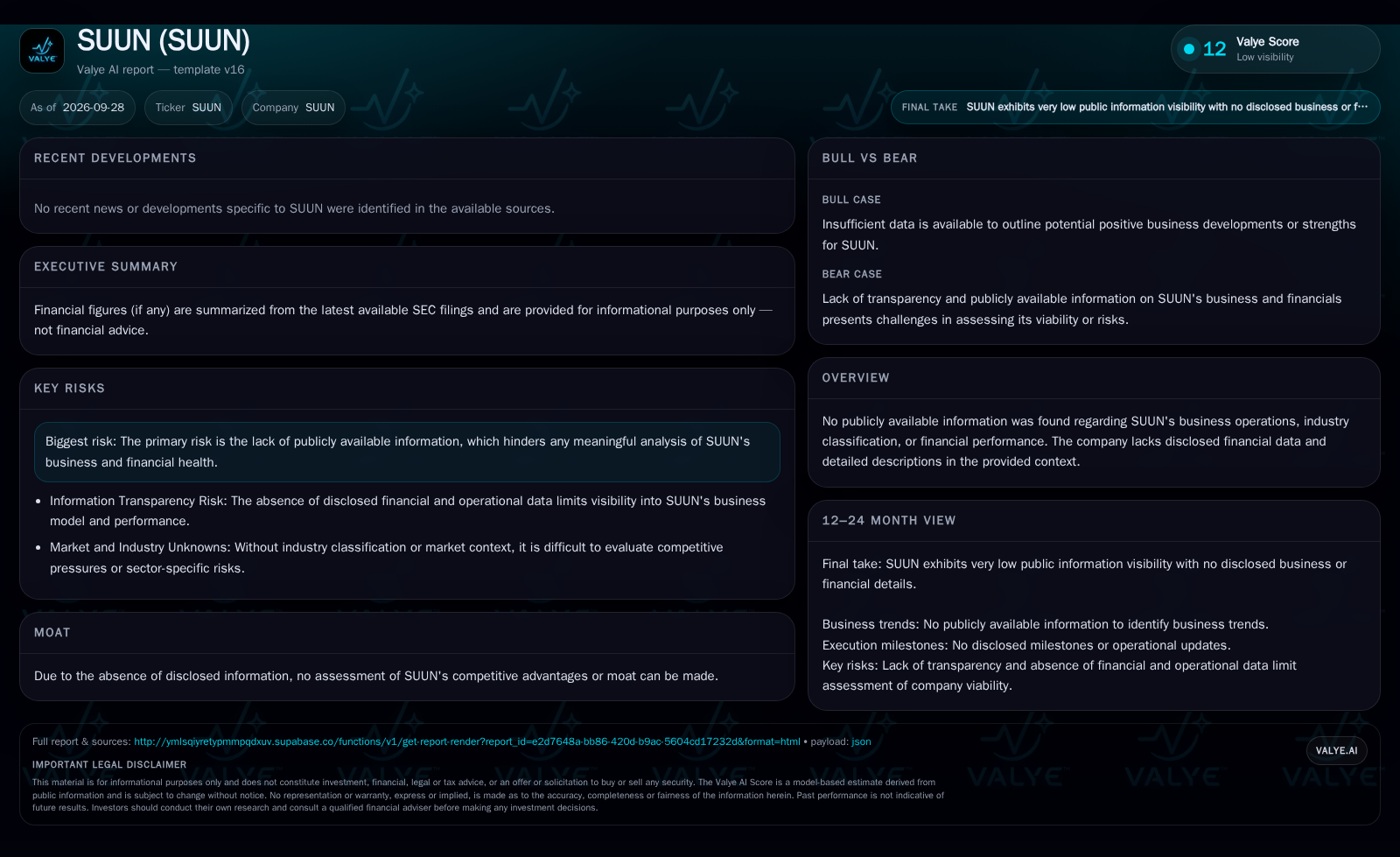
SUUN presents an extreme case of public opacity, with no available data on business activities, industry, or financials. This absence forces investors to focus on transparency risk, speculative mechanisms, and the rare signals that could clarify the company’s true prospects.
SUUN currently discloses no information about its business model, financial status, or industry, presenting a significant transparency risk. The lack of operational or financial data means that all scenario analysis must remain conditional and hypothetical, hinging on future disclosures. Investors are left to monitor for any sign of concrete business activity, regulatory filings, or third-party validation to move beyond pure speculation.
SUUN stands out for its total lack of public disclosure: as of September 2026, there is no available information on what the company does, where it operates, or how it performs financially. This radical opacity creates a unique analytical challenge, eliminating any ability to assess business model, industry dynamics, or even basic solvency. For investors, the situation is binary: either meaningful disclosure emerges, or the company remains an information black hole. The only actionable thesis is to track for any sign of credible business activity or regulatory engagement that could illuminate SUUN’s true nature and prospects. Until then, all analysis is inherently speculative and focused on the risks of such extreme non-transparency.
Total Absence of Disclosed Operations: Why This Matters for SUUN
As of September 28, 2026, SUUN has not published any description of its business activities, sector, or financial position. There are no known SEC filings, press releases, or third-party reports that offer insight into its operations, revenue, assets, or liabilities. This information void is highly unusual among public companies and precludes even the most basic assessment of business health, industry context, or management intent. The most material fact is thus the absence of facts itself: transparency risk becomes the dominant consideration, and all conventional analytical frameworks are suspended until disclosure occurs.
The lack of any public signals—whether regulatory filings, operational updates, or even a basic web presence—raises the possibility that SUUN is either a dormant shell, a company in transition, or an entity with no active operations. This situation is rare in public markets, where even the smallest or most distressed issuers typically provide some degree of ongoing disclosure. For stakeholders, this means that the company’s true status, intentions, and prospects remain entirely opaque, with no way to distinguish between benign neglect, strategic silence, or deeper underlying issues.
Hypothetical Economics: What Could SUUN’s Business Model Be?
With no data, the economics of SUUN’s business are entirely opaque. If SUUN is an operating business, its cash flow profile, capital requirements, and cost structure remain unknown. The company could plausibly be a shell, an early-stage venture, or a reorganized entity awaiting reactivation. Each scenario presents different economic implications: a shell’s economics are minimal (often only compliance and listing costs), while an active operating company would have fixed and variable costs, possible revenue streams, and capital needs. The absence of financial disclosure also means there is no way to infer leverage, burn rate, or funding runway.
In the absence of any financial or operational data, even basic metrics such as revenue, gross margin, or cash balance are unavailable. This prevents any assessment of solvency, liquidity, or capital efficiency. If SUUN is a shell, its economics may be limited to the costs of maintaining a listing and compliance. If it is a dormant operating company, there may be legacy liabilities or assets that are not visible to the public. Alternatively, if SUUN is in the process of reorganization or seeking a business combination, the economics could shift rapidly upon a transaction or new capital infusion. Until SUUN reveals its commercial mechanics—such as whether it generates recurring revenue, sells products, or develops technology—investors can only speculate about unit economics or scalability.
Competitive Landscape: An Unknown Player in an Undefined Market
No information is available about SUUN’s sector, target market, or competitive set. As a result, it is impossible to benchmark the company against sector peers, assess barriers to entry, or analyze market structure. If SUUN is a shell or inactive entity, it may face competition only at the level of capital market vehicles (e.g., SPACs, blank-check companies). If it is an operating company, its lack of disclosure puts it at a severe disadvantage in attracting customers, partners, or investors relative to transparent peers.
The absence of a stated value proposition or product offering also means there is no basis for evaluating differentiation, pricing power, or switching costs. In the event that SUUN becomes active and discloses its business model, its competitive position would depend on the specifics of its sector, the strength of its management team, and the uniqueness of its offering. Until then, the company’s market relevance and ability to compete remain entirely hypothetical.
What a Positive Inflection Would Require: From Black Box to Business Validity
The only plausible upside scenario is that SUUN breaks its silence with credible disclosures: a detailed business description, audited financials, or a material event such as an acquisition or regulatory approval. If such information reveals a viable business model, attractive economics, or a strategic asset, the company’s risk profile could change dramatically.
Early signals might include SEC filings, a new website, executive team announcements, or third-party partnerships. To confirm this scenario, investors would look for independently verifiable evidence of real operations—such as revenue contracts, customer lists, or audited statements. The emergence of a credible management team or board, along with transparent communication, would further support a positive re-rating.
Falsification would occur if subsequent disclosures reveal the company to be a shell, a litigation vehicle, or a non-operating entity. In such a case, any initial optimism would likely dissipate, and the company’s investability would remain highly constrained.
Stasis in the Dark: Most Likely Continuation of Non-Disclosure
The most probable scenario, in the absence of new information, is that SUUN remains in a state of non-disclosure. This could mean the company is a dormant shell, an entity in the process of reorganization, or simply one that does not meet reporting standards. In this scenario, the investability remains extremely low, with valuation, risk, and opportunity entirely indeterminate.
Confirmation would come from ongoing silence, lack of SEC filings, and no material news. Investors would continue to face an information vacuum, with no basis for forming a view on the company’s prospects. A falsification of this scenario would be any credible, detailed public communication that clarifies SUUN’s business activities or financial standing.
Risks of Prolonged Opacity: From Delisting to Litigation
The primary downside is that SUUN’s lack of disclosure could trigger negative regulatory or market outcomes. Prolonged failure to file required reports or communicate material information may result in trading halts, delisting from exchanges, or regulatory enforcement actions. There is also the risk that the company is, in fact, a litigation shell, a defunct entity, or subject to insider disputes.
Confirmation of this scenario would be regulatory actions, trading suspensions, or public notices of delisting. Investors should also be alert to the possibility of litigation, bankruptcy proceedings, or restructuring announcements, all of which could further erode any residual value. Falsification would require the company to resume timely and comprehensive disclosures, demonstrating active operations and compliance.
Concrete Triggers That Would Clarify SUUN’s Future Trajectory
Any new SEC filing, such as a 10-K, 10-Q, or 8-K, that provides business description or financials.
A press release or official communication outlining an operational milestone, acquisition, or business plan.
Evidence of a functioning website, active communications channel, or executive team appointments.
Announcements of partnerships, customer contracts, or third-party audits, if disclosed.
Regulatory actions: notices of non-compliance, trading halts, or delisting warnings.
Litigation filings, bankruptcy proceedings, or restructuring announcements.
Verified third-party references (media, industry databases) to SUUN’s operations or assets.
A useful metric would be any disclosed revenue, cash balance, or employee count to test for active operations.
Disclaimer: This is research-only, informational analysis and not investment advice. It may include AI-generated interpretation and general industry context. Always verify important details using primary sources.

Comments