
ReposiTrak: Traceability Mandates, Network Effects, and the Economics of SaaS in Retail Supply Chains
As regulatory forces intensify and supply chains digitize, ReposiTrak aims to capitalize on compliance-driven demand and network effects in retail traceability. The company’s patent-pending technologies and hub-and-spoke model offer potential for durable platform economics, but competitive and regulatory uncertainties remain.
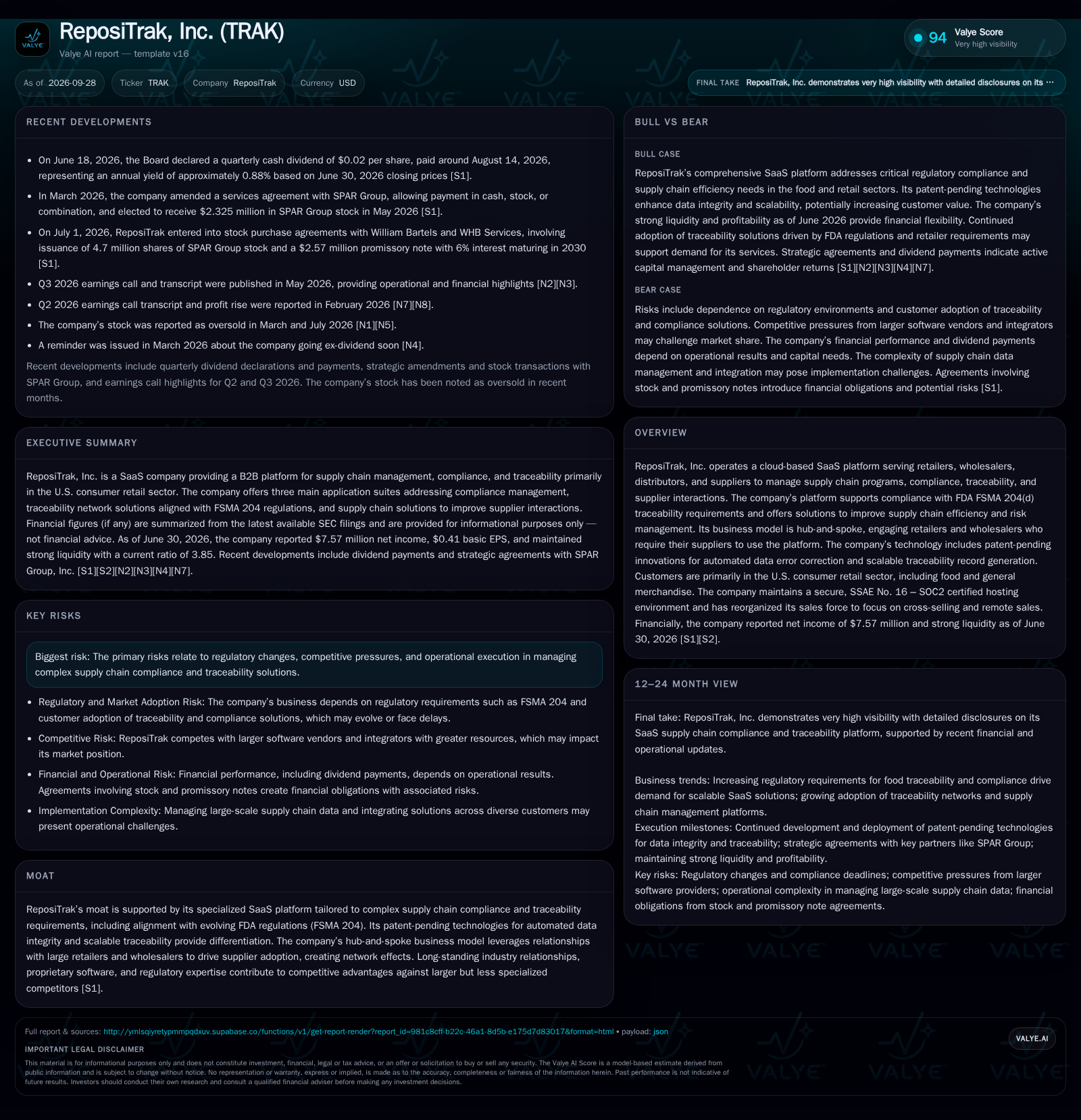
ReposiTrak, Inc. provides a B2B SaaS platform for supply chain compliance, traceability, and supplier management, targeting U.S. retailers and their supply networks. The company reported $7.57 million in net income and a reported current ratio of 3.85 as of June 2026, reflecting both profitability and liquidity [S1]. Its hub-and-spoke approach leverages retailer mandates to drive supplier adoption, with patent-pending technologies designed to handle regulatory traceability requirements (notably FSMA 204). Competitive threats from larger software vendors and evolving regulatory timelines are ongoing risks.
ReposiTrak, Inc. sits at the intersection of regulatory tailwinds and digital transformation in the U.S. retail supply chain. With regulatory mandates like FSMA 204 accelerating demand for traceability and compliance solutions, ReposiTrak’s SaaS platform aims to lock in both retailers and their suppliers through a hub-and-spoke adoption model. However, the company must navigate the challenges of larger competitors, regulatory shifts, and the operational complexity of scaling a B2B compliance network.
Recent Financial Performance and Regulatory Positioning
ReposiTrak reported net income of $7.57 million for the fiscal year ended June 30, 2026, with basic EPS of $0.41 and diluted EPS of $0.39 [S1]. The company held $24.07 million in cash and equivalents, supporting a current ratio of 3.85 [S1]. No single customer accounted for more than 10% of revenue during this period, underscoring a diversified revenue base that reduces direct concentration risk [S1].
The company’s SaaS platform is designed to help customers comply with FDA FSMA 204 traceability regulations, and its patent-pending technology automates error correction and record generation, potentially easing regulatory compliance for a large swath of the U.S. food and retail sector [S1].
ReposiTrak’s hub-and-spoke model, which leverages retailer and wholesaler mandates to drive supplier onboarding, is central to its strategy. Strategic moves in 2026—including agreements with SPAR Group involving both equity and debt—reflect ongoing efforts to expand commercial reach and manage capital allocation [S1].
How Platform Scale and Compliance Complexity Shape Economics
ReposiTrak’s revenue is primarily generated through SaaS subscription fees paid by both hubs (retailers/wholesalers) and their suppliers. The hub-and-spoke model creates a multiplier effect: once a major retailer requires compliance, hundreds or thousands of suppliers may be compelled to join the platform, increasing volume at relatively low marginal cost. This structure supports potentially high gross margins typical of mature SaaS businesses, as each additional supplier or transaction is largely incremental from a cost perspective.
The company’s investment in patent-pending automation for traceability and compliance—such as generating compliant records without case-level scanning—could reduce onboarding friction and support scalable growth. If these technologies successfully lower implementation costs and increase supplier adoption rates, the company could achieve significant operating leverage as recurring revenue scales without a commensurate rise in support or integration expenses.
ReposiTrak’s capital needs appear moderate, with no evidence of heavy hardware outlays or major infrastructure investments; hosting is outsourced to SSAE No. 16 – SOC2 certified data centers [S1]. The cited source reports dividend-related activity; that disclosure alone does not establish dividend-policy continuity, management confidence, or a material constraint on capital flexibility. However, new agreements involving equity and promissory notes introduce contingent obligations that could constrain future flexibility if profitability or cash flow were to weaken [S1].
Specialization Versus Scale: Competitive Dynamics in Traceability SaaS
ReposiTrak’s competitive positioning is built on its specialization in regulatory compliance and traceability for the U.S. food and retail supply chain. Its patent-pending technologies—designed to automate data integrity and compliance with FDA FSMA 204—provide a degree of differentiation versus generic supply chain platforms [S1].
The hub-and-spoke model may create network effects and switching frictions, as supplier onboarding is often mandated by large retailers. However, larger enterprise software vendors and integrators, with deeper resources and broader product portfolios, pose a significant threat. These companies could bundle compliance features with adjacent supply chain, ERP, or logistics offerings, making it difficult for ReposiTrak to defend its turf unless its regulatory focus and data automation tools are clearly superior.
Additionally, the complexity and fragmentation of the supply chain software market means that integration with legacy systems, customer-specific workflows, and evolving regulatory requirements all serve as both barriers to entry for new entrants and potential friction points for ReposiTrak’s own expansion.
Mandated Traceability Drives Network Effects and Margin Expansion
If FDA FSMA 204 enforcement accelerates and large retailers increasingly mandate traceability compliance from their supply base, ReposiTrak could see rapid supplier onboarding and recurring revenue growth. The company’s automated record-generation capabilities could reduce onboarding friction, making it the preferred compliance partner for both retailers and suppliers.
Operating leverage would become more pronounced as incremental suppliers are added at marginal cost, potentially expanding gross and operating margins. A virtuous cycle could emerge if network effects deter supplier churn and create potentially leading industry standards around ReposiTrak’s platform.
Evidence supporting this scenario would include accelerating supplier counts (if disclosed), rising average revenue per customer as network density increases, and visible expansion of multi-year agreements with major retailers.
Compliance-Driven Growth Tempered by Competitive Pressures
The most plausible near-term outcome is steady, compliance-driven adoption among U.S. food and retail supply chains, with growth paced by the rollout and enforcement of regulatory requirements. ReposiTrak continues to add retailers and suppliers, but faces ongoing pricing pressure and product bundling from larger software competitors.
The company’s network effects and regulatory expertise provide some insulation, but customer acquisition costs may rise as competitive intensity increases.
Confirmation of this scenario would be stable or modestly growing revenue and net income, steady supplier onboarding (if disclosed), and continued diversification of the customer base. Signs of increased sales and marketing expense or reduced margin could suggest intensifying competition.
Regulatory Delays and Platform Substitution Erode Growth Momentum
In a bearish scenario, delays or changes in FSMA 204 enforcement slow the urgency for compliance adoption, leading to deferred onboarding or reduced willingness among suppliers to pay for traceability solutions. Simultaneously, larger enterprise vendors could undercut ReposiTrak by bundling compliance features at lower incremental cost or by leveraging their scale to offer aggressive discounts.
ReposiTrak may face increased churn or pricing concessions, while still carrying the cost base needed to support ongoing R&D and customer service. Obligations from recent financial agreements could constrain flexibility if cash flows deteriorate.
This scenario would be confirmed by slowing or declining revenue, margin compression, or evidence of customer defection to larger platforms. Reductions or suspensions in dividend payments, rising accounts receivable, or increased debt reliance would signal further stress.
What Will Determine ReposiTrak’s Platform Durability and Growth?
Supplier onboarding rates and total supplier count across the platform—if disclosed—would demonstrate the strength of network effects and adoption velocity.
Average revenue per customer and shifts in customer mix (hubs vs. spokes) would clarify margin dynamics and platform leverage.
Updates on FSMA 204 enforcement timelines and any regulatory changes affecting traceability requirements will directly impact demand.
Evidence of expanded or renewed multi-year agreements with major retailers would support the case for durable, recurring revenue.
Gross and operating margin trends, particularly as supplier volume increases, will indicate the degree of operating leverage being realized.
Customer retention and churn rates—if disclosed—would test the stickiness of the platform and the effectiveness of switching frictions.
Tracking sales and marketing expense as a percentage of revenue will help assess whether customer acquisition costs are rising due to competitive pressure.
Monitoring the impact of recent financial agreements (e.g., contingent equity or debt obligations) on free cash flow and capital allocation would clarify future flexibility.
Disclaimer: This is research-only, informational analysis and not investment advice. It may include AI-generated interpretation and general industry context. Always verify important details using primary sources.

Comments