
MacKenzie Realty Capital: Mid-Market Real Estate Ambitions, Structural Shifts, and the Challenge of Delivering Income
MacKenzie Realty Capital, Inc.
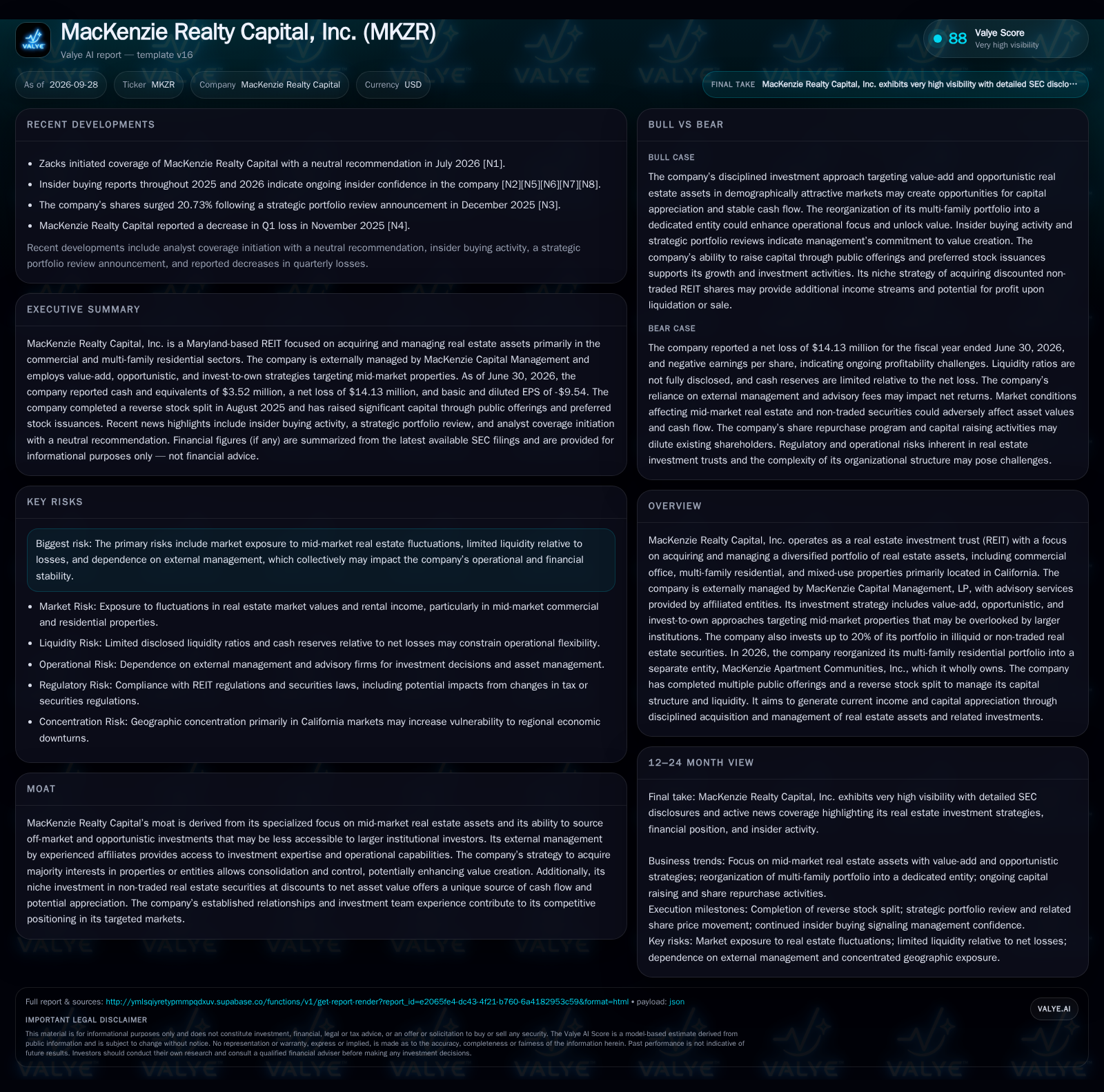
MacKenzie Realty Capital, Inc. (MKZR) operates as a REIT focused on California-centric mid-market commercial and residential real estate. In 2026, it reorganized its multi-family assets into a wholly owned entity, completed a reverse stock split, and maintained active insider buying and capital-raising efforts. [S1] [N1] [N2] [N3] [N4] [N5] [N6] [N7] [N8]
MacKenzie Realty Capital, Inc. stands at a strategic crossroads after a year marked by major portfolio restructuring, capital structure adjustments, and visible insider buying. The 2026 carve-out of its multi-family assets into a separate entity and active share repurchases reflect a drive for operational focus and potential value unlocking. Yet, with a reported net loss of $14.13 million and only $3.52 million in cash as of June 30, 2026, ongoing profitability and liquidity remain open questions. The company’s focus on mid-market California properties and illiquid real estate securities is both its differentiator and a source of risk, as it navigates the challenges inherent in externally managed REIT models and fluctuating real estate markets. [S1] [N2] [N3] [N5] [N6] [N7] [N8]
Recent Restructuring, Insider Activity, and Persistent Losses Define the Current Landscape
As of June 30, 2026, MacKenzie Realty Capital reported a net loss of $14.13 million and held $3.52 million in cash and equivalents, highlighting ongoing profitability hurdles and constrained liquidity. [S1] The completion of a 1-for-10 reverse stock split in August 2025 and total equity capital raised of approximately $125.76 million since inception underscore a focus on capital structure management. [S1] In 2026, the company reorganized its multi-family portfolio into MacKenzie Apartment Communities, Inc., a wholly owned subsidiary, signaling a strategic effort to sharpen operational focus and potentially unlock segment-specific value. [S1] Insider buying reports throughout 2025 and 2026, alongside a share price surge following a strategic portfolio review announcement in December 2025, indicate ongoing management engagement and market reactions to portfolio realignment efforts. [N2] [N3] [N5] [N6] [N7] [N8]
How the Value-Add REIT Model Interacts with Capital Structure and Fee Drag
MacKenzie Realty Capital generates revenue primarily through rental income from its portfolio of commercial, multi-family, and mixed-use properties, with a focus on mid-market assets in California. Its value-add and opportunistic investment strategies aim for capital appreciation via property repositioning, operational improvements, and selective acquisitions—often in segments overlooked by larger institutional players. The company also invests up to 20% of its portfolio in illiquid or non-traded securities, seeking discounted entry points for potential capital gains.
A key cost layer is the external management and advisory fee structure, which typically includes base fees and potential bonuses tied to assets and funds from operations. While external management offers access to experienced real estate professionals and deal flow, it also introduces fee drag that can erode net returns, especially during periods of underperformance. Capital needs are ongoing—both for acquisitions and property improvements—which heightens dependence on external capital markets, as evidenced by the company’s repeated equity and preferred stock offerings.
Niche Focus and Sourcing Capabilities: Advantages and Counterforces in the Mid-Market Arena
MacKenzie Realty Capital’s core competitive angle lies in its focus on mid-market properties and off-market deal sourcing, which can yield attractive risk-adjusted returns when markets are inefficient or institutional capital is less active. Its ability to acquire discounted non-traded real estate securities provides a unique, though sometimes lumpy, source of potential appreciation and cash flow.
However, this niche focus also exposes the company to several counterforces. The geographic concentration in California increases vulnerability to regional economic cycles, regulatory shifts, and property market fluctuations. Larger REITs and private equity real estate funds may have lower cost of capital, more diversified portfolios, and operational scale, making it difficult for MacKenzie to compete for higher-quality assets or weather downturns. Additionally, the illiquidity of non-traded securities and mid-market properties can amplify volatility and impair exit flexibility, especially if the company is forced to sell assets to address liquidity shortfalls.
Operational Focus and Portfolio Optimization Unlock Value and Cash Flow
If the reorganization of the multi-family portfolio results in greater operational focus and more efficient asset management, MacKenzie Realty Capital could realize improved cash flows and higher asset values. Successful execution of value-add and opportunistic strategies—such as repositioning properties, increasing occupancy, or capturing market rent growth—would support the generation of both current income and capital appreciation. The company’s ability to source off-market deals at compelling valuations could further enhance returns, particularly if market conditions favor buyers in the mid-market segment.
The company reported profitability for the period. Additional confirmation could come from continued insider buying, positive analyst revisions, and successful capital recycling into higher-yielding assets.
Incremental Progress Amid Fee Drag and Market Cyclicality
The most plausible scenario is one in which MacKenzie Realty Capital achieves modest improvement in cash flow and asset values, but remains constrained by external management fees, ongoing capital needs, and market cyclicality. The company may succeed in selectively recycling capital and enhancing certain property values, yet persistent fee drag and the cost of raising new capital could limit distributable income and slow net asset value growth.
Evidence of continued capital raising—especially through preferred stock and public equity—would suggest that organic cash flow remains insufficient to fully fund growth ambitions. Portfolio metrics would show incremental improvement but not a transformative change, and market sentiment (as indicated by neutral analyst coverage) would remain cautious. [N1]
Liquidity Constraints and Market Weakness Force Asset Sales or Dilution
If real estate market conditions deteriorate—particularly in California’s mid-market segment—or if rental income and asset values fail to recover, MacKenzie Realty Capital could face acute liquidity pressure. reported cash balance relative to ongoing net losses may force the company to sell assets at suboptimal prices, further eroding net asset value and potentially triggering covenant breaches or regulatory complications.
In this scenario, persistent negative earnings and limited access to favorable capital markets could necessitate dilutive equity or preferred stock offerings, reducing existing shareholder value. The illiquid nature of certain portfolio holdings (such as non-traded securities) could further constrain the company’s ability to meet obligations or capitalize on recovery opportunities. Evidence would include further increases in net losses, declining cash balances, distressed asset sales, downward revisions to portfolio valuations, and negative shifts in analyst or market sentiment.
Milestones That Will Shape MacKenzie Realty Capital’s Ability to Deliver on Its REIT Thesis
Disclosure of funds from operations (FFO) and its trajectory, if provided, would clarify whether the portfolio is generating sustainable distributable cash flow or if fee drag and capital costs remain dominant.
Quarterly trends in net income/loss and cash balances will indicate if the company is moving toward profitability or deepening its liquidity challenges.
Occupancy rates, rent roll changes, and realized gains/losses on asset sales would help test the effectiveness of the company’s value-add and opportunistic strategies.
Updates on portfolio composition—specifically the proportion of illiquid or non-traded securities—would provide insight into risk concentration and potential liquidity constraints.
Any changes to the external management agreement (fee structure, performance incentives, or termination provisions) would be material for net returns and alignment of interests.
Evidence of successful refinancing or access to non-dilutive capital (e.g., property-level debt at favorable rates) would improve funding flexibility.
Insider transaction activity was reported in the cited source; this activity does not by itself establish insider confidence.
Analyst rating changes and market reactions to strategic portfolio reviews or asset revaluations would provide a read on external confidence in the business model.
Disclaimer: This is research-only, informational analysis and not investment advice. It may include AI-generated interpretation and general industry context. Always verify important details using primary sources.

Comments