
Agroz Inc.: Leveraging AI and Robotics to Transform Sustainable Agriculture
Agroz Inc. has gained international recognition for its AI-powered, vertically integrated agricultural technologies and strategic partnerships.
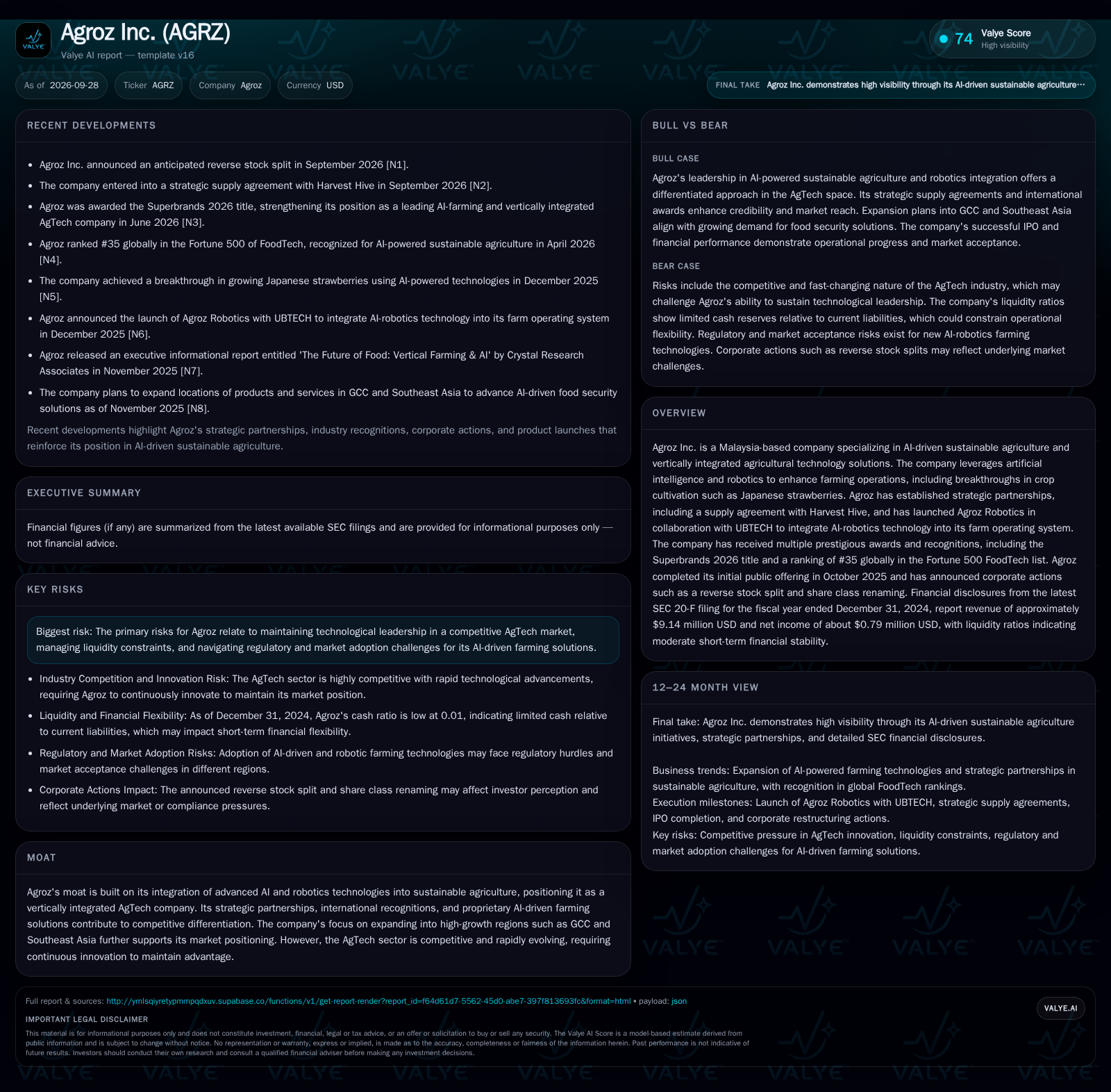
Agroz Inc. is a Malaysia-based AI-AgTech company integrating robotics and advanced analytics into sustainable farming. Recent strategic supply agreements, global awards, and partnerships underscore its ambition, but its reported cash balance and upcoming reverse stock split indicate financial pressures that could impact execution. The next phase hinges on commercial scaling, regional expansion, and the company's ability to manage liquidity while defending its technological edge.
Agroz Inc. has emerged as a leading player in the AI-driven agriculture space, integrating robotics and advanced analytics into its vertically integrated farm operating systems. The company’s global accolades and strategic partnerships, including a recent supply agreement with Harvest Hive and the launch of Agroz Robotics with UBTECH, signal both commercial momentum and technological innovation. However, a reported cash ratio and impending reverse stock split suggest underlying financial pressures, highlighting the delicate balance Agroz must strike between ambitious growth and operational sustainability in a fiercely competitive AgTech landscape.
Insights from Recent Strategic Initiatives and Financial Performance
Agroz Inc. has recently solidified its commercial positioning through a strategic supply agreement with Harvest Hive, signaling its active pursuit of integration within broader AgTech ecosystems [N2]. The company continues to build credibility, having received the Superbrands 2026 title and ranking #35 in the Fortune 500 FoodTech list, which underscore its international visibility and perceived innovation [N3] [N4]. On the financial side, Agroz reported approximately $9.14 million in revenue and $0.79 million in net income for FY2024, indicating positive operating leverage at its current scale [S1]. [S1] The recent announcement of a reverse stock split and share class renaming in September and July 2026, respectively, suggest ongoing efforts to address market or compliance pressures, possibly triggered by share price performance or listing requirements [N1].
Beyond headline financial figures, a deeper analysis of Agroz's cash flow dynamics and capital allocation priorities would clarify its operational sustainability. For instance, understanding the proportion of revenue reinvested into R&D versus sales and marketing could indicate the company's balance between innovation and market penetration. Additionally, the timing and structure of the reverse stock split may reflect strategic attempts to stabilize share price volatility or meet listing standards, which can influence investor perception and access to capital. Monitoring how these financial maneuvers align with commercial milestones will be critical to assess whether liquidity management supports or constrains growth ambitions.
Value Creation and Risks Within Agroz’s Vertically Integrated Approach
Agroz’s business model centers on the deployment of AI and robotics to automate and optimize farming operations, aiming to deliver higher yields, resource efficiency, and premium crop outcomes—illustrated by its Japanese strawberry breakthrough [N5]. This vertical integration could, in theory, enable Agroz to capture margin both from technology licensing or sales and from direct agricultural production. If its AI-powered solutions are offered as a service (e.g., SaaS for farm management) or through hardware-plus-software bundles, recurring revenue streams may develop over time, but this commercial structure is not explicitly confirmed in the current disclosures.
The company’s modest scale—$9.14 million in revenue—suggests it is still in early commercialization, where fixed costs of technology development (R&D, robotics integration, platform maintenance) are high relative to revenue. This should, over time, create operating leverage if platform adoption accelerates. Capital intensity is likely significant given robotics and AI infrastructure, and future funding rounds or partnerships may be necessary to sustain growth unless internal cash generation improves markedly.
The vertical integration strategy, while offering potential margin capture across the value chain, also concentrates execution risk. The company must effectively coordinate technology development, hardware manufacturing, and agricultural operations, each with distinct cost structures and operational challenges. If Agroz can modularize its offerings—separating hardware, software, and farm production services—it may better manage risk and tailor solutions to diverse customer needs. However, this modularity could dilute integration benefits and complicate revenue recognition. The capital intensity of robotics and AI infrastructure further underscores the importance of achieving scale economies; failure to do so could pressure margins and constrain reinvestment capacity.
Assessing Agroz’s Competitive Edge Through AI Innovation and Collaborations
Agroz’s positioning as an AI-driven, vertically integrated AgTech player is reinforced by its international recognitions and the recent strategic partnership with UBTECH for robotics integration [N6]. These moves suggest early-mover status in the application of advanced AI and robotics to high-value crop cultivation in Southeast Asia. However, the AgTech sector is crowded with both global incumbents (large equipment manufacturers, established farm management software providers) and a rising wave of startups leveraging similar technologies. While partnerships and awards generate visibility, sustainable differentiation will depend on the scalability, reliability, and cost-competitiveness of Agroz’s solutions compared to substitute offerings—ranging from traditional farming methods to other AI-driven platforms.
Switching costs for customers may be moderate if Agroz’s platform is deeply embedded in farm operations, but if deployment is modular or non-exclusive, retention risk rises. The company’s expansion into the GCC and Southeast Asia targets regions with rising food security concerns and government support, but also exposes Agroz to new regulatory, logistical, and cultural challenges.
Sustaining a competitive edge in AI-driven AgTech hinges on continuous innovation and ecosystem development. Agroz's collaborations suggest a strategy to leverage external expertise and accelerate product refinement, which is essential given rapid technological evolution. However, the sector's fragmented customer base and variability in farm sizes and practices may challenge standardization and scalability of solutions. Moreover, the company's ability to generate defensible intellectual property and integrate user feedback into iterative product improvements will influence long-term differentiation. In markets with diverse regulatory environments, adaptability and local partnerships will also be key to overcoming barriers and achieving meaningful adoption.
Potential Growth Pathways Fueled by Expanding Platform Adoption
If Agroz successfully scales its AI- and robotics-powered farm operating system across a growing base of commercial partners—leveraging the Harvest Hive supply agreement as a proof point—revenue could shift from project-based to recurring, with higher-margin software and services complementing hardware deployments. Expansion into the GCC and Southeast Asia could unlock larger contracts, especially if governments or large agribusinesses adopt its technology for food security initiatives. As its customer base grows, operating leverage would improve, supporting reinvestment in R&D and geographic reach.
Confirmation of this scenario would require evidence of multi-year or recurring contracts, accelerating revenue growth, improved gross margins as software/services mix rises, and expansion of strategic partnerships in new regions. Additional capital raised on favorable terms or internally generated free cash flow would further validate scaling potential.
Navigating Commercial Development Amid Funding and Market Pressures
The most plausible trajectory is that Agroz continues to execute on select commercial agreements and regional pilots, with incremental revenue growth supported by its AI and robotics offerings. The company may face pressure to demonstrate differentiated outcomes (e.g., yield improvement, cost reduction) to compete for new business and justify premium pricing.
Base-case confirmation would include steady but not explosive revenue growth, maintenance of strategic partnerships, periodic new agreements in targeted regions, and manageable dilution or debt as Agroz seeks to bridge its funding gap. Falsification would be signaled by deteriorating financials, inability to renew or expand key contracts, or a need for distress financing.
Risks from Cash Flow Challenges and Market Competition That Could Impact Outcomes
Intensifying competition—whether from global AgTech incumbents or fast-moving regional startups—could compress margins and drive down pricing, while regulatory or customer adoption hurdles in new markets might stall expansion.
Early warning signs would include declining cash balances, missed project milestones, loss of key personnel or partners, and negative working capital trends. Failure to secure additional capital or convert pilot projects into long-term contracts would amplify downside risk, potentially leading to restructuring or asset sales.
Critical Developments Shaping the Future of Agroz’s Agricultural Technology
Revenue growth rate by quarter, especially from recurring sources or new regional contracts, if disclosed.
Gross margin trends as the mix of software/services versus hardware or direct agricultural production evolves.
Cash conversion cycle and working capital trends, as indicators of operational efficiency and liquidity stress.
Number and scale of active commercial partnerships, including expansion or renewal of the Harvest Hive agreement, if disclosed.
Geographic expansion progress in GCC and Southeast Asia, including regulatory approvals or government-backed deployments.
Capital raises, debt issuance, or other funding events and their terms, as signals of potential financial flexibility or distress.
Customer adoption metrics—such as installed base, retention rates, and farm productivity improvements attributable to Agroz's technology, if disclosed.
Operational milestones in robotics integration, such as the rollout of Agroz Robotics in new farm environments or product categories.
Disclaimer: This is research-only, informational analysis and not investment advice. It may include AI-generated interpretation and general industry context. Always verify important details using primary sources.

Comments