
Zone Frontier’s AI Infrastructure Bet: From Cleaning Tech to Data Center Ambition
Zone Frontier Inc. (formerly CleanCore Solutions) is executing a high-stakes pivot from patented cleaning products and digital assets to the capital-intensive world of AI-focused data centers. Its multi-billion dollar contract with Cerebras Systems anchors early revenue, but execution, customer concentration, and capital deployment risks loom large as the company seeks to scale.
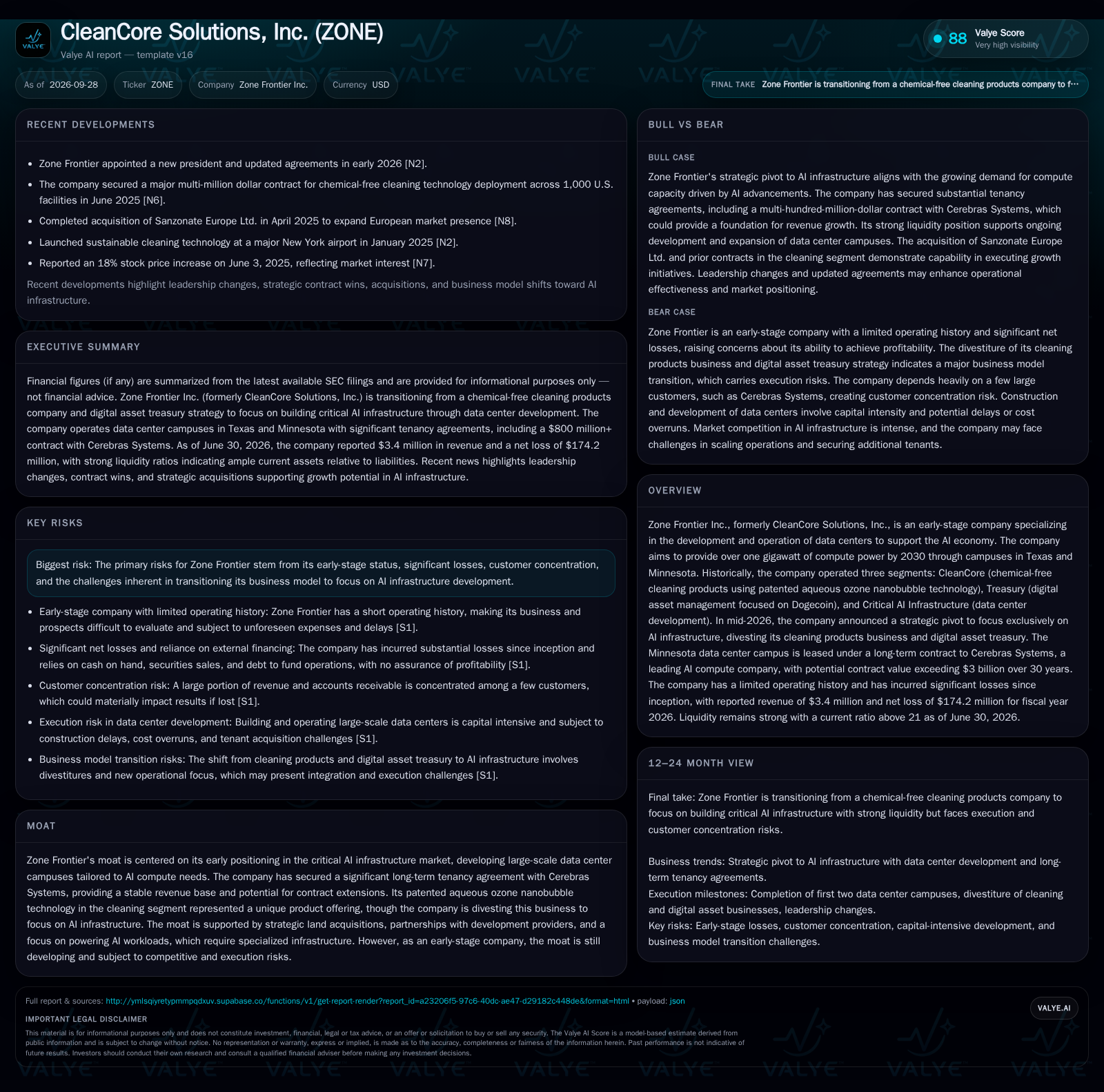
Zone Frontier is transforming into an AI infrastructure company, focusing on large-scale data centers with contracts like a $800M+ deal with Cerebras Systems. The company retains reported liquidity position but faces high early losses, major dependence on a single tenant, and unproven scalability in a competitive sector. Success will hinge on operational execution, tenant diversification, and managing capital intensity as it builds toward its one-gigawatt vision by 2030. [S1]
Zone Frontier Inc., emerging from its CleanCore Solutions legacy, is wagering its future on powering the AI revolution through hyperscale data centers. Anchored by a major long-term contract with Cerebras Systems, the company’s strategic overhaul puts it on a collision course with industry giants and the sector’s capital demands.
Major Contract and Strategic Refocus Define Zone Frontier’s Present
Zone Frontier Inc. recently announced a strategic pivot to focus exclusively on AI infrastructure, divesting its chemical-free cleaning products and digital asset treasury businesses to concentrate on developing and operating data centers for AI workloads. This shift is anchored by two new campuses: a 200-megawatt facility in West Texas and a 40-megawatt Minnesota campus leased under a ten-year contract to Cerebras Systems—a leading AI compute firm. The initial value of this Cerebras deal exceeds $800 million, with renewal options that could bring the total to over $3 billion. As of June 30, 2026, Zone Frontier reported $15.4 million in cash and equivalents, a current ratio of 21.24, and a net loss of $174.2 million against $3.4 million in revenue, reflecting the high up-front costs and early-stage nature of its new business. [S1]
Data Center Economics: High Fixed Costs, Recurring Revenue Potential
Zone Frontier’s new core business model is built on developing, owning, and leasing high-capacity data centers tailored for AI workloads. This model is capital-intensive, with substantial up-front costs for land, construction, power infrastructure, and cooling systems. Once operational, data centers generate revenue primarily through long-term leasing contracts, often structured on a per-megawatt or per-cabinet basis, providing a foundation for recurring cash flows if tenant occupancy is high and renewal rates are strong.
The contract with Cerebras Systems illustrates this dynamic: a ten-year commitment provides revenue visibility, and renewal options could extend the value and duration significantly. However, the path to profitability is constrained by large depreciation, ongoing maintenance, and the need to fund additional expansion to meet the one-gigawatt goal. The company reported cash and liquidity metrics for the period; these figures do not by themselves establish operating runway, investment capacity, financial flexibility, or financing capacity. As operating leverage increases with higher occupancy and more campuses coming online, margins could improve, but only if Zone Frontier successfully fills capacity and manages costs.
A critical factor influencing Zone Frontier’s economics is the scalability of its infrastructure investments. Given the capital-intensive nature of data center development, the company must carefully balance incremental capacity additions with anticipated demand growth to avoid underutilized assets that can depress returns. This necessitates robust demand forecasting and flexible design approaches that allow phased expansions. Additionally, power costs represent a significant portion of ongoing operational expenses, especially for AI workloads that demand high-density computing and advanced cooling solutions. Zone Frontier’s ability to negotiate favorable power purchase agreements or invest in renewable energy sources could materially affect its cost structure and appeal to sustainability-conscious tenants.
Early Entrant Position Versus Established Data Center Operators
Zone Frontier’s advantage rests in its early focus on purpose-built AI data centers, potentially allowing it to tailor infrastructure to the specific needs of advanced AI tenants. The long-term Cerebras contract demonstrates initial market credibility and a degree of embedded switching friction, as relocating high-density AI workloads is costly and operationally complex for tenants.
However, the broader data center industry is highly competitive, with entrenched players such as Equinix, Digital Realty, and hyperscale cloud providers offering proven scale, access to capital, and established customer relationships. These incumbents may have pricing power, lower cost of capital, and deeper technical expertise, making customer acquisition and retention a challenge for new entrants. Zone Frontier’s ability to win further anchor tenants, differentiate through technology or sustainability, and execute reliably will be critical in defending its position as the sector matures.
Zone Frontier’s positioning also hinges on technological differentiation beyond physical infrastructure. As AI workloads evolve rapidly, data center operators must offer adaptable architectures that can support diverse hardware configurations and emerging compute paradigms. This could involve integrating specialized networking capabilities, low-latency interconnects, or modular designs that facilitate rapid upgrades. The company’s success in cultivating a technology ecosystem that aligns with tenant innovation cycles may increase switching costs and foster long-term partnerships. However, established incumbents with entrenched ecosystems and broader service portfolios may counter with bundled offerings, making it imperative for Zone Frontier to articulate clear value propositions and operational reliability.
Scaling Successfully: Tenant Diversification and Margin Expansion
If Zone Frontier can leverage its initial Cerebras Systems partnership to attract additional blue-chip AI and cloud tenants—especially those seeking specialized, high-density compute infrastructure—it could achieve rapid occupancy gains and revenue scale. Successful completion and leasing of new campuses, combined with consistently high renewal rates, would improve operating leverage and drive margin expansion as fixed costs are spread across a larger revenue base.
Evidence confirming this scenario would include new multi-year tenant contracts, expansion of the Minnesota or Texas campuses, and announcements of additional campuses or anchor clients. A declining net loss trajectory, improving gross margins, and positive cash flow from operations would further validate that the business model is gaining traction and that Zone Frontier is transitioning from an early-stage loss leader to a scalable infrastructure provider.
Building Out Core Capacity While Managing Losses and Customer Risk
The most plausible near-term course is one of gradual capacity build-out, continued reliance on the Cerebras contract for the bulk of revenue, and persistent but narrowing losses as new facilities come online. Zone Frontier may secure a handful of additional tenants, though likely not at the scale or terms of the Cerebras deal initially.
Confirmation would come from stable or growing contracted IT load, modest revenue growth, and evidence that operating expenses are not outpacing gross profit improvements. Signs of customer concentration risk—such as revenue dependency on Cerebras or delayed tenant signings—would reinforce the base scenario’s constraints.
Execution Stumbles and Tenant Dependency Threaten Viability
The main adverse pathway involves project delays, cost overruns, or operational setbacks that erode liquidity before new revenue streams can materialize. If Cerebras Systems reduces its commitment, fails to renew, or encounters its own business headwinds, Zone Frontier could face a significant revenue shortfall and struggle to cover fixed costs. Failure to attract new tenants would exacerbate this vulnerability, potentially forcing asset sales, dilutive equity raises, or even restructuring.
Confirmation of this scenario would include construction delays, missed occupancy or revenue targets, unexpected cash burn, or public disclosures of tenant churn or contract renegotiations. Any inability to access capital for future buildouts would further highlight downside risk.
Another dimension of execution risk lies in the complexity of managing large-scale construction projects within tight timelines and budgets. Delays or cost overruns can cascade into liquidity pressures, especially if tenant onboarding is contingent on phased facility completions. Furthermore, reliance on a single anchor tenant exposes Zone Frontier to tenant-specific risks, including shifts in strategic priorities or technology roadmaps that reduce space requirements. In a scenario where tenant diversification fails to materialize, the company might face pricing pressures or need to offer concessions to attract smaller tenants, eroding margins. Such dynamics could necessitate additional capital raises under less favorable terms, diluting existing shareholders and constraining strategic flexibility.
How Zone Frontier’s AI Data Center Ambitions Will Be Tested
Track the pace of new tenant announcements and the number of signed megawatts under contract—if disclosed—to gauge demand beyond Cerebras.
Monitor project delivery timelines and capital expenditure discipline for new campuses, as delays or overruns would pressure liquidity and confidence.
Watch for updates on the divestiture of legacy cleaning and digital asset businesses, as successful exits may provide additional capital or reduce distraction.
Observe any changes in the terms, scope, or renewal status of the Cerebras Systems contract, as this remains the company’s anchor revenue source.
A useful metric would be cash flow from operations—sustained improvement would indicate a transition toward a self-funding model.
Pay attention to announcements of new financing rounds, debt issuances, or partnerships, which could signal either growth opportunity or capital strain.
If disclosed, monitor occupancy rates and the mix of tenant types at each campus to assess diversification and potential pricing power.
External conditions such as changes in AI compute demand, power costs, or competitive data center builds in the same regions could materially impact Zone Frontier’s prospects.
Disclaimer: This is research-only, informational analysis and not investment advice. It may include AI-generated interpretation and general industry context. Always verify important details using primary sources.

Comments