
WeShop Holdings: Social Commerce Ambitions Meet Liquidity and Platform Dependency Hurdles
WeShop Holdings is expanding its capital-light social commerce platform from the UK to the US, leveraging affiliate and advertising revenue streams.
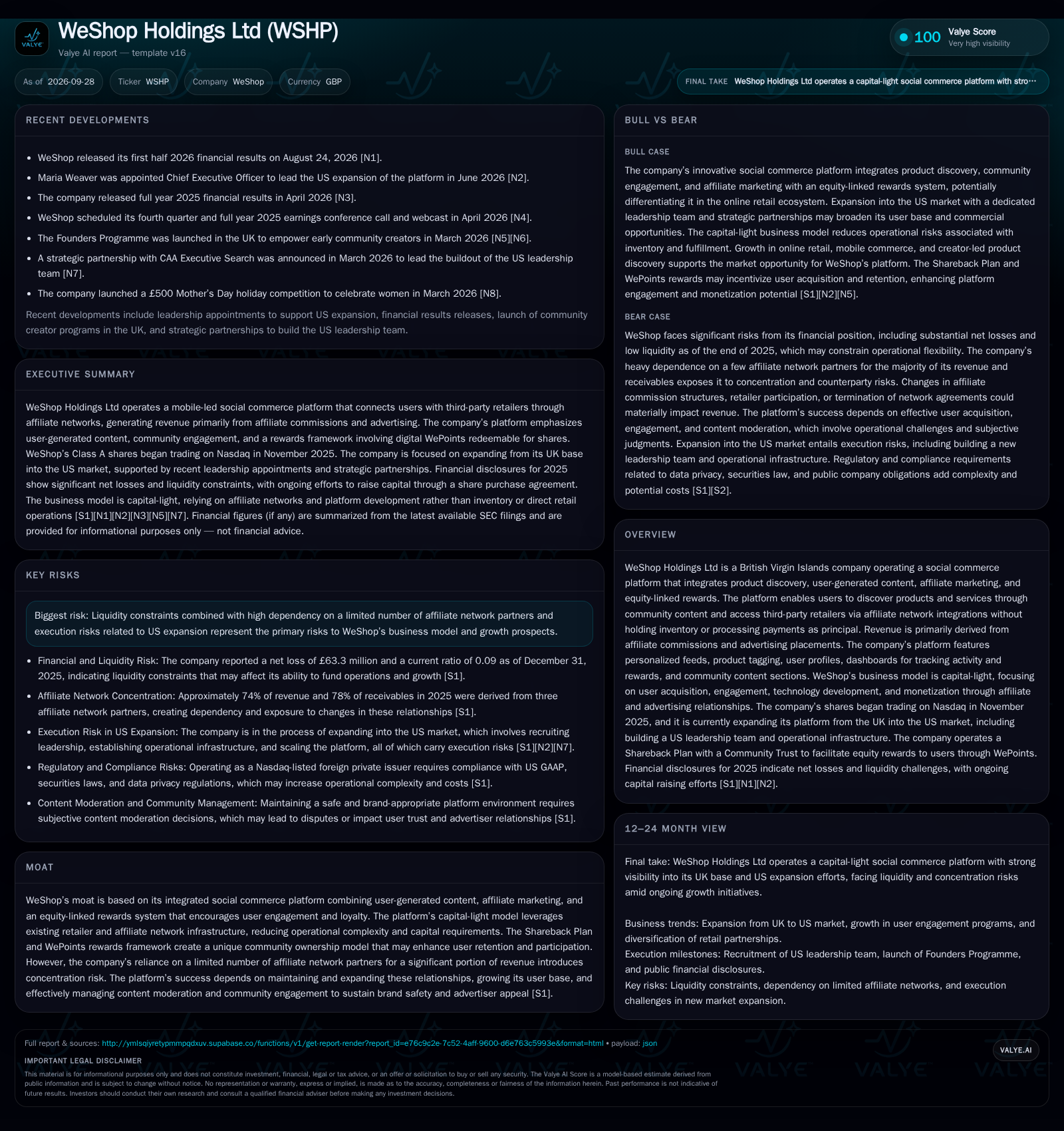
WeShop Holdings operates a mobile-first social commerce platform, focusing on affiliate commissions and advertising for revenue, and recently began US expansion with a new CEO. Despite a differentiated equity-linked rewards model and community-driven growth efforts, the company faces acute liquidity pressure and heavy reliance on a handful of affiliate networks for most of its revenue. Execution in the US and diversification of revenue streams will be critical for future viability. [S1] [N2]
WeShop Holdings is racing to establish itself as a differentiated player in the social commerce landscape, blending community-driven content with affiliate shopping, all underpinned by an equity-linked rewards model. With a new CEO in place and US expansion underway, the next phase will test whether WeShop’s platform and community incentives can drive sustainable engagement and revenue diversification, or whether operational and financial headwinds will prove insurmountable. [S1] [N2]
Liquidity Crunch and Platform Dependency Define Near-Term Outlook
[S1] This financial posture severely limits operating flexibility and heightens the urgency of external capital raising.
The company’s revenue model is heavily concentrated, with three affiliate networks accounting for approximately 74% of revenue and 78% of receivables in 2025, exposing WeShop to significant counterparty and contract risk. [S1]
To address funding needs, WeShop has filed a Purchase Agreement for up to $25 million in share sales, but the timing and ability to draw on this facility remain subject to market conditions and Nasdaq requirements. [S2]
Operationally, the company has signaled a strategic pivot to the US market, appointing Maria Weaver as CEO and launching a search for US-based leadership, aiming to broaden its commercial footprint. [N2] [N7]
How WeShop’s Capital-Light Model Drives Revenue—And Its Limits
WeShop’s economics hinge on a platform model that avoids inventory, warehousing, and direct retail risk. Instead, the mobile app connects users to third-party retailers via affiliate networks, earning commissions on referred sales. This structure keeps fixed costs low and allows for rapid geographic expansion, with variable costs tied mainly to technology, user acquisition, and platform operations. [S1]
Advertising represents a secondary, nascent revenue stream, with tenancy-style and promotional placements supplementing affiliate commissions. The scalability of advertising is theoretically high, but requires a critical mass of active users and quality content to attract paying advertisers.
WeShop’s Shareback Plan and WePoints system—allowing users to earn digital rewards redeemable for company shares—aim to boost engagement and retention. While this could lower user acquisition costs and deepen network effects, it also introduces dilution risk and future equity management complexity.
On the cost side, the absence of inventory and fulfillment means lower working capital requirements, but the company remains heavily dependent on continuous investment in technology and marketing to build and retain a vibrant community.
Social Commerce Differentiation Meets Platform and Channel Risks
WeShop’s core differentiation lies in integrating user-generated content, social discovery, and affiliate shopping with a unique equity-linked rewards structure. This approach seeks to blend the engagement of social platforms with the transactionality of e-commerce, potentially carving out a niche distinct from pure content or pure marketplace competitors.
However, several structural disadvantages exist. Heavy reliance on external affiliate networks means WeShop lacks direct bargaining power with retailers and is exposed to changes in commission rates, affiliate program policies, or outright contract terminations.
The platform must compete not only with established social and e-commerce giants (which may build similar affiliate layers or creator monetization tools) but also with specialized creator economy startups, vertical marketplaces, and shopping discovery apps. The lack of exclusive merchant relationships makes differentiation more reliant on community, user experience, and perceived value of the equity rewards.
Switching costs for users are relatively low; unless the rewards system proves materially attractive or the content community becomes a destination in its own right, user churn risk remains high. Advertisers and affiliate partners, meanwhile, may view WeShop as one of many traffic sources, limiting pricing power until critical mass is achieved.
If Community Flywheel and US Expansion Succeed, Network Effects Could Compound
A favorable scenario would see WeShop’s US expansion catalyze rapid user and creator adoption, with the Shareback Plan and WePoints rewards creating a sticky, engaged community. As user-generated content volume and quality grow, platform engagement would rise, driving more traffic to affiliate partners and boosting commission revenue.
If WeShop can demonstrate meaningful advertising traction—perhaps by attracting brand campaigns or influencer partnerships—the advertising revenue mix could increase, improving gross margin and reducing concentration risk. This could also enable the company to negotiate more favorable terms with affiliate networks or even develop direct retailer relationships.
Evidence that would confirm this scenario includes: accelerating active user and creator growth (if disclosed), material growth in advertising revenue, improved affiliate network diversification, and successful capital raising that extends operating runway.
Sustained Losses, Incremental User Growth, and Ongoing Platform Dependence
The most plausible near-term trajectory is that WeShop achieves incremental user and engagement growth in the UK and makes initial inroads in the US, but remains heavily dependent on its top affiliate networks and faces continued operating losses.
While user acquisition efforts like the Founders Programme and promotional campaigns may drive short-term engagement, the absence of significant advertising traction or network diversification keeps revenue growth modest and margins thin.
Liquidity remains a persistent challenge; the company may access some capital under the share purchase agreement but will likely need further dilutive financing. Execution risk in the US could delay or blunt the impact of expansion efforts.
This scenario would be confirmed by user and revenue growth that lags major competitors, persistent negative net income, and continued heavy affiliate concentration in revenue disclosures.
Affiliate Network Disruption or Funding Shortfall Triggers Business Model Stress
A negative scenario could materialize if one or more of WeShop’s key affiliate network partners reduce commission rates, alter terms, or terminate agreements. Given the concentration (74% of revenue), such a change would have an immediate and outsized impact on cash flow and revenue.
Alternatively, if the company is unable to draw sufficiently on its share purchase agreement or raise additional capital, liquidity constraints could force cuts to platform development, marketing, or even core operations, accelerating user churn and eroding community engagement.
Additional risks include regulatory changes affecting data use, content moderation controversies, or reputational damage that reduces advertiser or affiliate partner interest.
This scenario would be confirmed by sudden revenue declines, sharp reductions in user engagement metrics, public disclosure of affiliate network renegotiations or terminations, or the announcement of cost-cutting measures and layoffs.
Milestones That Will Clarify WeShop’s Ability to Scale and De-Risk Its Model
Affiliate network diversification: A useful metric would be the percentage of revenue and receivables from the top three affiliate networks (if updated), as a measure of concentration risk.
Active user and creator growth: Disclosed active user and creator figures, especially in the US market, would help test the platform’s scaling potential.
Advertising revenue traction: Growth in advertising-related revenue as a percentage of total revenue (if disclosed) would indicate progress toward monetization diversification.
Shareback Plan participation: Metrics on the volume of WePoints issued, redeemed, and shares delivered would provide insight into user engagement and dilution risk.
Gross margin evolution: Any disclosure of gross margin or contribution margin trends would help clarify the impact of revenue mix changes and operating leverage.
Capital raised under share purchase agreement: Updates on the amount drawn and runway extension from the $25 million facility would indicate potential financial flexibility.
US leadership buildout and market launch milestones: Announcements of new hires, US user growth, or market launches would serve as execution markers.
Churn and retention rates: If disclosed, these would illuminate the stickiness of the platform and the effectiveness of the rewards model.
Disclaimer: This is research-only, informational analysis and not investment advice. It may include AI-generated interpretation and general industry context. Always verify important details using primary sources.

Comments