
FreeCast’s White-Label Streaming Ambitions: Scaling Engagement and Monetization in a Crowded Aggregator Market
FreeCast, Inc. has built a proprietary white-label streaming aggregation platform with a multi-pronged monetization strategy and a reported subscriber base exceeding 1.19 million. While the company launched its own ad tech and supports enterprise partners across telecom, device, and housing sectors, its low revenue per user, persistent losses, and cash constraints highlight the challenge of converting broad registration into durable, profitable engagement.
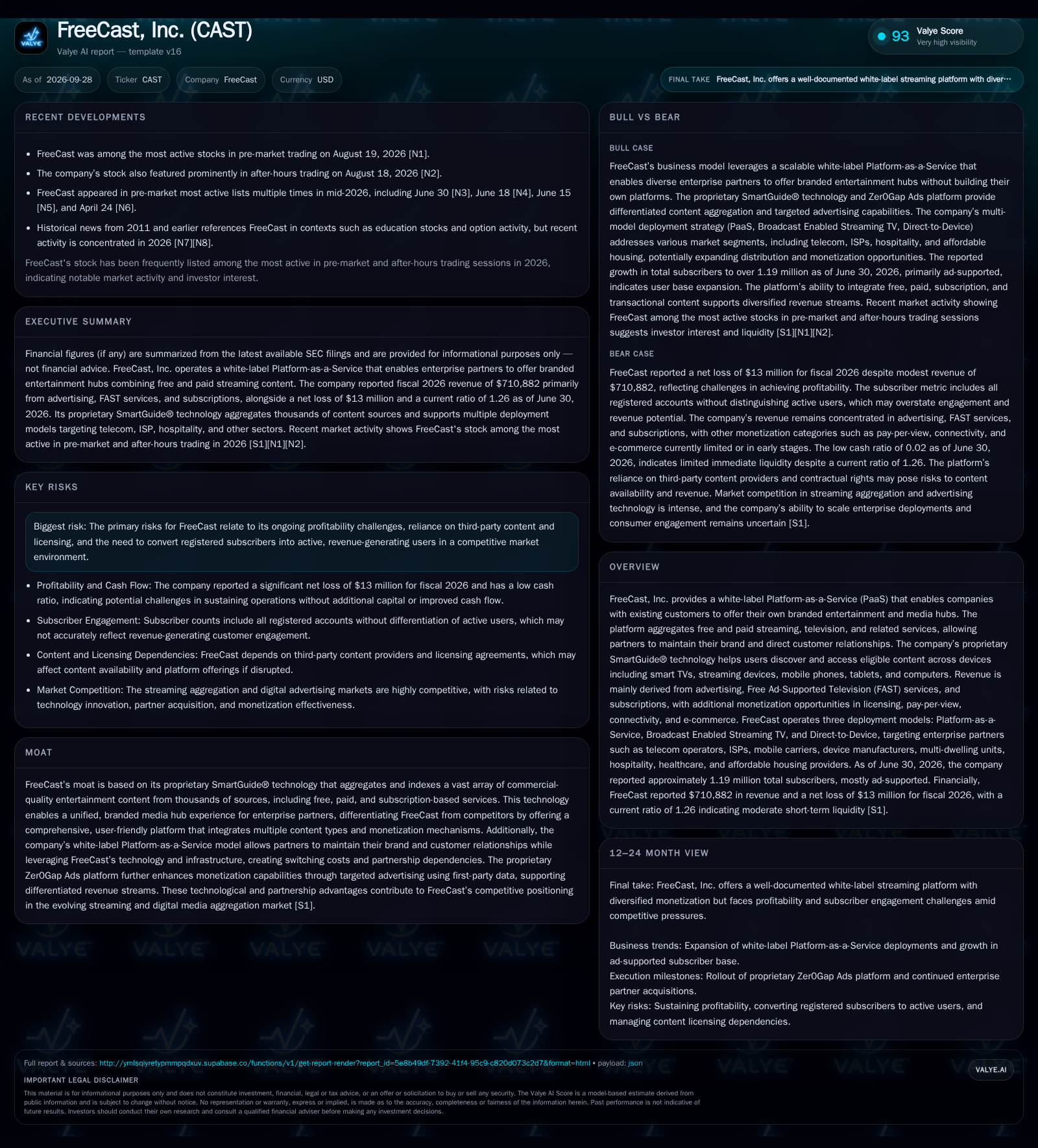
FreeCast, Inc. aggregates streaming content into branded media hubs for enterprise partners, generating revenue from advertising, FAST services, and subscriptions. Despite a reported 1.19 million subscribers (mostly ad-supported), fiscal 2026 revenue was only $710,882, with a net loss of $13 million. The company’s proprietary ad platform and white-label approach provide technical differentiation, but profitability and user engagement remain major hurdles as competition intensifies and monetization per user lags [S1].
FreeCast, Inc. aims to carve out a niche in the crowded streaming aggregation market by offering a white-label platform that allows enterprise partners—from telecom operators to hospitality providers—to deliver branded entertainment experiences. Despite proprietary technology for content discovery and targeted advertising, FreeCast’s fiscal 2026 results reveal a fundamental challenge: monetizing a large registered subscriber base, the vast majority of which is ad-supported, into meaningful revenue and profitability. The company’s future will depend on its ability to drive active engagement, expand monetization avenues, and prove the resilience of its PaaS model in the face of aggressive competition and shifting content economics.
Recent Metrics Underscore Engagement and Monetization Hurdles
For the fiscal year ended June 30, 2026, FreeCast reported total revenue of $710,882, with advertising accounting for $385,602, FAST services for $267,509, and subscriptions for $56,311. Despite a reported subscriber base of 1,194,219, the vast majority (98.8%) are ad-supported, and only 14,275 are paid subscribers. The company posted a net loss of $13,044,799 and basic/diluted EPS of -$0.62 [S1].
Recent liquidity metrics show current assets of $9.4 million against current liabilities of $7.5 million, resulting in a current ratio of 1.26 and a notably reported cash ratio of 0.02 [S1].
In 2026, FreeCast launched its Zer0Gap Ads platform, aiming to internalize ad-serving and improve targeting via first-party data. Meanwhile, the company’s stock has appeared frequently in pre-market and after-hours trading activity, indicating market interest but not necessarily operational momentum [S1] [N1] [N2].
Revenue Streams, Cost Structure, and the Path to Operating Leverage
FreeCast’s revenue model spans six categories: advertising, FAST (Free Ad-Supported Television), subscriptions, licensing, pay-per-view/transactional, connectivity, and e-commerce. In practice, advertising and FAST services currently dominate, with subscription and other categories contributing marginally [S1].
As a white-label Platform-as-a-Service provider, FreeCast’s core economics rely on scaling fixed technology and infrastructure costs across a growing partner and end-user base. Theoretically, as more enterprise partners deploy the platform and user engagement rises, incremental costs per user should decline, offering operating leverage.
However, the very low revenue per claimed subscriber (well below $1/year) suggests either limited monetization per user or low active engagement. High fixed costs for technology, content aggregation, customer support, and partner onboarding make breakeven challenging without a significant increase in either active users or monetization intensity.
The launch of Zer0Gap Ads could improve advertising yield if FreeCast succeeds in leveraging first-party data for targeted campaigns, but effective CPMs in the ad-supported streaming space are often modest. Additional revenue streams like licensing and e-commerce remain largely unproven and may require further investment and integration.
Aggregation Advantage or Commodity Platform? Assessing FreeCast’s Differentiation
FreeCast’s competitive pitch centers on its proprietary SmartGuide® technology for content discovery and its ability to offer partners a branded, unified entertainment hub. The company’s white-label PaaS approach allows partners—telecom firms, ISPs, device makers, hospitality, and housing providers—to retain their customer relationships and brand equity while leveraging FreeCast’s infrastructure [S1].
The Zer0Gap Ads platform, launched in 2026, provides FreeCast with direct control over ad targeting and inventory management, potentially boosting ad revenues and partner value.
However, the streaming aggregation space is crowded, with competitors ranging from device-native platforms (e.g., Roku, Amazon Fire, Samsung TV Plus) to independent aggregators and middleware providers. Many of these competitors offer their own ad tech stacks, deep content relationships, and significant marketing resources.
Switching costs for enterprise partners may exist if FreeCast’s platform is deeply integrated or customized, but the risk of churn is real if competitors can offer better economics, content, or user engagement tools. Furthermore, FreeCast’s dependence on third-party content and licensing limits its negotiating leverage and could expose it to content cost inflation or rights disputes.
What Success Looks Like: Active Engagement, Higher Monetization, and Enterprise Expansion
In a favorable scenario, FreeCast converts a meaningful portion of its registered subscriber base into actively engaged users, driving higher ad impressions, subscription upgrades, and participation in transactional/e-commerce offerings.
The company leverages the Zer0Gap Ads platform to improve ad targeting and yield, increasing average revenue per user (ARPU) and attracting premium advertisers—especially as privacy restrictions make first-party data more valuable. Expansion into new enterprise partnerships (e.g., additional ISPs, device manufacturers, or hospitality chains) broadens distribution and creates recurring licensing/ad revenue streams.
Proof points would include: a sustained increase in ARPU, growth in active (not just registered) users, new enterprise partnership announcements with material revenue commitments, and positive operating cash flow trends. An uptick in licensing or e-commerce revenue would further validate the multi-pronged model.
This upside would be challenged if engagement fails to materialize or if enterprise partners do not see measurable value in FreeCast’s platform.
Incremental Progress but Persistent Losses: The Likely Near-Term Trajectory
The most plausible scenario is incremental revenue growth driven by modest gains in partner adoption and gradual improvements in ad yield from Zer0Gap Ads, but with ongoing challenges in converting registered accounts to active, monetizable users.
FreeCast may add new enterprise partners in targeted verticals, but these deployments are likely to be gradual and may not immediately translate into revenue scale. Advertising and FAST services remain the primary revenue drivers, with subscriptions and other streams contributing only marginally.
Operating losses persist, as fixed costs for platform maintenance, content aggregation, and business development remain high relative to revenue.
Confirmation would come from continued low ARPU, limited movement in paid subscriber numbers, and ongoing net losses. A step-change in engagement or monetization would be required to alter this trajectory.
Structural Challenges: Stalled Engagement and Content/Partner Risk
In a negative scenario, FreeCast fails to meaningfully convert its large pool of registered users into active or paying customers, resulting in persistently low monetization and ongoing cash burn.
Reliance on third-party content providers becomes a vulnerability if licensing costs rise or key content relationships are lost, reducing the attractiveness of the platform for both partners and end users. Meanwhile, competitive pressure from device-native and well-capitalized streaming platforms erodes FreeCast’s value proposition, leading to partner churn or unfavorable contract renegotiations.
Liquidity constraints may force FreeCast to slow investment, delay feature rollouts, or seek dilutive external financing, further limiting its competitive options.
Downside confirmation would include declining or stagnant revenue, loss of major enterprise partners, negative trends in active user engagement (if disclosed), and further deterioration in cash metrics.
Milestones That Will Test the FreeCast Thesis
Sustained growth in active (not just registered) users—if disclosed—would indicate improving engagement and monetization potential.
Trends in average revenue per user (ARPU), particularly for ad-supported and paid tiers, to gauge effectiveness of monetization initiatives.
Expansion or renewal of enterprise partner agreements, especially with material revenue commitments or multi-year terms.
Ad yield metrics and fill rates from the Zer0Gap Ads platform, which would demonstrate the value of proprietary ad technology.
Breakdown of revenue by deployment model (PaaS, BEST, D2D) to assess which segments are gaining traction.
Evidence of growing licensing, e-commerce, or transactional revenue, supporting the platform’s diversification thesis.
Cash flow from operations and changes in working capital to monitor liquidity risk and the need for external funding.
Disclosure of content acquisition or licensing costs as a percentage of revenue, to evaluate exposure to margin compression.
Disclaimer: This is research-only, informational analysis and not investment advice. It may include AI-generated interpretation and general industry context. Always verify important details using primary sources.

Comments