
Sino Green Land Corp.: Recycling Scale Meets Financial Strain in the Global R-PET Supply Chain
The company's ability to translate technical scale and regulatory alignment into sustainable economics remains the central question as demand, competition, and execution risks intensify.
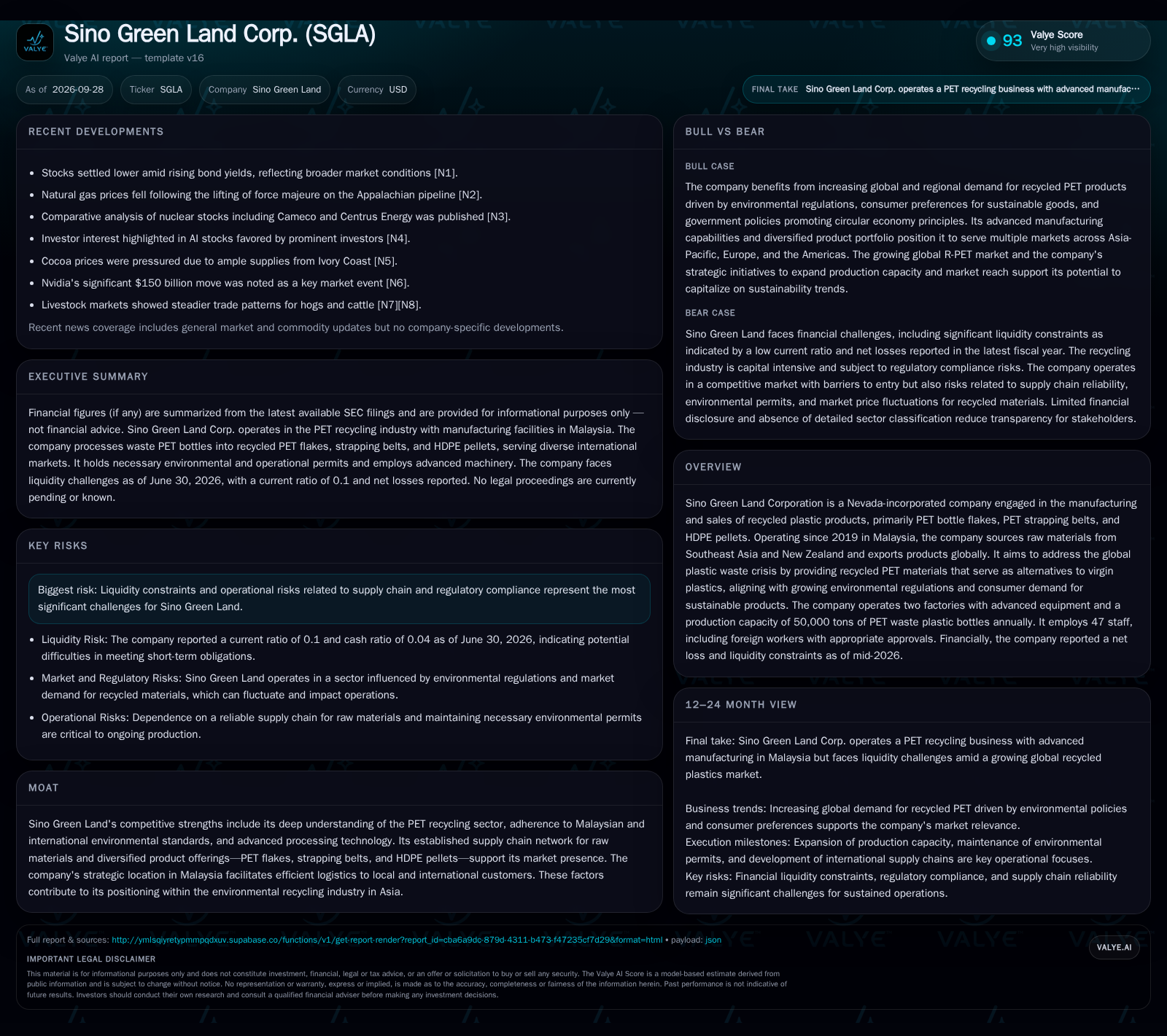
Sino Green Land Corp. operates two advanced recycling factories in Malaysia, producing PET flakes, PET strapping belts, and HDPE pellets for global export. The path forward hinges on balancing operational execution, supply chain reliability, and capital needs in a competitive and regulation-driven market. [S1]
Sino Green Land Corp. stands at the intersection of global sustainability trends and the harsh economics of the recycled plastics industry. With advanced manufacturing capacity in Malaysia and a product mix serving international markets, the company is structurally positioned to benefit from the rising tide of recycled PET demand. However, a stark liquidity crunch and ongoing net losses highlight the financial tightrope facing many recyclers: scaling up to meet demand, while managing the capital intensity, supply chain complexity, and regulatory hurdles inherent to the sector. The company's future trajectory will be dictated by its ability to convert operational scale and regulatory compliance into sustainable financial performance.
Liquidity Compression and Net Losses Define Near-Term Outlook
As of June 30, 2026, Sino Green Land reported cash and equivalents of $204,020 against current liabilities of $4,976,247, resulting in a current ratio of 0.1 and a cash ratio of just 0.04 [S1]. This acute liquidity shortfall underscores significant near-term risk to ongoing operations, supplier relationships, and the ability to execute on growth ambitions. The company also posted a net loss of $1,393,031 for the fiscal year, with negative earnings per share, reinforcing the challenge of achieving profitability even as recycled PET demand accelerates [S1]. On the operational front, the company maintains two Malaysian factories with a combined capacity to process 50,000 tons of PET bottles annually, producing PET flakes, strapping belts, and HDPE pellets for export to Europe, the Americas, and Asia-Pacific. These facts frame a business with technical and geographical reach, but under acute financial strain.
The Capital-Intensive Reality of PET Recycling Economics
PET recycling is fundamentally a scale-driven, capital-intensive business. Fixed costs—spanning advanced sorting, crushing, washing, and extrusion equipment, as well as regulatory compliance and labor—dominate the cost structure. Variable costs include raw PET feedstock (often sourced internationally), energy, transportation, and consumables. Gross margins are heavily influenced by the spread between the cost of waste PET and the market price of recycled PET flakes, strapping belts, and HDPE pellets. However, recycled material prices are volatile and often track the price of virgin plastics, compressing margins during commodity downturns.
Sino Green Land’s two-factory setup and advanced machinery suggest potential for operating leverage if utilization rises, but achieving breakeven requires steady throughput, reliable raw material supply, and efficient export logistics. The company reported cash and liquidity metrics for the period; these figures do not by themselves establish operating runway, investment capacity, financial flexibility, or financing capacity. Without adequate potential financial flexibility, even modest disruptions—such as supply chain delays, regulatory changes, or input price spikes—could amplify losses or force curtailment of operations.
Global Reach Amid Intensifying Competition and Substitution Risks
Sino Green Land’s competitive position is shaped by several factors: its advanced processing capabilities, regulatory compliance, and established supply relationships for both input (waste PET) and output (global customers). Its ability to export PET flakes to Europe, the Americas, and Asia-Pacific, as well as to supply specialized strapping belts and HDPE pellets, provides geographic and product diversification.
However, the R-PET market is increasingly crowded, with global incumbents, regional recyclers, and integrated packaging and chemical companies all vying for feedstock and market share. Barriers to entry exist in the form of permitting, technical know-how, and logistics, but the commoditized nature of PET flakes means price competition is intense. Substitution risk is also present: the price of virgin PET can undercut recycled PET during oil price downturns, and alternative materials (such as biodegradable plastics or aluminum) could further pressure demand. In this context, Sino Green Land’s ability to maintain cost discipline, secure reliable raw material flows, and develop higher-value or specialty recycled products will be critical to defending margins.
Policy Tailwinds and Capacity Utilization Unlock Margin Expansion
In a favorable scenario, tightening global regulations on single-use plastics and minimum recycled content mandates drive sustained demand growth for R-PET products. Sino Green Land leverages its permitted capacity and advanced equipment to ramp up throughput, achieving higher factory utilization and improved operating leverage. Strategic sourcing agreements for waste PET in Southeast Asia and New Zealand ensure stable feedstock costs, while export relationships enable premium pricing for high-quality PET flakes and specialty strapping belts in regulated markets.
If the company can secure new working capital—through equity, debt, or strategic partnerships—it could alleviate immediate liquidity constraints, invest in further automation, and expand capacity. Evidence confirming this scenario would include a sharp rebound in utilization rates, new supply or offtake agreements, improved gross margins, and a return to positive operating cash flow. Conversely, continued underutilization, persistent negative cash flow, or inability to access external capital would falsify the upside trajectory.
Balancing Execution and Survival in a Volatile Recycling Market
The most plausible near-term path for Sino Green Land involves incremental operational improvements but continued financial strain. The company may maintain stable production volumes and customer relationships, benefiting from secular demand for recycled PET, but remains constrained by working capital shortages and tight cash flows. Factory throughput could hover near breakeven, with sporadic margin pressure from raw material price swings and competitive pricing in export markets.
Regulatory compliance and supply chain management remain ongoing priorities, but without a material improvement in liquidity or a step-change in market demand, the company is likely to operate in a holding pattern—avoiding insolvency but unable to invest meaningfully in expansion or product differentiation. Confirmation of this scenario would be evidenced by stable but modest revenue, persistent net losses, and limited capital expenditure. A shift in working capital terms, successful refinancing, or unexpected regulatory/fiscal incentives could tilt the balance either way.
Liquidity Crunch Triggers Operational Retrenchment or Disruption
Should Sino Green Land fail to address its acute liquidity shortfall, the company could be forced to curtail production, delay payments to suppliers, or suspend operations, particularly if raw PET feedstock becomes scarce or more expensive. In this scenario, loss of key environmental permits or inability to meet regulatory requirements could further restrict activity, while customer attrition and reputational damage compound the financial distress.
External shocks—such as a downturn in recycled PET prices, new competitors entering core export markets, or unfavorable regulatory changes—could accelerate this negative spiral. Evidence of a downside scenario would include factory shutdowns, workforce reductions, missed supplier payments, or disclosure of going-concern uncertainties. Conversely, emergency financing, asset sales, or government support could provide temporary relief, but would not resolve the underlying structural vulnerabilities.
Milestones and External Shifts That Will Determine Sino Green Land’s Trajectory
Monitoring monthly or quarterly factory utilization rates—if disclosed—would clarify whether the company is operating near capacity or suffering from underutilization.
Tracking working capital movements, especially changes in accounts payable/receivable cycles and inventory turnover, would provide early warning of liquidity stress or improvement.
Disclosure of new supply agreements for waste PET or long-term offtake contracts with major customers would signal enhanced revenue visibility and supply chain security.
Updates on regulatory compliance status or environmental permit renewals are critical, as loss or suspension could halt operations.
Any external financing events (debt, equity, or strategic investment) would directly affect the company’s ability to bridge liquidity gaps.
Reporting on gross margin trends by product line would help assess the company’s ability to pass through cost increases or capture premium pricing.
Evidence of product or market diversification—such as entry into higher-value recycled plastics or new geographic markets—would indicate progress toward margin expansion.
Changes in the competitive landscape, such as new entrants in core export regions or shifts in virgin PET pricing, could materially impact both top line and margins.
Disclaimer: This is research-only, informational analysis and not investment advice. It may include AI-generated interpretation and general industry context. Always verify important details using primary sources.

Comments