
Natural Alternatives International: Margin Pressures Persist Despite Sales Growth and Strategic Partnerships
Natural Alternatives International’s recent sales gains highlight the value of its contract manufacturing partnerships, yet widening net losses and reported liquidity position raise concerns about the sustainability of its business model. The company’s reliance on a few key customers, ongoing margin compression, and evolving regulatory and cybersecurity risks define the core debate for investors.
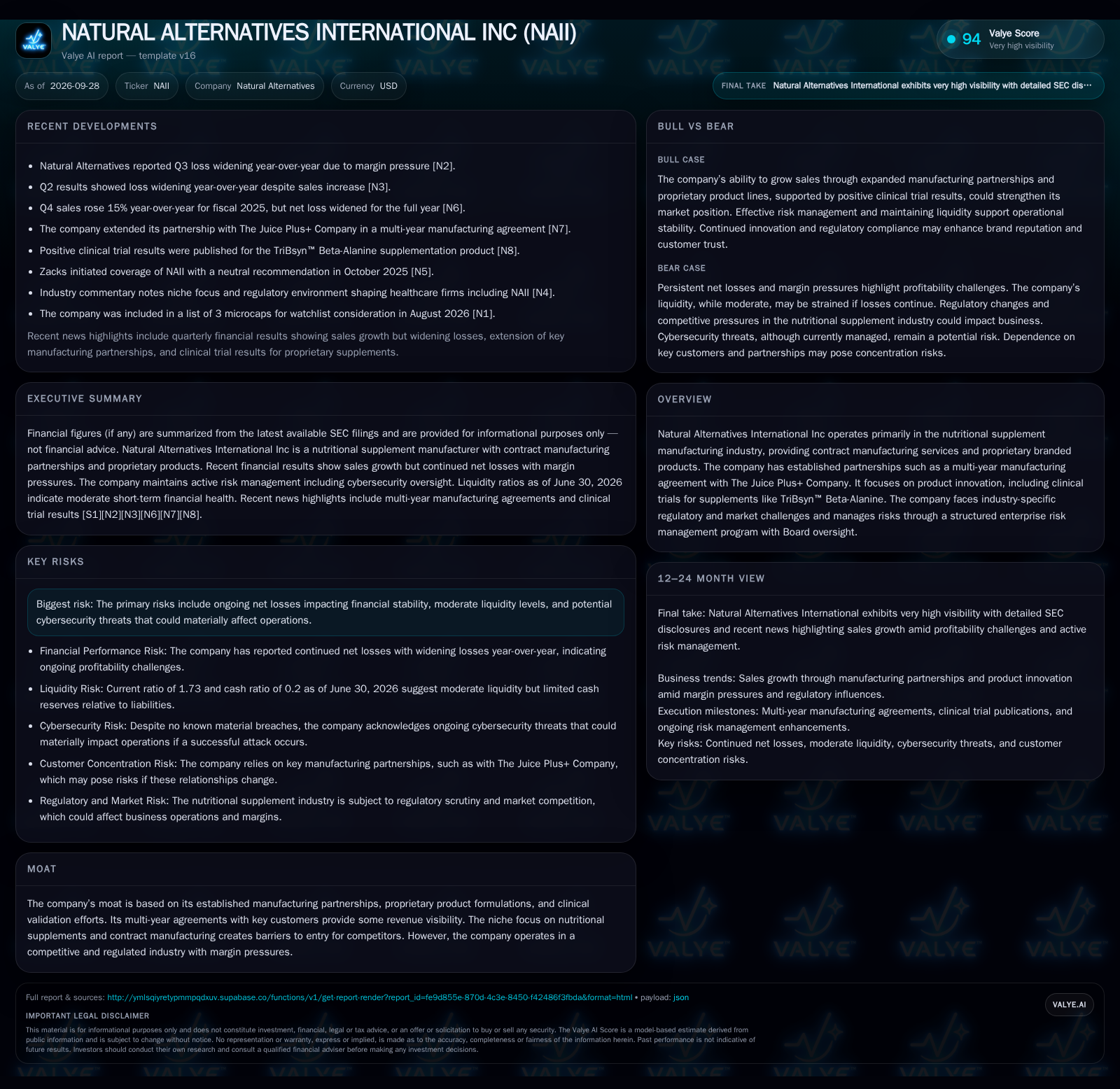
Natural Alternatives International reported 15% year-over-year sales growth in Q4 FY25, but net losses continued to widen for the full year, reflecting persistent margin pressures. The company’s active risk management, including cybersecurity oversight, provides some operational stability, but long-term profitability and diversification are unresolved challenges. [N6] [N7] [S1]
Its strategy centers on contract manufacturing partnerships—most notably a recently extended multi-year agreement with The Juice Plus+ Company—while proprietary branded products and clinical validation efforts aim to support differentiation. However, persistent margin compression, reliance on a handful of major customers, and evolving regulatory and cybersecurity threats shape the debate over long-term sustainability and upside.
Recent Results Underscore Sales Momentum but Deepening Losses
Natural Alternatives International reported a 15% year-over-year increase in sales for Q4 FY25, yet the full-year net loss widened, signaling that revenue growth is not translating into profitability. This persistent disconnect between sales and earnings puts the company’s cost structure and pricing power under scrutiny. The extension of a multi-year manufacturing agreement with The Juice Plus+ Company provides some revenue visibility, but it also reinforces customer concentration risk. The company reported cash and liquidity metrics for the period; these figures do not by themselves establish operating runway, investment capacity, financial flexibility, or financing capacity. [N6] [N7] [S1]
A deeper examination of the revenue growth versus profitability disconnect reveals structural challenges inherent in the contract manufacturing model. While sales gains provide topline momentum, the inability to translate these into net income gains suggests that incremental revenue is absorbed by rising operational costs or pricing limitations. This dynamic often reflects a competitive environment where customers exert downward pricing pressure, and fixed costs remain rigid.
Contract Manufacturing Drives Revenue, But Margin Compression Limits Upside
Natural Alternatives generates most of its revenue from contract manufacturing for third parties and, to a lesser extent, from proprietary branded supplements. In contract manufacturing, pricing power is typically constrained by customer size and competition, while cost inflation (labor, inputs, regulatory compliance) can erode margins. The company’s ability to scale is partly linked to the volume and duration of key partnerships—multi-year deals like the one with The Juice Plus+ Company can provide stability, but may also be subject to periodic renegotiation and margin pressure.
Operating leverage is limited if incremental revenue comes primarily from low-margin manufacturing contracts rather than higher-margin proprietary products. Capital needs are moderate in this model—cash is required to maintain inventory, fund working capital, and invest in quality control and regulatory compliance. However, persistent net losses suggest that fixed costs (such as plant overhead and SG&A) are not being covered by gross profit, raising the risk that further sales growth may not materially improve profitability unless the company can either raise prices, shift mix to higher-margin products, or achieve cost reductions.
The limited operating leverage in contract manufacturing arises because many costs are fixed or semi-fixed, such as plant overhead, quality assurance, and compliance functions, which do not scale down easily during volume fluctuations. Consequently, any volume increase must be significant enough to cover these fixed costs before profitability improves. Additionally, reliance on a few large customers can reduce pricing flexibility, as these customers may demand volume discounts or resist price increases, further compressing margins. The company’s ability to innovate proprietary products is critical, as these typically command higher margins, but scaling such offerings requires investment in R&D, marketing, and distribution channels, which can strain resources if not carefully managed.
Industry Competition and Concentration Expose Structural Vulnerabilities
The nutritional supplement manufacturing industry is highly competitive, with numerous contract manufacturers competing on price, reliability, and regulatory compliance. Natural Alternatives’ moat rests on long-term customer relationships, proprietary product formulations, and clinical validation efforts. However, the company’s reliance on a few large customers—especially The Juice Plus+ Company—creates concentration risk. If a major customer reduces orders or switches suppliers, revenue and utilization could fall sharply.
Product innovation and clinical validation may help Natural Alternatives differentiate its proprietary brands, but these products are a smaller portion of total revenue and face entrenched competitors with broader distribution and marketing budgets. Regulatory scrutiny is also a constant threat, as non-compliance can lead to costly recalls or reputational damage. The company’s enterprise risk management and cybersecurity protocols are active mitigants but do not eliminate these structural risks.
The competitive landscape imposes structural constraints that limit pricing power and margin expansion. Large customers often have the leverage to dictate terms, while smaller competitors may compete aggressively on price to gain market share. Regulatory compliance adds complexity and cost, as evolving standards require continuous investment in quality systems and documentation. The company’s clinical validation efforts may create differentiation but also necessitate ongoing expenditure without guaranteed commercial payoff. Cybersecurity risks, increasingly prominent in manufacturing environments, require sustained vigilance and investment to protect intellectual property and operational continuity, adding another layer of operational cost that must be balanced against profitability goals.
Margin Expansion and Diversification Could Unlock Operating Leverage
The most favorable scenario for Natural Alternatives involves a combination of margin improvement and customer diversification. If the company can renegotiate contracts for better pricing, reduce input costs, or successfully shift its sales mix toward higher-margin proprietary products, operating leverage could turn sales growth into sustained profitability. New clinical trial results or successful innovation in branded supplements could enable premium pricing and expand distribution.
Confirmation would come from sequential improvements in gross and operating margins, declining net losses (or a return to profitability), and evidence of new customer wins or expanded proprietary brand sales. Conversely, continued margin stagnation or further customer concentration would falsify this path.
Stability Hinges on Key Partnerships Amid Ongoing Margin Pressure
The most plausible path is that Natural Alternatives maintains its core manufacturing partnerships, particularly with The Juice Plus+ Company, and achieves incremental sales growth. However, absent a step-change in margin structure or significant proprietary brand expansion, net losses are likely to persist. Liquidity remains sufficient for short-term operations but does not provide a substantial buffer for strategic investment or prolonged downturns.
Indicators supporting this scenario would include stable or modestly growing sales, persistent but manageable net losses, and renewal or extension of key manufacturing agreements. Deterioration in either customer relationships or liquidity would shift the outlook toward the downside.
Customer Loss or Further Margin Deterioration Could Trigger Financial Strain
The adverse scenario for Natural Alternatives involves the loss of a major customer or continued erosion of gross margins. If The Juice Plus+ Company were to reduce volumes or terminate its agreement, the company’s revenue base and plant utilization could drop sharply, exposing fixed costs and further widening losses. Alternatively, ongoing input cost inflation or inability to pass through price increases could result in deeper net losses, potentially pressuring liquidity.
Evidence for this scenario would include a sharp sequential decline in sales, further widening of net losses, deterioration in liquidity metrics, or disclosure of major contract changes. A need to raise capital or restructure operations would confirm financial strain.
What Could Shift the Natural Alternatives Thesis Over the Next Year
Gross margin trends: Sequential improvements or declines would clarify whether sales growth is translating into better profitability or being offset by cost pressures.
Net income trajectory: Persistent losses versus a narrowing loss or return to profitability will determine the company’s financial sustainability.
Contract renewals and new customer wins: Disclosure of additional multi-year agreements or loss of existing ones would directly impact revenue visibility and concentration risk.
Sales mix evolution: Increased contribution from proprietary branded products (if disclosed) could signal progress toward higher-margin revenue streams.
Customer concentration: Any update on reliance on The Juice Plus+ Company or diversification efforts would help assess structural risk.
Regulatory or cybersecurity incidents: Disclosure of adverse events would test the effectiveness of risk management protocols.
SG&A and fixed cost management: Evidence of cost containment or restructuring initiatives would inform the potential for operating leverage.
Disclaimer: This is research-only, informational analysis and not investment advice. It may include AI-generated interpretation and general industry context. Always verify important details using primary sources.

Comments