
Vail Resorts: Capital Intensity, Guest Experience, and the Economics of a Multi-Season Resort Network
Vail Resorts’ expansive portfolio of destination resorts and regional ski areas underpins its market leadership, but capital requirements, weather volatility, and evolving competitive pressures shape the economics and future trajectory of its business. The company’s ability to monetize its network, balance guest experience investments, and navigate liquidity frictions will determine long-term value creation.
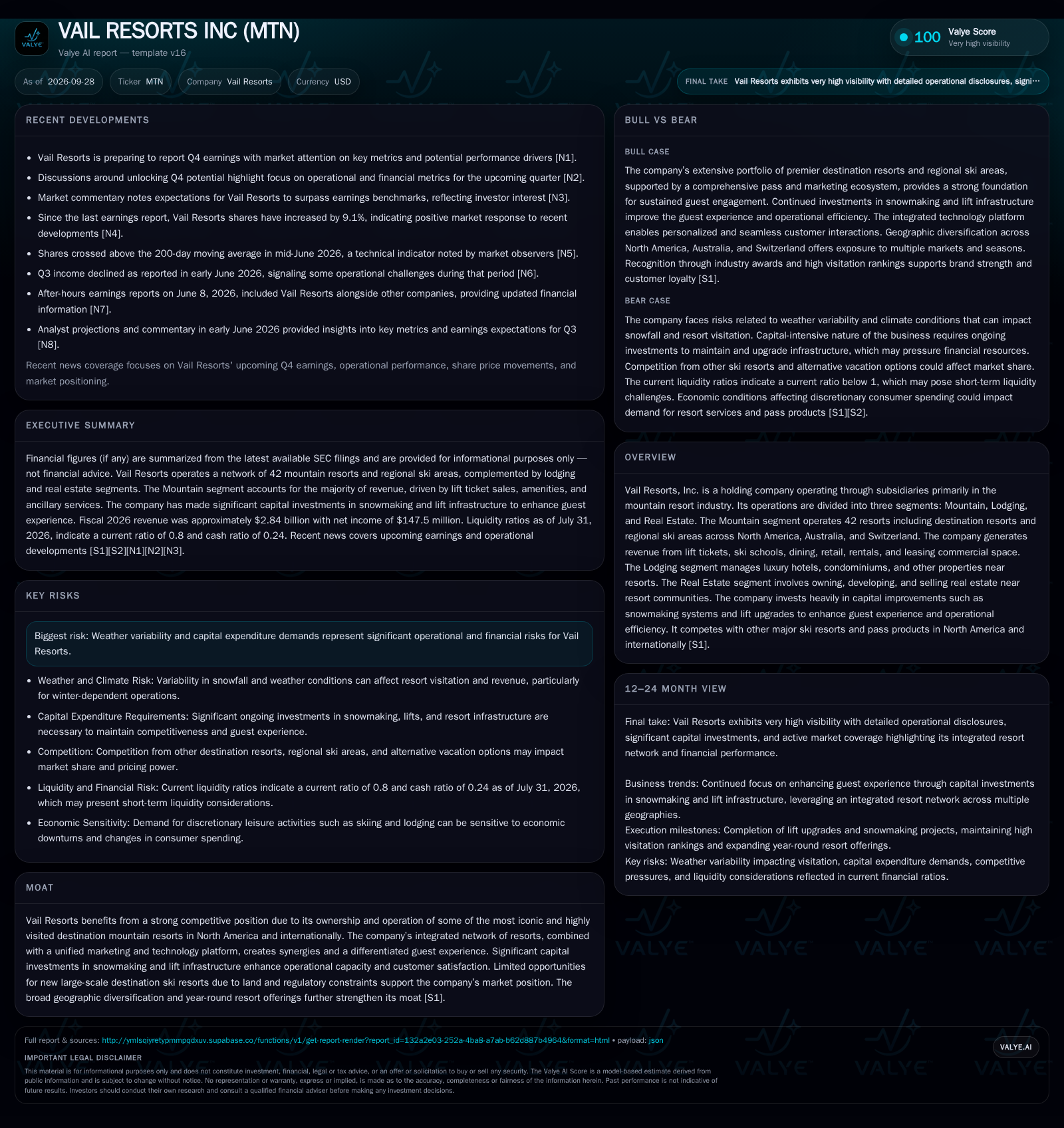
Vail Resorts operates 42 mountain destinations and regional ski areas, generating $2.84 billion in fiscal 2026 revenue with $147.5 million in net income. Its strategy hinges on significant capital investments in snowmaking and lift infrastructure to support guest experience and operational scale. Competition from other pass products and resorts, along with weather and economic sensitivity, will shape the company’s growth, margins, and risk profile over the coming years. [S1] [S2]
Vail Resorts commands one of the world’s largest and most iconic portfolios of ski and mountain destinations, generating nearly $2.84 billion in fiscal 2026 revenue across 42 resorts. The company’s playbook relies on capital-intensive upgrades in snowmaking and lifts to support both winter and summer activity, driving high guest throughput and engagement. How Vail manages these intertwined drivers will shape its performance as the ski and mountain leisure industry evolves. [S1] [S2]
Recent Performance and Liquidity: Signals from Fiscal 2026
Vail Resorts reported fiscal 2026 revenue of approximately $2.84 billion and net income of $147.5 million, with basic EPS of $4.13. The Mountain segment, accounting for 88% of net revenue, remains the company’s economic engine, leveraging high-traffic flagship resorts such as Vail Mountain, Breckenridge, and Whistler Blackcomb. Liquidity metrics as of July 31, 2026 show a current ratio of 0.8 and cash ratio of 0.24, with $231.3 million in cash and equivalents. The company reported cash and liquidity metrics for the period; these figures do not by themselves establish operating runway, investment capacity, financial flexibility, or financing capacity. [S1] [S2]
Recent news has highlighted a 9.1% share price increase since the last earnings report, positive market sentiment ahead of Q4 earnings, and analyst expectations for performance, but also noted a Q3 income decline—reminding investors that operational momentum can be volatile even for market leaders. [N4] [N6]
The Economics of a Capital-Intensive, Multi-Segment Resort Operator
Vail Resorts’ revenue model is anchored in lift ticket sales, including both daily and season pass products, which drive upfront cash flow and customer lock-in. Ancillary revenue streams—ski schools, dining, retail, rentals, and lodging—create opportunities for high-margin upsell and cross-sell, especially at flagship destinations. However, the fixed-cost structure is substantial: snowmaking systems, high-speed lifts, and extensive resort infrastructure require ongoing, significant capital expenditure simply to maintain competitive parity and guest satisfaction.
Operating leverage is evident in peak seasons, as incremental guests can be served with relatively lower variable costs once fixed investments are in place; however, this leverage cuts both ways in poor-weather or recessionary periods, amplifying downside risk. The company’s reported capital spend—over $560 million on lifts and $105 million on snowmaking since 2016—demonstrates both the scale of required reinvestment and the potential for enhanced throughput and yield per guest if demand remains robust. Cash flows are thus highly seasonal and sensitive to both weather and consumer sentiment, with real estate and lodging providing some diversification but limited as countercyclical hedges. [S1]
Brand, Network, and the Battle for Passholder Loyalty
Vail’s principal competitive advantage is the breadth and prestige of its resort portfolio, including several of the most visited ski destinations in North America and internationally. The network effect is reinforced through the Epic Pass, which incentivizes multi-resort visitation and creates a switching barrier for core customers. However, the competitive landscape is evolving: rival passes like IKON and Indy Pass aggregate alternative destinations, offering consumers more flexibility and value, and limiting Vail’s ability to unilaterally raise prices or dictate terms.
Further, the capital intensity and regulatory constraints on new large-scale resorts act as a barrier to entry, but also lock in high maintenance costs and limit the company’s ability to quickly adjust capacity. As climate change and demographic shifts alter recreational preferences, Vail’s year-round activity strategy (mountain biking, hiking, summer events) may be critical, but these segments typically deliver lower margins and less pricing power than peak ski season. Customer loyalty, guest experience, and the ability to maintain premium positioning amid a proliferation of alternatives will be central to defending share and sustaining margins. [S1]
Leveraging the Resort Network for Higher Per-Guest Yield
A favorable scenario would see Vail’s continued investments in guest experience—via upgraded lifts, expanded snowmaking, and integrated digital platforms—translating into higher visitation, premium pricing, and greater per-guest spend across both winter and summer seasons. The ability to cross-promote lodging, retail, and ancillary services to Epic Pass holders could further boost revenue per available guest, particularly if economic conditions remain stable and weather is cooperative.
Confirmation would come from reported increases in season pass sales, higher occupancy rates at owned lodging properties, and a measurable rise in ancillary revenue streams (ski school, dining, retail). Margin expansion—despite ongoing capex—would validate the operating leverage thesis. Conversely, stagnation in passholder growth, weak ancillary sales, or margin compression despite higher revenue would undermine the upside case.
Sustaining Leadership, Managing Volatility, and Funding Investment
The most plausible path is that Vail sustains its leadership in North American ski and mountain leisure by maintaining high guest satisfaction and visitation at flagship resorts, but faces ongoing volatility from weather, economic cycles, and competitive pricing dynamics. Capital expenditures remain high, with incremental improvements in infrastructure needed to keep pace with guest expectations and rival offerings. While the Epic Pass ecosystem continues to drive repeat visitation and some pricing power, growing competition and the maturation of the multi-resort pass market constrain outsized growth.
In this scenario, revenue grows modestly ahead of inflation, margins remain stable (but not expanding), and liquidity is managed through careful balancing of capex, debt, and working capital. Confirmation would be visible in stable or slightly improving net income, sustained passholder growth, and a return to more reported liquidity position. Signs of stress would include persistent sub-1 current ratios, rising leverage, or evidence of deferred maintenance/capex.
Weather, Liquidity Squeeze, and Competitive Price Wars
The adverse scenario envisions a combination of poor snowfall, macroeconomic downturn, and intensifying price competition from rival passes or alternative vacation options. Under these conditions, Vail could see declines in visitation, forced discounting on lift tickets and lodging, and underutilization of recently upgraded infrastructure. The capital-intensive model would expose the company to cash flow shortfalls, especially with liquidity metrics already below typical comfort thresholds.
A failure to keep pace with competitive guest experience investments, or negative brand/review momentum, would compound the risk.
Benchmarks for Testing Vail Resorts’ Capital-Efficient Growth Thesis
Year-over-year growth in Epic Pass and season pass sales—if disclosed—would signal the health of Vail’s core recurring revenue engine and customer loyalty.
Total visitation and visitation mix (destination vs. regional, winter vs. summer) would help assess demand resilience and the success of year-round engagement strategy.
Revenue per available guest (RevPAG) and per-guest ancillary spend—if reported—would clarify the effectiveness of upsell and cross-sell initiatives.
Operating margin trends and capex as a percentage of revenue would illuminate whether investments are translating into improved unit economics.
Weather-adjusted performance metrics (e.g., visitation or revenue normalized for snowfall) would help isolate execution from uncontrollable externalities.
Share of wallet and passholder retention rates—if disclosed—would provide insight into competitive positioning and switching risk.
Progress on new lift and snowmaking projects, as well as guest satisfaction or NPS scores, would validate that capital investments are delivering tangible guest experience improvements.
Disclaimer: This is research-only, informational analysis and not investment advice. It may include AI-generated interpretation and general industry context. Always verify important details using primary sources.

Comments