
Robinhood Ventures Fund II: Navigating an Opaque Financial Landscape with Sparse Disclosure
This extreme information gap leaves investors with little visibility into the fund’s core operations, financial resilience, or strategic direction, heightening uncertainty and risk.
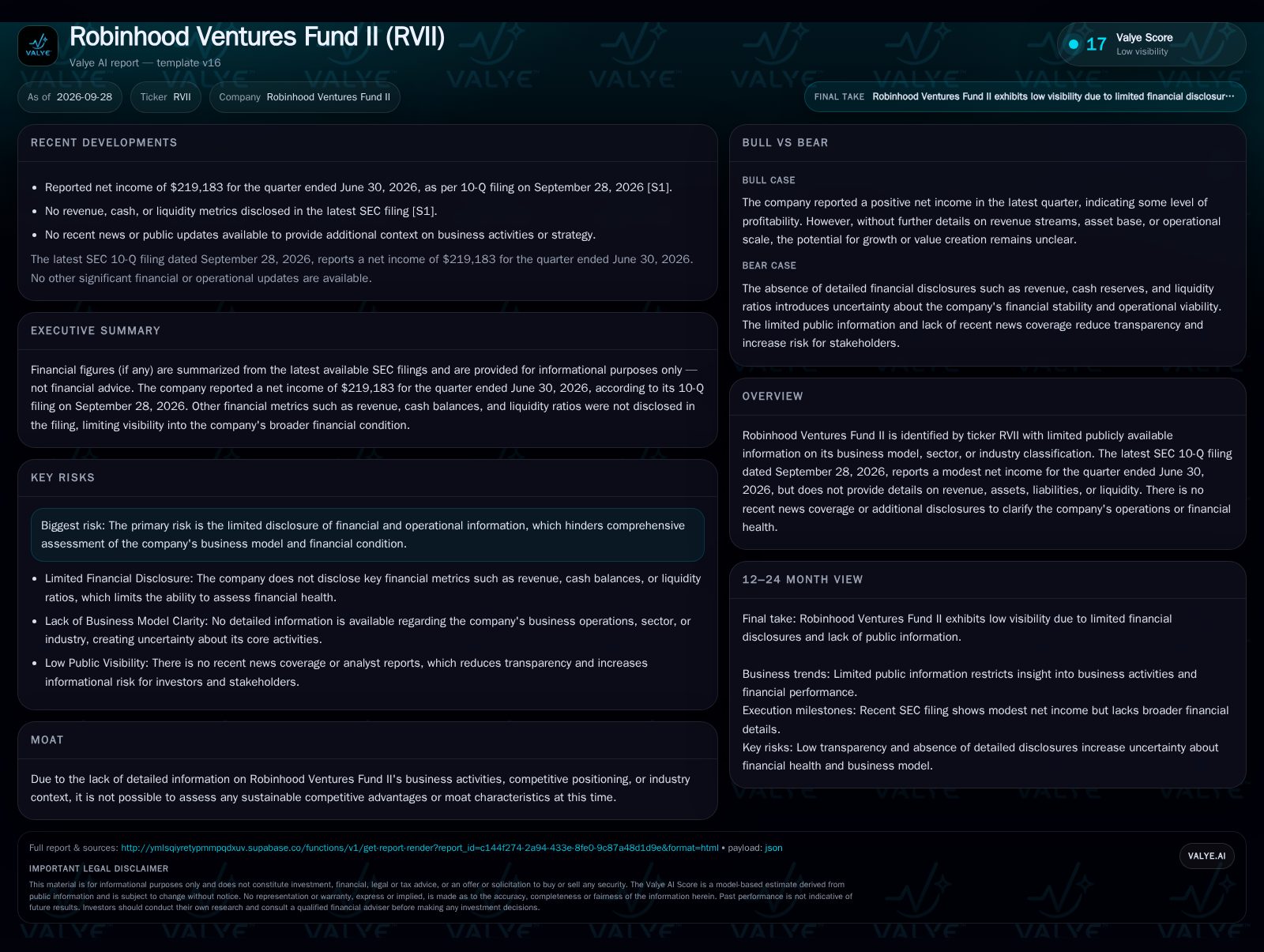
Robinhood Ventures Fund II’s latest SEC filing shows a net income of $219,183 for Q2 2026 but omits revenue, liquidity, and operational details. The absence of business model and sector information makes it impossible to assess how the fund generates returns, what risks it faces, or whether its profitability is sustainable. Investors must approach with caution due to the high degree of informational opacity.[S1]
This absence of disclosure leaves investors with no clear sense of how RVII earns money, manages risk, or competes in its market—if, indeed, it is an operating business or an investment vehicle. In this environment, the primary fact is informational opacity, which itself becomes the central risk and analytical challenge.
What Is Known: Sparse Financial Disclosure Highlights the Information Gap
The only concrete fact disclosed in Robinhood Ventures Fund II’s (RVII) latest SEC filing is a net income of $219,183 for the quarter ended June 30, 2026.[S1] No revenue, cash, current assets, liabilities, or other balance sheet data were made available. There is no sector, industry, or business model detail, nor any recent news or public commentary to clarify operations or strategy. This extreme lack of transparency is highly unusual for a public entity and makes it impossible to evaluate the company’s underlying health, growth prospects, or operational risks using conventional financial analysis. As a result, the most material current fact is not the net income figure itself, but the near-total absence of context for interpreting it.
The lack of standard financial disclosures such as revenue or asset breakdowns impedes traditional ratio analysis, which investors typically rely on to assess profitability, efficiency, and solvency. Without these metrics, it is challenging to apply discounted cash flow models or relative valuation techniques, leaving valuation largely speculative. Furthermore, the absence of segment reporting or geographic breakdowns restricts the ability to evaluate business diversification or exposure to macroeconomic risks. This opacity also complicates risk assessment frameworks that depend on understanding the company's capital structure, leverage ratios, or liquidity buffers, thereby increasing the uncertainty premium demanded by potential investors.
Economic Model Remains a Black Box: Potential Structures and Implications
With no disclosure of revenue, assets, or sector focus, RVII’s economic engine is entirely opaque. The entity’s name—Robinhood Ventures Fund II—suggests it may be a venture capital or private investment fund, which could mean its net income is driven by investment gains, realized exits, or changes in portfolio valuation, rather than recurring operating revenue. If so, net income could be volatile and highly dependent on the timing of asset sales or revaluations. Alternatively, if RVII is an operating company, the absence of revenue data makes it impossible to discern its pricing, volume, or cost structure.
If RVII is indeed a fund, it may operate with a relatively fixed cost base and variable investment returns, but this is speculative in the absence of disclosures. The net income figure alone does not permit conclusions about operating leverage, recurring profitability, or margin structure.
If RVII operates as an investment fund, its economic model likely depends heavily on capital deployment cycles, exit timing, and market valuation fluctuations, all of which can cause significant earnings volatility. The absence of disclosed capital commitments or fund size obscures understanding of scale advantages or limitations in deal sourcing and negotiation power. Conversely, if RVII functions as an operating business, the lack of cost structure visibility prevents analysis of fixed versus variable expenses, which is critical to understanding operating leverage and break-even dynamics. In either case, the interplay between cash flow generation and reinvestment needs remains unknown, hindering assessment of sustainable growth potential or dividend capacity.
Competitive Landscape: Opaque Peer Set and Unknown Differentiation
Without sector or business model disclosure, RVII’s competitive set is undefined. If it is a venture or private investment fund, it would typically compete with other alternative asset managers, private equity/venture vehicles, or possibly special purpose acquisition companies (SPACs). In such spaces, differentiation often comes from deal sourcing, portfolio performance, or sector specialization. However, with zero detail on portfolio composition, investment themes, or returns, it is impossible to assess whether RVII possesses any edge or moat.
Alternatively, if RVII operates a business rather than a fund, the absence of product, customer, or market information precludes any meaningful analysis of market share, pricing power, or barriers to entry. The company’s lack of visibility itself is a competitive disadvantage in public markets, as it may limit access to capital and deter potential partners or investors.
Competitive positioning analysis typically requires insight into barriers to entry, customer concentration, and innovation pipeline, none of which are accessible here. If RVII is a fund, its competitive advantage might stem from proprietary access to deal flow, superior due diligence, or sector specialization, but these factors remain unquantifiable without portfolio disclosure. Similarly, if it is an operating company, the absence of product differentiation, pricing strategy, or customer retention data prevents evaluation of market power or vulnerability to substitution. This informational void may itself be a strategic choice, but it paradoxically undermines investor confidence and may restrict capital inflows, which are essential for scaling competitive advantages.
Positive Surprises Could Stem from Hidden Asset Value or Superior Investment Returns
The most favorable scenario is that RVII’s modest net income masks an underlying portfolio of high-quality assets or investments poised for outsized returns. If future disclosures were to reveal a robust, diversified investment portfolio with meaningful unrealized gains or access to proprietary deal flow, RVII could rerate as a valuable alternative asset manager. Confirmation would require detailed reporting of portfolio holdings, realized/unrealized gains, and capital commitments.
In this scenario, evidence of recurring net income, growing book value, or distribution of realized gains would validate the thesis of hidden value. Alternatively, if RVII is an operating business, the upside would hinge on revealing a scalable, high-margin revenue stream. The critical falsification would be future filings that continue to omit core financials or reveal only sporadic, nonrecurring profits.
Sustained Opacity Likely Limits Investor Confidence and Access to Growth Capital
The most plausible outcome is that RVII continues to operate with minimal disclosure, reporting only basic net income (or loss) figures without opening its books on revenue, assets, or investment strategy. In this scenario, the company may persist as a ‘black box’—possibly due to a small scale, passive investment structure, or legal constraints on disclosure. This persistent opacity would deter institutional capital, limit trading liquidity, and keep the stock at a discount relative to more transparent peers.
Confirmation of this scenario would come from continued sparse quarterly filings and lack of investor communications. Evidence to the contrary would include a shift toward more comprehensive disclosures, earnings calls, or detailed portfolio reporting.
Risks of Non-Recurring Gains, Asset Impairments, or Hidden Liabilities
The primary downside risk is that RVII’s reported net income is a one-off event, perhaps from the sale of a single asset or mark-to-market adjustment, with no underlying recurring earnings power. Without visibility into revenue or assets, there is also the risk of undisclosed liabilities, capital calls, or asset impairments that could quickly reverse profitability and drain value.
This scenario would be confirmed by future filings showing erratic swings between profit and loss, negative equity movements, or the belated disclosure of losses, write-downs, or legal contingencies. Continued silence on liquidity or capital structure would further heighten risk, as stakeholders would have no basis to assess solvency or resilience to market shocks.
Concrete Disclosures Needed to Illuminate RVII’s True Risk and Opportunity Profile
Quarterly disclosure of revenue, if any, would help determine whether RVII operates as a fund or a business, and reveal the nature and stability of its income.
A breakdown of net income drivers—such as realized gains, unrealized gains, interest income, or operating profit—would illuminate the sustainability of profitability.
Disclosure of portfolio composition or sector focus, if RVII is a fund, would enable comparison to relevant peer benchmarks.
Any commentary on management strategy, risk appetite, or investment process would provide insight into the company’s ability to generate value over time.
If disclosed, a schedule of capital commitments or unfunded obligations would help gauge future liquidity and risk.
Regular news releases or investor communications would increase transparency and help contextualize financial results.
Disclosure of any material legal, regulatory, or contingent liabilities would help assess hidden risks that could impact future performance.
Disclaimer: This is research-only, informational analysis and not investment advice. It may include AI-generated interpretation and general industry context. Always verify important details using primary sources.

Comments