
Blue Line Holdings: Early-Stage Distribution Ambitions Collide with Capital and Competitive Realities
Blue Line Holdings seeks a foothold in France’s growing flavored water market through a limited licensing deal and sustainability-oriented branding.
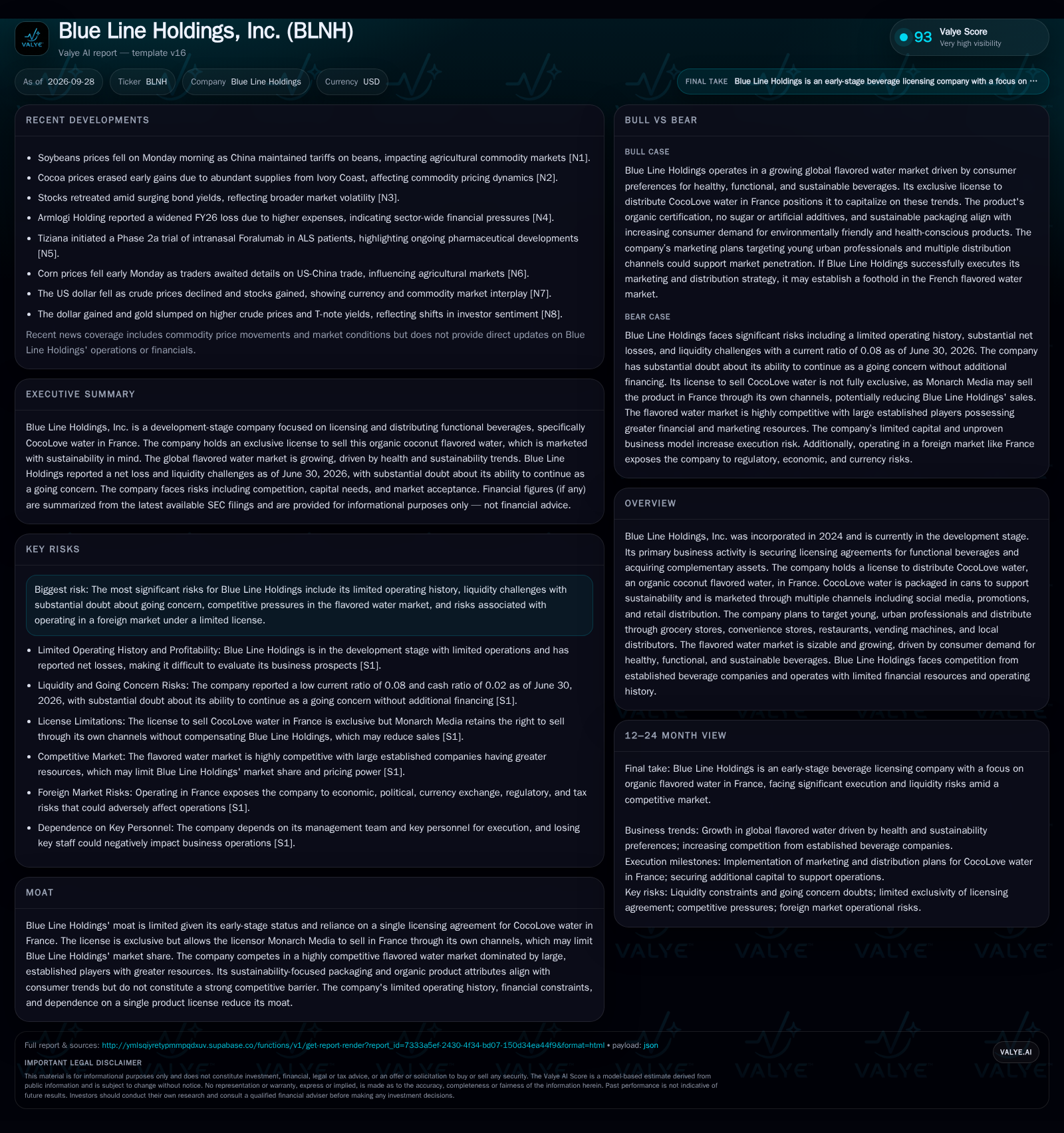
Blue Line Holdings is a development-stage company licensed to distribute CocoLove organic coconut water in France, targeting health- and sustainability-minded consumers.Despite a large addressable market, the company faces a net loss of $16.1 million, a reported current ratio of 0.08, and substantial doubt about its ability to continue as a going concern without new financing. Its licensing rights are limited, with Monarch Media able to sell directly in France. Execution risk is high given intense competition from established beverage brands and the need for rapid market acceptance and capital infusion. [S1]
Blue Line Holdings, Inc. aims to tap into France’s expanding flavored water market with the distribution of CocoLove, an organic coconut water packaged for sustainability. The company’s strategy is to leverage health and eco-conscious consumer trends through targeted marketing and broad retail placement. As it faces entrenched multinational rivals and must rapidly prove market acceptance, Blue Line’s prospects hinge on its ability to secure new capital and execute its launch before financial runway runs out.
Liquidity Constraints and License Limitations Define Blue Line’s Starting Point
As of June 30, 2026, Blue Line Holdings reported a net loss of $16.1 million with cash and equivalents of $2.18 million, current assets of $7.49 million, and current liabilities of $91.05 million. This results in a current ratio of 0.08 and a cash ratio of 0.02—metrics that indicate acute liquidity stress and substantial doubt about the company’s ability to continue as a going concern without new financing. [S1]
Blue Line’s primary commercial asset is an exclusive license to distribute CocoLove water in France. However, Monarch Media, the licensor, retains the right to sell CocoLove in France through its own channels, without compensating Blue Line. This undermines the exclusivity of Blue Line’s position and exposes it to direct competition from its own supplier. [S1]
The company plans to spend approximately $100,000 on marketing and distribution over the next year, a modest budget given the scale of the market and intensity of competition. [S1]
Commercial Model Relies on Thin Margins and Capital-Intensive Execution
Blue Line’s economics are structured around licensing and distribution rather than brand ownership or manufacturing. This model typically yields lower gross margins, as the bulk of economic value accrues to the brand owner (Monarch Media) and upstream suppliers. Distribution businesses in beverages often depend on scale to drive profitability, with significant upfront investment required in inventory, logistics, and marketing to achieve meaningful volume.
The company’s planned $100,000 marketing spend suggests limited ability to generate rapid awareness or secure premium shelf space, particularly against entrenched global brands. Fixed costs—such as staffing, logistics infrastructure, and compliance—may quickly outstrip available resources if revenue ramps slowly. Variable costs tied to volume (product acquisition, shipping, handling) are likely to be high in early phases, squeezing operating leverage.
Capital needs are pronounced: the current asset/liability mismatch and negative operating history suggest Blue Line will require substantial external funding to cover working capital, promotional activity, and any expansion of distribution. Without rapid sales traction or additional capital, the company is at risk of being unable to meet obligations or invest for growth.
Facing Global Giants in a Crowded, Brand-Driven Market
The flavored water category is intensely competitive, dominated by multinational beverage companies such as Nestlé, PepsiCo, and Coca-Cola, all of whom have deep distribution networks, established retail relationships, and massive marketing budgets. These incumbents can outspend new entrants on promotion, secure premium shelf placement, and use portfolio leverage to negotiate with retailers.
Blue Line’s differentiation is based on CocoLove’s organic certification, lack of sugar or artificial ingredients, and sustainable packaging. While these features align with current consumer trends, they are increasingly table stakes in the premium beverage segment—and are often matched or exceeded by competitors’ sub-brands or private labels.
The lack of true exclusivity in the licensing agreement further weakens Blue Line’s position: Monarch Media’s ability to distribute in France directly means Blue Line could face channel conflict or price/margin pressure, even in its core market. The company’s limited resources and nascent brand presence further constrain its ability to build meaningful switching costs or consumer loyalty.
Rapid Traction Through Niche Positioning and Effective Execution
In a favorable scenario, Blue Line leverages CocoLove’s organic and sustainability positioning to carve out a niche among urban, health-conscious French consumers—particularly in universities and trend-forward retail outlets. Effective micro-targeted marketing, viral social media campaigns, and strong in-store promotions could drive early adoption and word-of-mouth momentum.
If Blue Line rapidly secures distribution agreements with key grocery and convenience chains, and Monarch Media refrains from directly competing in those channels, initial sales could exceed expectations. Early sell-through data, repeat purchase rates, and retailer reorders would confirm traction.
This scenario would likely require additional capital to scale marketing and inventory, but early proof points could attract new investment or partnerships. Confirmation would come from disclosed sales growth, expanded distribution footprints, and evidence of increasing brand awareness among the target demographic.
Slow Market Entry and Ongoing Funding Pressure
The most plausible outcome is a slow, uneven ramp in sales as Blue Line contends with limited promotional budgets, a lack of brand awareness, and difficulty securing shelf space in a crowded marketplace. Retailers may be reluctant to allocate meaningful space to an unproven product, especially when global brands offer incentives and established sell-through data.
Channel conflict with Monarch Media could emerge if both parties compete in overlapping distribution points, leading to price erosion or retailer confusion. The company may struggle to generate sufficient volume to achieve breakeven economics, while fixed operating costs persist.
Progress would be measured by incremental distribution wins, pilot program results, and initial consumer feedback.
Liquidity Shortfall and Competitive Displacement Lead to Strategic Retreat
In a negative scenario, Blue Line fails to secure additional funding in time to support operations, leading to an inability to finance inventory, marketing, or fulfill retailer orders. As a result, distribution efforts stall, and the company loses relevance with both retailers and consumers.
Aggressive moves by Monarch Media or established beverage giants could further marginalize Blue Line, either through direct competition in key channels or by launching similar organic/sustainable SKUs. Without brand equity or unique channel access, Blue Line could be forced to relinquish its license or pursue asset sales under distressed conditions.
This scenario would be confirmed by missed payment obligations, shrinking distribution presence, and deteriorating relationships with suppliers or retailers. A lack of disclosed sales growth, new financing, or meaningful operational milestones would further validate this adverse outcome.
Milestones That Will Reveal Whether Blue Line Can Overcome Early-Stage Hurdles
Disclosure of initial sales volumes and sell-through rates in key French retail and convenience channels would clarify market acceptance and early consumer traction, if reported.
Any update on new financing, credit facilities, or capital raises is critical to assessing the company’s ability to fund operations and execute its business plan.
Expansion of distribution agreements—especially with national grocery chains or dominant local distributors—would signal commercial progress.
Evidence of Monarch Media’s activity in France: If Monarch Media launches direct-to-retail or e-commerce sales, channel conflict risk rises.
Reported marketing ROI or campaign effectiveness metrics (such as digital engagement rates, in-store promotion results, or university program uptake) would help assess the efficacy of planned spending.
Updates on working capital management, including inventory turnover and payment terms with suppliers, would shed light on operational sustainability.
If disclosed, gross margin per unit and contribution margin trends would help test the scalability and economic viability of the distribution model.
Management commentary or disclosures on regulatory, tax, or currency headwinds in France could indicate potential operational frictions or future margin pressure.
Disclaimer: This is research-only, informational analysis and not investment advice. It may include AI-generated interpretation and general industry context. Always verify important details using primary sources.

Comments