
Exascale Labs: Asset-Light AI Compute Ambitions Confront Financial and Operational Headwinds
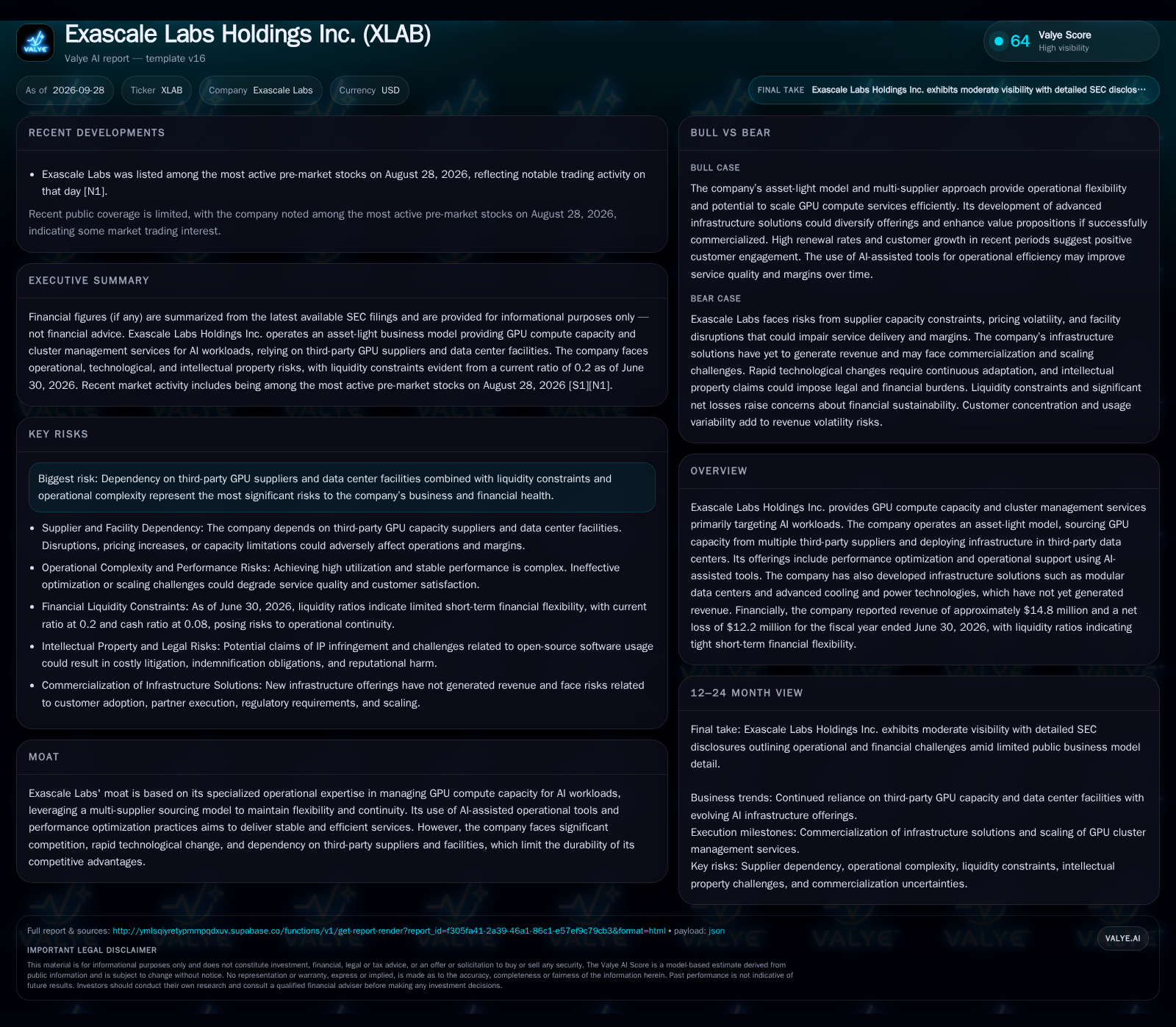
Exascale Labs Holdings Inc. seeks to carve out a niche in GPU compute capacity and cluster management for AI workloads using an asset-light, multi-supplier model.
Commercialization of internally developed infrastructure solutions has yet to produce revenue. Key risks include supply chain dependency, operational challenges, and financial constraints, all of which threaten the company’s ability to scale or weather shocks. [S1]
Exascale Labs Holdings Inc. is positioning itself as an enabler of AI-scale computing by providing GPU compute capacity and management services using an asset-light, multi-supplier sourcing model. The company’s operational flexibility and focus on performance optimization are counterbalanced by significant financial constraints and dependency on third-party suppliers and facilities. Acute liquidity pressures and a still-unproven infrastructure product pipeline raise questions about the company’s ability to achieve sustainable growth or withstand operational shocks in a fiercely competitive, rapidly evolving sector. [S1]
Liquidity Constraints and Unproven Infrastructure Solutions Shape the Present
As of June 30, 2026, Exascale Labs reported $14.82 million in revenue and a net loss of $12.16 million, reflecting ongoing difficulty in converting topline growth into profitability. The company reported a current ratio of 0.2 for the period. While Exascale Labs has developed modular data centers, liquid cooling, and advanced power solutions, these offerings have not yet generated revenue, leaving the company heavily reliant on its core GPU compute and cluster management services. This combination of operational ambition and financial fragility underscores the urgency of demonstrating commercial traction or securing additional funding to sustain operations. [S1]
How Exascale Labs’ Asset-Light Model Makes and Loses Money
Exascale Labs’ economics are centered on brokering GPU compute capacity sourced from multiple third-party suppliers and deploying these assets in external data centers. This model avoids heavy capital expenditure on owned infrastructure, but it introduces high variable costs—primarily from GPU capacity sourcing fees and facility-related expenses. Gross margins are thus highly sensitive to supplier pricing and the company’s ability to optimize utilization and performance across a heterogeneous hardware landscape. If supplier costs rise or utilization drops, margin compression is likely.
The absence of take-or-pay contracts or supplier exclusivity agreements helps Exascale Labs avoid fixed obligations, but it also reduces bargaining power and exposes the company to spot-market volatility. Revenue recognition is likely tied to usage-based or term-based contracts with customers, but the degree of predictability and customer concentration is not established. The company’s unprofitable position, with a net loss nearly matching revenue, suggests that either scale economies have not yet been realized or operating expenses (including R&D for new infrastructure products and AI-assisted operations) remain too high relative to current volumes.
Working capital needs are acute given the mismatch between current assets and short-term liabilities. Without recurring, multi-year customer contracts or backlog (not established in the report), cash flow volatility could force Exascale Labs to seek external financing or restructure operations if new revenue streams from infrastructure solutions do not materialize quickly. [S1]
Operational Expertise Versus Market Power: Where Exascale Labs Fits
Exascale Labs competes in the rapidly scaling GPU computing and AI infrastructure market, where hyperscalers, vertically integrated cloud providers, and specialized colocation players all vie for share. The company’s multi-supplier sourcing and asset-light deployment offer flexibility and the potential to quickly adjust capacity to demand. However, this flexibility comes at the cost of limited control over core assets and exposure to upstream supply and pricing risk.
The company’s operational expertise in cluster management and the use of AI-assisted tools for issue detection and optimization can, in theory, deliver differentiated performance and reliability for demanding AI workloads. However, absent evidence of proprietary technology, switching frictions, or network effects, these advantages may be transient—particularly as larger competitors invest heavily in similar or superior automation and management layers.
Customer loyalty is likely tied to service quality, cost, and reliability rather than contractual lock-in. This dynamic makes customer retention vulnerable to performance hiccups or aggressive pricing by larger, capital-rich competitors. The company’s new modular data center and cooling solutions could provide a future differentiator if commercialized, but these offerings face significant go-to-market and adoption hurdles in a field already targeted by deep-pocketed incumbents and well-funded startups.
Unlocking Value Through Commercialization and Operational Excellence
The favorable outcome for Exascale Labs would involve successfully commercializing its modular data center and advanced cooling/power solutions, creating a second revenue stream and improving margins through differentiated, higher-value offerings. If the company can demonstrate that its AI-assisted cluster management materially improves utilization and reduces downtime, it may attract larger enterprise or cloud customers seeking specialized, cost-effective GPU capacity.
Evidence supporting this scenario would include public announcements of major customer wins for the new infrastructure solutions, growing revenue contribution from non-GPU services, and improved gross margins. Additional confirmation would come from disclosure of multi-year contracts, backlog growth, or a reduction in customer concentration, signaling greater revenue visibility and improved bargaining leverage with suppliers. A successful capital raise or strategic partnership that alleviates liquidity constraints would further support this scenario. Conversely, failure to generate traction with new offerings or persistent reliance on low-margin GPU reselling would falsify the upside case.
Sustaining Core Operations Amid Tight Financial Conditions
The most plausible near-term outcome is that Exascale Labs continues to operate primarily as a broker and manager of GPU compute capacity, with incremental improvements in operational efficiency but no substantial revenue from its infrastructure innovations. The company may retain a niche customer base attracted to its flexible, asset-light approach, but ongoing margin compression and high operating costs keep the business unprofitable.
Confirmation of this scenario would be continued revenue growth from GPU cluster management, but with persistent net losses and flat or worsening liquidity ratios. Lack of significant customer wins for modular data centers or advanced cooling solutions, and continued reliance on short-term, usage-based contracts, would further support this base case. If the company is forced to pursue dilutive financings or restructure obligations to maintain operations, it would reinforce the view that scaling the business under the current model is challenging without a major strategic shift.
Liquidity Crunch and Supplier Disruptions Trigger a Strategic Crisis
A negative outcome could unfold if liquidity constraints intensify before Exascale Labs can secure new funding, leading to operational disruptions, supplier disputes, or inability to meet customer commitments. Given the company’s low cash and current ratios, any delay in collections, spike in supplier costs, or facility outage could quickly escalate into a cash crisis. The lack of take-or-pay or exclusivity agreements, while limiting fixed costs, also exposes the company to abrupt supply withdrawals or price hikes with little recourse.
Signs of this scenario would include missed payments to suppliers, layoffs, customer churn due to performance issues, and public disclosure of going-concern risks or pursuit of asset sales. A protracted inability to commercialize infrastructure solutions, combined with rising legal or IP costs, could force the company to wind down core operations or seek a distressed sale. If customer demand cycles turn adverse and no strategic partner emerges, the company’s viability would be severely threatened.
Milestones and Metrics That Could Shift the Exascale Labs Thesis
Disclosures of revenue generated from modular data centers, liquid cooling, or other new infrastructure solutions—if disclosed—would demonstrate commercial progress beyond the core GPU business.
Updates on customer concentration, contract duration, and renewal rates—if provided—would clarify revenue visibility and the risk of sudden demand shocks.
Any announced multi-year or backlog contracts, especially with enterprise or AI developer customers, would signal improved revenue predictability and bargaining power.
Quarterly gross margin and operating expense trends, if disclosed, would help determine whether operational leverage or cost discipline is improving.
Evidence of successful capital raises, debt refinancing, or strategic partnerships would indicate steps to alleviate liquidity constraints and support growth.
Operational performance metrics such as GPU utilization rates, downtime incidents, or customer satisfaction (if disclosed) would reveal whether AI-assisted tools are delivering a competitive edge.
Regulatory, legal, or intellectual property developments—especially infringement claims or open-source licensing disputes—could introduce new liabilities or operational hurdles.
Supply chain and facility disruption incidents, particularly those affecting large portions of deployed GPU capacity, would be critical early warnings of service continuity risks.
Disclaimer: This is research-only, informational analysis and not investment advice. It may include AI-generated interpretation and general industry context. Always verify important details using primary sources.

Comments